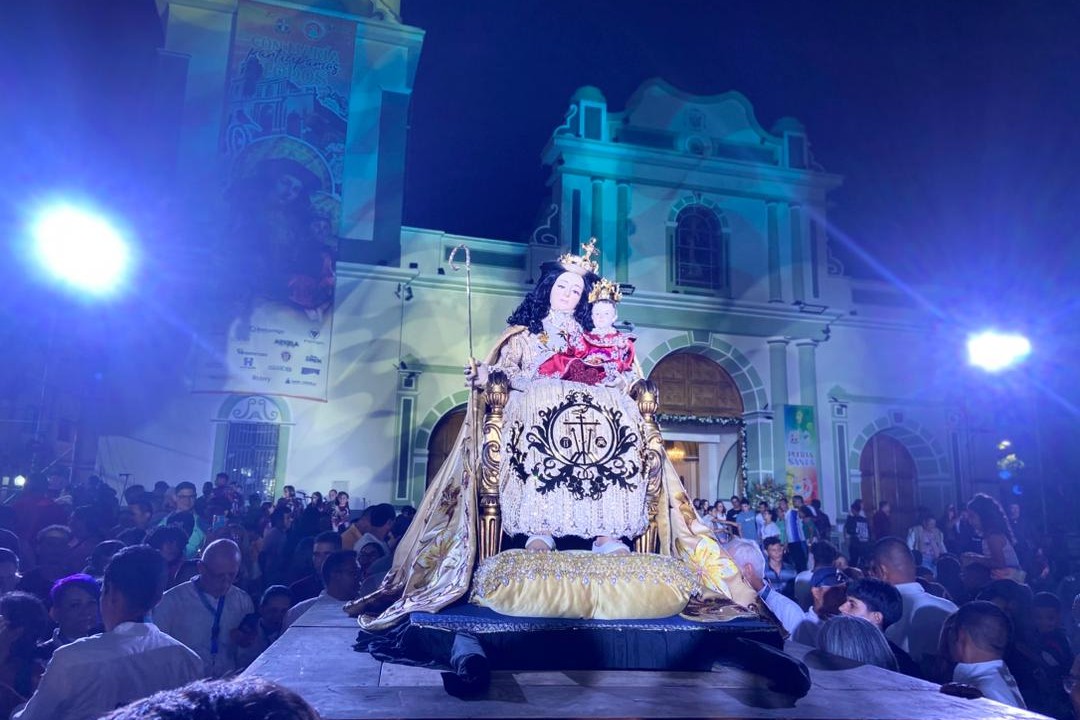
The faithful accompany the Divina Pastora at the conclusion of the procession in Barquisimeto, Venezuela. Every Jan. 14, thousands of pilgrims walk 7.5 kilometers from the Basilica of Santa Rosa to the Cathedral of Barquisimeto. (Courtesy of María Gabriela Torres)
by Maura Aranguren
On Jan. 14, 1856, Fr. José Macario Yépez asked the Divina Pastora to intercede for Barquisimeto, in the state of Lara, Venezuela, as a cholera epidemic swept through much of the population. The city was facing both public health and economic crises, and faith in the Virgin Mary drew together rich and poor, young and old, all seeking comfort and protection. Since then, every Jan. 14, thousands of Venezuelans have joined one of the largest processions in the world, walking 7.5 kilometers (4.7 miles) from the Basílica de Santa Rosa sanctuary to the Cathedral of Barquisimeto. Over time, the procession has grown beyond an act of personal devotion; it has become a public expression of unity and hope in times of political, social and economic turmoil.
The Divina Pastora is inseparable from the identity of Barquisimeto and holds a central place in the life of the country. In uncertain times, she unites, strengthens and guides the people of Venezuela. She inspires us to live this historic moment with the serenity of those who await a new dawn for our country. Even amid suffering, turning to our mother, the Virgin Mary, has been an oasis of peace. She has accompanied our struggles and our grief: every Venezuelan imprisoned for speaking out or calling for a better country; every family without the means to feed or send their children to school; every educational institution struggling to pay staff or maintain dignified facilities for students.
The size of the gathering reflects not only a clear Marian devotion, but also a shared longing for comfort, unity and hope amid Venezuela’s profound social and economic crises.
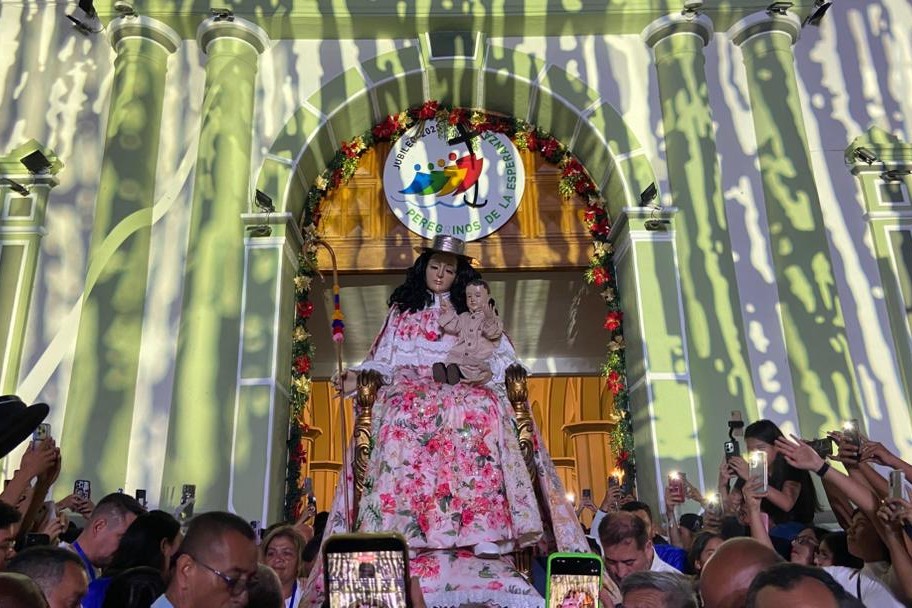
Devotees surround the image of the Divina Pastora during the procession in Barquisimeto, Venezuela. This year, nearly 4 million people accompanied the procession, one of the highest numbers recorded in its 168-year tradition. (Courtesy of María Gabriela Torres)
For many, the Virgin Mary represents family unity, maternal protection, respect for our identity and fidelity to Christian values. Her image conveys freedom, forgiveness and reconciliation. To speak of this Marian devotion, venerated by many Venezuelans both inside and outside the country, is to recognize that we have a mother who comforts, guides and protects us. She hears our prayers and intercedes before God, helping our faith remain steady in the face of adversity.
Each year during the pilgrimage, the Virgin wears a different gown designed by local artists, reflecting themes tied to important celebrations in the Venezuelan church. Her original image — pink robe, blue mantle, surrounded by sheep, holding a staff in her right hand and the infant Jesus in her left — inspires trust and tenderness. Standing before her, I feel called to be better and to defend human rights, never lowering my head before evil or injustice, but placing my confidence in God, who "brings down rulers from their thrones and lifts up the humble" (Luke 1:52).
Every Jan. 14, the streets of Barquisimeto fill with thousands of pilgrims who join the procession, asking for a miracle or giving thanks for one received. This year, in its 168th edition, the Divina Pastora procession drew a historic crowd: Nearly 4 million people walked the main route, one of the largest turnouts in its history. The size of the gathering reflects not only a clear Marian devotion, but also a shared longing for comfort, unity and hope amid Venezuela's profound social and economic crises.
During the celebration, the Venezuelan church, through Archbishop Polito Rodríguez of Barquisimeto, called for what he described as the great miracle: the release of nearly 900 political prisoners held across Venezuela. Their families continue to wait outside the prisons day and night, without receiving answers and without knowing whether their loved ones are still alive. "We applaud that some have already been released, but many others remain whose pleas — and those of their families — cannot continue to be ignored," he said during the opening Mass. He also urged pilgrims not to remain "paralyzed by fear, sadness or discouragement."
Advertisement
I was not able to attend the pilgrimage this year, but I had the blessing of visiting the Basílica de Santa Rosa sanctuary, where the image of Our Lady of the Divina Pastora is kept. In 2016, I made the pilgrimage with members of the Consolación family — teachers, administrators and environmental advocates — to pass through the Holy Door and receive plenary indulgence.
For that pilgrimage, I prepared spiritually. I prayed a novena to the Virgin Mary for nine consecutive days, read about her and entered the experience with intention. The journey was long and tiring because I also visited, with colleagues, the sanctuary of Our Lady of Coromoto, patroness of Venezuela, but it was worth it. I remember standing before her image and feeling deep joy and a profound silence, as though words were insufficient to express my gratitude for what she represents in my life. I prayed for our country, which was then enduring its worst political, social, food and economic crisis. Many of us wept before her, seeking comfort and strength. In that moment of peace, I saw in the faces of my colleagues that we are a people of faith, rooted in Christian values and deeply connected to the Virgin Mary.
Venezuelans continue to face serious challenges like poverty, food shortages, insecurity, lack of basic services and the anguish of relatives unjustly detained, yet we trust in the Divina Pastora because, since 1856, she has accompanied the people through epidemics, economic hardship and social conflict.
We continue to entrust Venezuela to the Divina Pastora, confident that her intercession will sustain our strength, unity and hope, and help us remain firm in the pursuit of justice, dignity and solidarity with the most vulnerable.
This story is also published in Spanish.