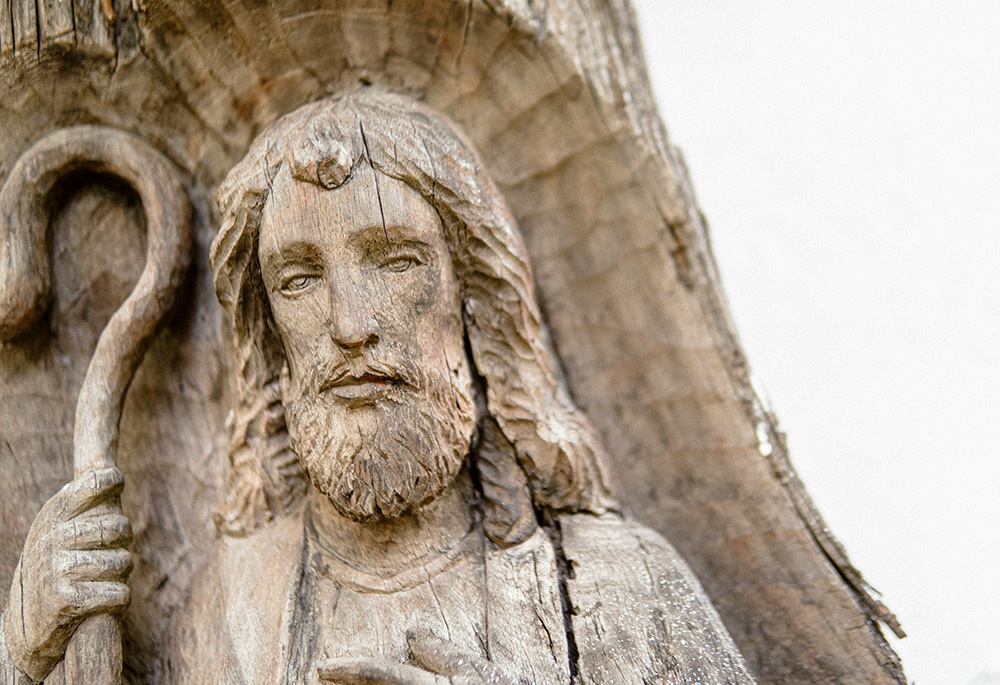
(Unsplash/Karl Raymund Catabas)

by Sr. Nameeta Renu
Editor's note: Welcome to Theologians' Corner, where each week a different woman theologian from around the world offers a fresh reflection on the Sunday readings.

Fifth Sunday of Lent
March 22, 2026
During a Lenten holy hour of eucharistic adoration, my prayer gravitated toward the church's reading of salvation history through the imagery of trees and gardens. The liturgical season draws us toward death, yet always with resurrection already implied. As so often happens in contemplative prayer, Advent and Lent, Christmas and Easter, appeared as mutually interpretive mysteries.
Isaiah announces hope through devastation: "A shoot shall come out from the stump of Jesse" (11:1). Jesus later radicalizes this imagery when he identifies himself as the vine in whom his followers abide as branches (John 15:5). What is promised in birth finds fulfilment through self-giving unto death.
The Fifth Sunday of Lent intensifies this tension by placing before us the raising of Lazarus (John 11:1-45). Here Jesus stands not before an abstract symbol of death, but before a sealed tomb. His declaration — "I am the resurrection and the life" — is not uttered from a safe distance. It is spoken amid grief, protest and the unmistakable finality of death. Resurrection is not introduced by bypassing loss but by entering it.
As I continued praying, my gaze shifted from the Eucharist to the crucifix above the tabernacle. I noticed that the corpus and the cross were carved from a single block of wood. Christ was not simply affixed to the tree; he had become inseparable from it.
In the natural world, when a living tree is wounded, sap flows outward to heal itself. On Calvary, Christ's wounded body releases blood and water — not to sustain himself, but to heal humanity. The cross, the very instrument meant to expose the falsity of his claims, is transfigured into the tree of life.
The Good Shepherd lays down his life for the sheep, and in the Eucharist he goes further still, becoming nourishment itself — the 'green pasture' that sustains life even in the valley of death.
This theological reversal has particular resonance in the church's present historical moment. The ongoing abuse crisis and its institutional cover-ups represent not peripheral failures, but wounds inflicted upon the ecclesial body itself. For women in consecrated life, these wounds are often intensified by asymmetries of power, spiritualization of obedience, and cultures shaped — sometimes unconsciously — by clericalism and patriarchy.
Such realities must be named with sobriety and theological seriousness, not dismissed as anomalies nor instrumentalized for polemical ends.
The Gospel proclaimed this Sunday offers a framework neither of denial nor despair. Like Martha and Mary, the church is summoned to bring its grief, protest and questions directly before Christ. Notably, Jesus weeps at the tomb before commanding the stone to be removed. Divine compassion precedes divine action. Life emerges not through suppression of suffering, but through its exposure to truth.
At the Last Supper, Jesus anticipates this dynamic when he offers his body and blood and commands his followers to do likewise in memory of him (Mark 14:22-25). This is not sacralization of suffering, nor endorsement of unjust structures that demand silence. Rather, it is a call to become participants in a pattern of life in which woundedness — acknowledged and redeemed — becomes the locus of communion.
The Good Shepherd lays down his life for the sheep (John 10:11), and in the Eucharist he goes further still, becoming nourishment itself — the "green pasture" that sustains life even in the valley of death (Psalm 23).
Advertisement
John's Gospel notes that Jesus was crucified in a garden and laid in a new tomb nearby (John 19:41-42). This detail evokes Eden, where humanity once walked in communion with God and freely shared the fruit of the tree of life (Genesis 2:9). After rupture and exile, access to that tree was lost.
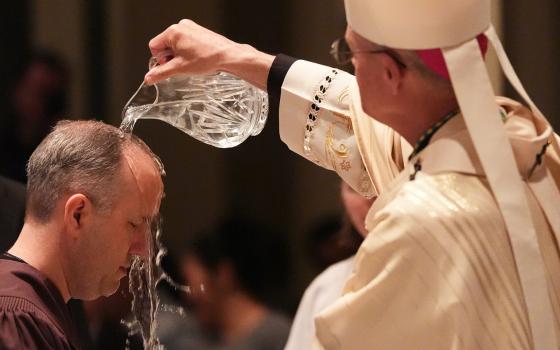
In Christ — the Word made flesh who pitches his tent among us — that access is restored. From his wounded side flows the life-sap of a renewed creation, sacramentally mediated through baptism and Eucharist.
St. Hildegard of Bingen named this divine vitality viriditas: the greening power of God's Spirit. Without it, the human person becomes like a tree drained of sap. Christ's wounds become the source of this greenness, not only healing individual lives but renewing the church's capacity for fruitfulness.
For consecrated persons — whether in religious institutes or the order of virgins — this imagery is both consoling and exacting. Grafted into Christ through the sacraments, we draw life from his roots (Romans 11:17). Our vocation exists not for self-preservation but as a visible sign of communion with God.
The pressing question, particularly in this moment of ecclesial purification, is whether our communities mediate Christ's life-giving presence or impede it through fear, silence or resistance to conversion.
Lent thus stands as both promise and summons. From the wounded tree of Calvary, life continues to flow. The credibility of consecrated life — and indeed of the church itself — depends on whether we allow that life to circulate freely, restoring what has been bound and offering the world a renewed taste of communion with God.