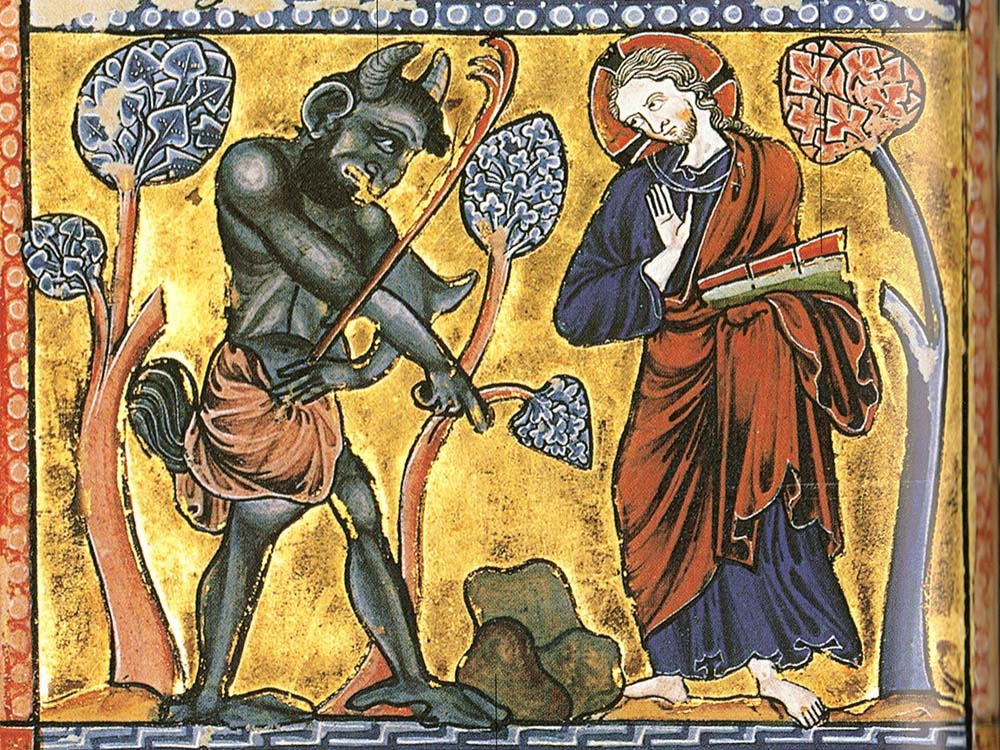
The first temptation of Christ, depicted in a psalter from circa 1222 (Wikimedia Commons)

by Stephanie Ann Puen
Editor's note: Welcome to Theologians' Corner, where each week a different woman theologian from around the world offers a fresh reflection on the Sunday readings.

First Sunday of Lent
Feb. 22, 2026
The Gospel for the first Sunday of Lent shares the story of the temptation of Jesus in the desert. This story holds an important place in my heart, as it raises important questions about how we are to think and go about our life and mission as Christians.
These questions and points of reflection and responses were raised during one of my classes in liberation theology and Catholic social thought under Roberto Guevara when I was still an undergraduate student. They are questions and responses that we continue to grapple with, especially in our current context, which can be very uncertain, violent and complex.
The three temptations Jesus was faced with — turning stones into bread, throwing oneself from the parapet of the Temple, and ruling over all the kingdoms of the world — tell a much deeper story of the kind of temptations Jesus faced, as well as the kinds of temptations we face in our work.
First, the turning of stones into bread. This temptation can be interpreted as the temptation to possessions. In the face of hunger and our daily needs, we do all need food and other necessities. We need certain things to survive, and we ask of this when we pray the Lord's prayer, that God may give us this day our daily bread. However, the temptation to possessions that decenter God in our life is not just the temptation here; the implied question to Jesus is also this: "Wouldn't it be easier if you had all the riches and possessions, so that you could do your mission more easily?"
Second, throwing oneself from the parapet of the Temple. This temptation can be interpreted as the temptation to prestige. Had Jesus thrown himself from the Temple and angels come, it could serve as proof of his being the Messiah and Son of God. Again, this is not just a temptation to prestige for its own sake; rather, we could also ask: "Wouldn't it have been easier for Jesus to have done his mission if he had prestige to convince people of his work and teachings?"
Advertisement
Lastly, ruling over all the kingdoms of the world. This temptation can be interpreted as a temptation to power. This power could be used to overthrow the oppressive empire, but at the same time also another question: "Wouldn't having power have made it easier for Jesus to enact the kingdom of God?"
These three temptations are not just malicious temptations to decenter God with other attachments; rather, they are a question about how Jesus was to go about his mission, and in turn a question to us about how we are to go about sharing in this mission. As someone who lives in our dominant neoliberal culture, it can be tempting to say yes to the questions raised above, and thus go the route of possessions, prestige and power in trying to fulfill Jesus' mission and the kingdom of God.
Yet, how did Jesus respond, and how then are we also invited to respond?
In the face of possession, we are called to share. Instead of the way of possessions, Jesus chose the way of sharing, reflecting in his ministry how possessions had value but only in their role to help nourish people's lives.
In the face of prestige, we are called to solidarity. Jesus asks us to love and help one another, not just through the influence, fame or honor that prestige brings, but rather to a firm commitment to the common good.
In the face of power, we are called to service. Rather than using force and power, Jesus invites us to service and a preferential option for the poor and marginalized.
This is not to say that power, prestige or possessions would not be able to help in mission. Rather, the point of reflection is that the choice is not just about what is the easiest or most efficient way to reach the goal of doing the good, but what is fundamental to Jesus' mission. We are invited to see things through this lens, and to align our lives to what best leads us to deepening God's life in ourselves and in the world.