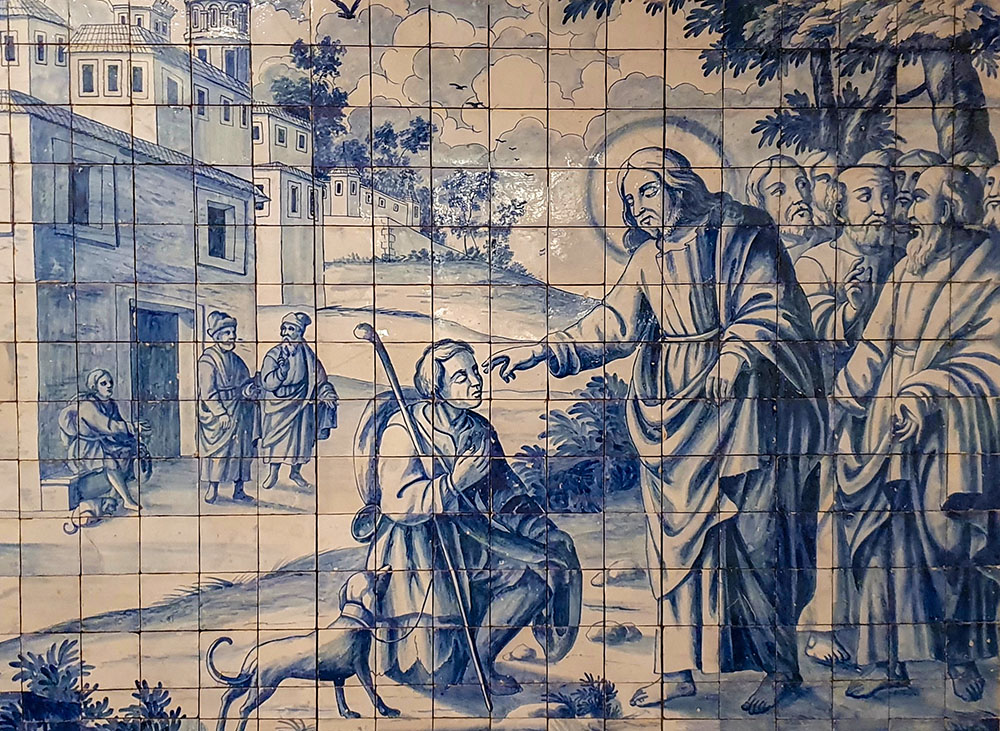
Jesus heals a blind man, depicted in 18th-century azulejos, displayed at the National Museum of the Azulejo in Lisbon, Portugal. (Wikimedia Commons/Yair Haklai)

by Sr. Hilda Mateo
Editor's note: Welcome to Theologians' Corner, where each week a different woman theologian from around the world offers a fresh reflection on the Sunday readings.

Fourth Sunday of Lent
March 15, 2026
Today, the Fourth Sunday of Lent, the Gospel of John (9:1-41) presents us with a situation that leads us to question not so much whether we can "see," but rather, what are the requirements for truly seeing, or allowing ourselves to be guided by Christ, the light of the world (cf. Ephesians 5:14 and John 9:5). Sight is a function of the eyes, but the genuine ability to see (or hear) deeply flows from our ability to pay attention.
Without revisiting the wonderful narrative detailed in the Gospel of John, I will simply begin with the common conclusion we have all heard in numerous homilies. That the blind man was able to "see" what the religious leaders (Pharisees) and culture of the time (elderly parents of the man) could not see: the presence of God manifested before them in the person of Jesus of Nazareth. Despite not knowing what Jesus looked like, the "blind man" was able to give witness to his healing presence. But what did the blind man have that the others did not? A keen sense of attentiveness.
All of us, and most of the time, go around the world with blinders on. The blinders are not physical hindrances, but rather a constant flow of thoughts, or judgments, created by the mind that block us from experiencing the present moment as it is. Our thoughts, in their own right a blessing, can and do prevent us from seeing or hearing or accepting life as it manifests itself to us in the now.
By "seeing" through the mind, we separate ourselves from what is before us in myriad ways, as soon as we label what we "see." The label can be positive — "What a beautiful sunset" — or negative — "We know this man is a sinner." Regardless, my mind, whose job is to analyze and objectify, creates a filter or blinder, which separates me from the sunset, this man, this reality, etc.
Advertisement
As soon as that happens, I no longer "see" what is present, but what I have "downloaded" from my head — beliefs, ideas and assumptions. I lose sight of the sacramental sign before me that is the manifestation of the presence of God, here and now. In other words, you don't have to lose your physical senses to walk in the dark.
If my mind or my ego or my false self — there are many ways to refer to the "blind person" we all carry within us — is the one who says, "I see," we simply separate ourselves from the God of life. We do not "see" what is, but what we "believe" or "think" or "download" from learned experiences. Instead of paying attention, I rely on my way of "seeing."
This is what happened to Samuel when he arrived in Bethlehem looking for God's chosen one to be anointed: He "sees" with his judgments. However, if it is the "I am" within me — my true self, the image and likeness of God that I am — that is paying attention, with all my senses, then I am able to truly see what is being presented to me now. No experience, however similar, is the same as another. When I trust my mind to "see," I literally and figuratively lose sight of what I have at hand in this moment.
We can all regain our sight when we take the time to be still and silence our automatic ways of 'seeing.' When we silence our minds and attend to the present moment, only light remains.
From the beginning of the story, Jesus offers us the good news that no one is born "blind" and there is no "sin" that can prevent us from seeing. We can all regain our sight when we take the time to be still and silence our automatic ways of "seeing." When we silence our minds and attend to the present moment, only light remains.
We are living in cultural and political situations of great blindness. Once again, the Gospel invites us to attend with love, a capacity that is acquired in silence and stillness of body. The blind man remains attentive and therefore, before regaining his physical sight, he can bear witness to the light.
Perhaps we can learn from the 17th-century Carmelite known as Brother Lawrence, who offers these instructions: "I do not advise you to use multiplicity of words in prayer. Many words and long discourses are often the occasions of wandering. Hold yourself in prayer before God, like a dumb or paralytic beggar at a rich man's gate."
Stillness and silence are the way to live as daughters and sons of light (Ephesians 5).