(Unsplash/NHN)

by Sr. Hilda Mateo
Editor's note: Welcome to Theologians' Corner, where each week a different woman theologian from around the world offers a fresh reflection on the Sunday readings.

Good Friday of the Lord's Passion
April 3, 2026
For far too long, one prevailing idea in the Christian tradition has been that the passion of Jesus of Nazareth was a punishment demanded by an angry Father from a Son who offers himself to "save" children who, deep down, don't deserve it.
We owe this to St. Anselm, who, in my humble opinion, did us a profound disservice with his satisfaction theory of atonement. He led us to believe that human sin offends God's honor and that God, in turn, can only accept the death of his Son, the Christ, to settle the debt.
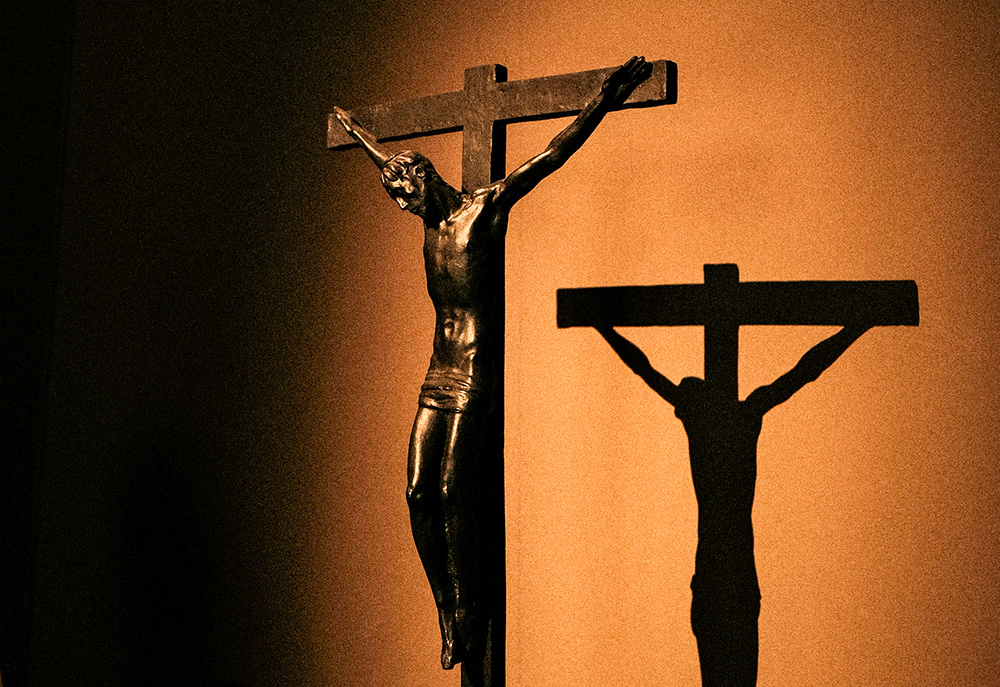
The deepest mystical traditions invite us to experience this day instead as the epicenter of transformation — a movement beyond "form" to recognize ourselves in the life that sustains us. Perhaps this day is called "good" because on the cross — the ultimate archetype of surrender — we see the definitive revelation of what it means to be in God: an act of absolute self-giving where the boundaries of the "self" dissolve into a relational love with the triune God.
When Jesus cries out, "Father, into your hands I commend my spirit," he isn't handing "something" over to someone "out there." He is acknowledging that his breath (pneuma) has always been God's breath. In that moment of "death," the perceived separation between creator and creature vanishes in the fire of love.
The cross teaches us that resistance is the source of suffering, while acceptance — which requires letting go — is the doorway to holiness and a life lived in its fullness.
Understanding this day's relevance in our lives requires looking at the blueprint of all spiritual transformation. According to William Bridges, a pioneer in transition theory, all real growth requires passing through three stages: an ending, a neutral zone and a new beginning.
Good Friday represents the necessary ending (and Holy Saturday, which we almost always skip over, serves as the neutral zone). Like every human being, Jesus of Nazareth necessarily experiences an absolute stripping away. On the cross, he is stripped of his clothes (identity and dignity), his friends (emotional support), his health (physical integrity) and, finally, even his own ideas of what the kingdom should look like.
For Life — with a capital L — to emerge, the "small self" must die. This is why Jesus invites us to take up our cross daily; life is actually full of many "endings" that keep us in the cycle of transformation.
You and I resist this process. We cling to our beliefs about ourselves, to the wounds that give us an identity, and to our judgments about how things "should be." The cross teaches us that resistance is the source of suffering, while acceptance — which requires letting go — is the doorway to holiness and a life lived in its fullness.
Advertisement
The passion on the cross reveals that when we let go of what is transitory (the ego, the masks, the attachment to control), the eternal remains. Jesus of Nazareth never preached that holiness was an accumulation of moral merits, but rather the recognition of our identity in God: I Am. On the cross, Jesus stops being "someone" and becomes "the all in all." By saying, "Into your hands I commend my spirit," he releases his final resistance. By letting go of judgment (the ego), separation disappears.
To experience Good Friday today means looking at our own crosses — those situations where we feel stripped or lost — and, instead of fighting them with the strength of the ego, learning the art of sacred surrender. It is saying: "I trust the source so deeply that I allow the current form of my life to die, so that the life that has always been within me can bloom."
Wisely, Good Friday's liturgy is marked by silence. Not an empty silence, but one pregnant with presence. Only in deep silence can we suspend the belief that death is the end of life. In recognizing this, the fear of dying loses its grip. We begin to see that no new beginning exists without an ending.
Good Friday is an invitation to consciously inhabit the threshold of death — or our many daily "deaths." It calls us to repeat those final words of Jesus like a constant mantra in the midst of our transitions in work, health, relationships or faith. By commending our spirit, we lay down the burden of having to be the architects of our own salvation. We discover, with awe, that holiness is the final rest in the truth that God is all in us. In that "all," there is nothing left to fear, nothing to judge and nothing to lose, because only what is released can be truly transformed.
Author's note: This reflection is dedicated in gratitude to Guadalupan Missionaries of the Holy Spirit Sr. Adriana Barreto at the threshold of her death.