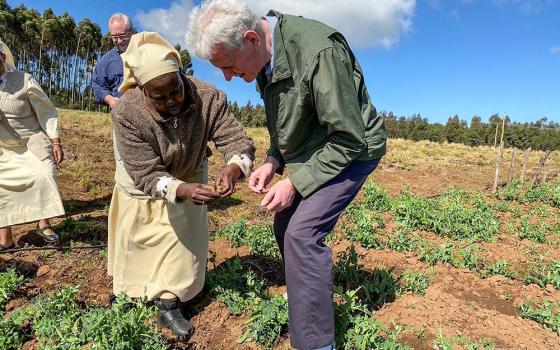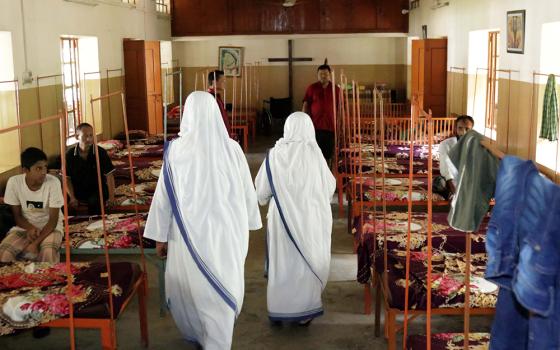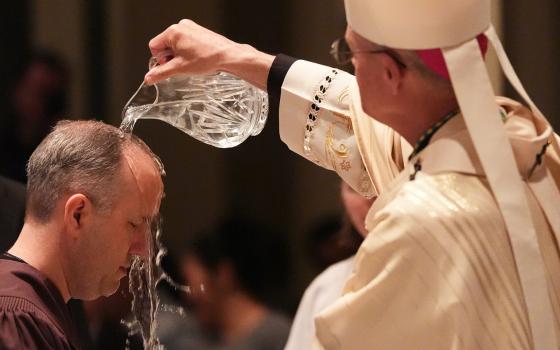
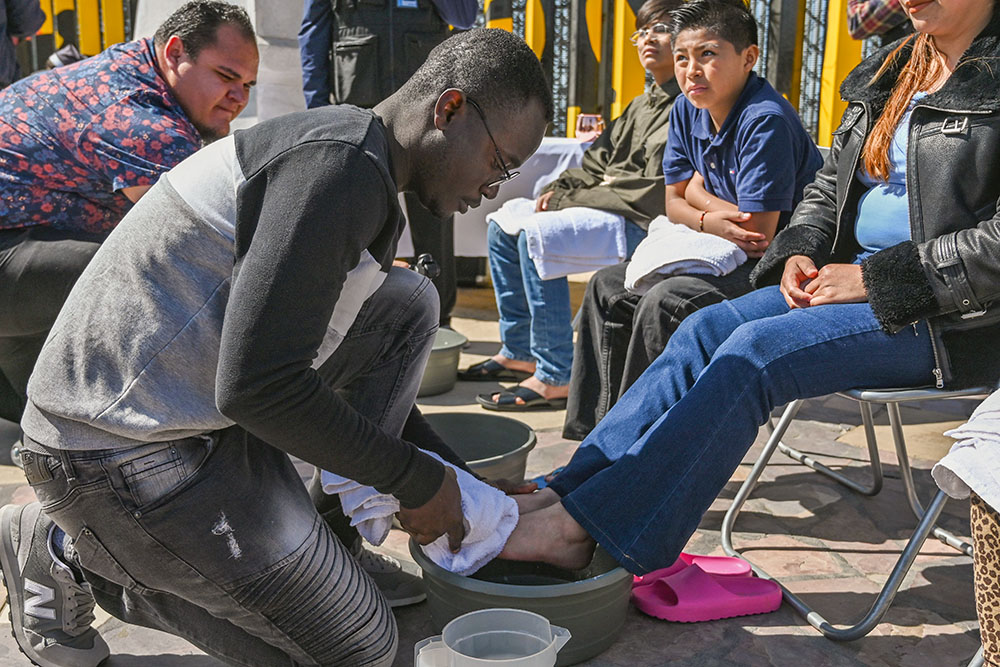
Haitian migrant and volunteer Djephy Wood Denios from La Casa del Migrante in Tijuana, Mexico, cleans the feet of a woman during the annual washing of the feet ceremony on Holy Thursday at Tijuana's Friendship Park circle on the U.S.-Mexico border April 17, 2025. (OSV News/Carlos A. Moreno)

by Consuelo Vélez
Editor's note: Welcome to Theologians' Corner, where each week a different woman theologian from around the world offers a fresh reflection on the Sunday readings.

Holy Thursday
April 2, 2026
Holy Thursday is known as the day of fraternity — today we also speak of sorority to make women visible (frater: brother; soror: sister) — and of service. It is also the day of the institution of the Eucharist and, for that reason, is considered a priestly day. However, today's Gospel places emphasis on the first aspect, which is what we will reflect on here.
This passage, which precedes the Passion, recounts a moment of encounter between Jesus and his own before he is arrested, crucified and put to death by the powers of his time. Later, Jesus will give the new commandment: "Love one another as I have loved you. By this everyone will know that you are my disciples, if you have love for one another" (John 13:34-35). Here, however, Jesus performs a gesture — one that, as the saying goes, speaks louder than words.
The act itself is profoundly countercultural: washing the feet of his disciples. Peter resists allowing it. This was the work of slaves. By doing this, Jesus places himself among the least; more than that, he becomes the least, the servant of all.
The text tells us that Judas had already decided to betray him, and yet Jesus does not hesitate to wash the feet of everyone present. This is how Jesus loves: for all, without restriction or reservation. After washing their feet, he explains the meaning of his action and tells them plainly: "If I, your teacher, have washed your feet, you also ought to wash one another's feet."
Advertisement
It is worth considering that women may also have been present in that scene. The text does not exclude them, and it is reasonable to think they were there. Jesus' discipleship was not limited to men. Women followed him from Galilee to Jerusalem, fulfilling the very condition required of a disciple, as described in the account of Judas' replacement (Acts 1:22).
Let us celebrate this Holy Thursday by allowing Jesus to teach us once again. Let us pay attention to his action and to his words. It is urgent that Christians recover what is essential in the Gospel: service, unconditional love and boundless mercy. It is easy to confuse the Gospel of Jesus with liturgies, doctrines, traditions or rituals — expressions that can support the life of faith, yet are not its core and, at times, can even obscure it.
Surely, Jesus would ask us again, "Do you understand what I have done for you?" And with simplicity, we should answer: Explain it to us again and help us live with the same depth of love that you have shown. This is what our world needs, and it is what we long to live fully and wholeheartedly.