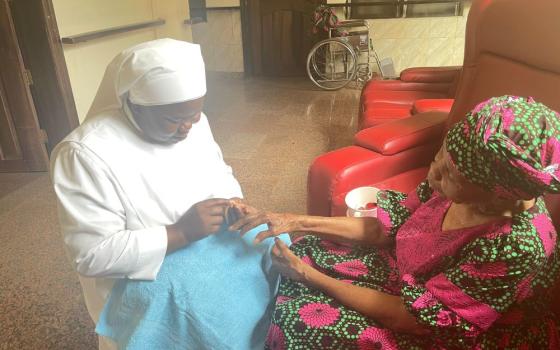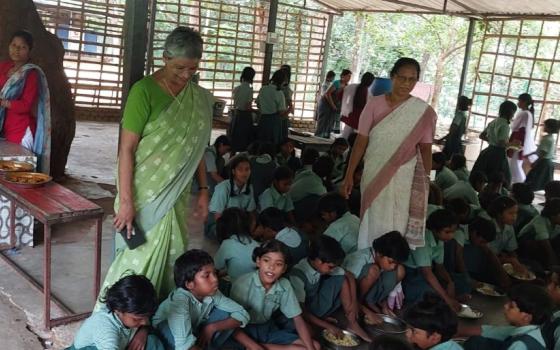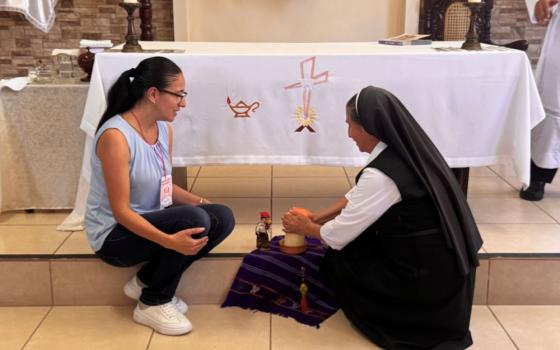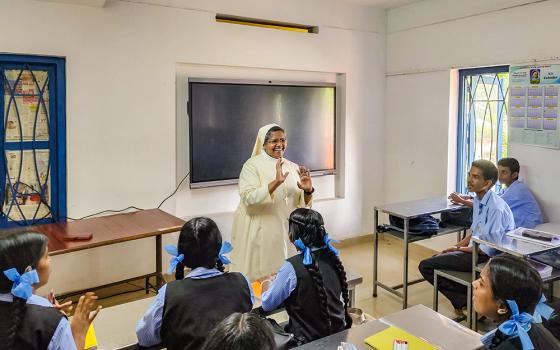
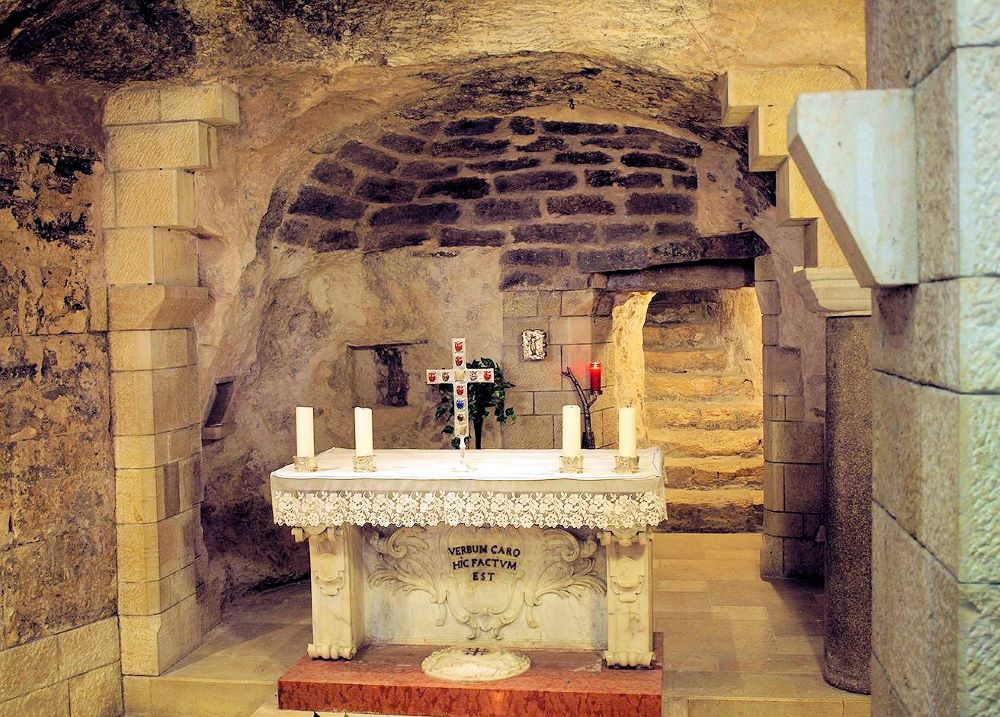
The Grotto of the Annunciation, beneath the Basilica of the Annunciation in Nazareth, pictured in December 2015, is believed to be the site where the angel Gabriel announced to Mary that she would conceive Jesus. The grotto contains first-century stone dwellings and draws pilgrims from around the world. (Mary Rose Kocab)
by Sr. Mary Rose Kocab
Mary of Nazareth lived in the small, seemingly insignificant town of Nazareth in Galilee (Nathanael, a disciple of Jesus, would later ask, "Can anything good come from Nazareth?") She was most likely poor, a young Jewish woman, and promised in marriage to a man named Joseph when she was visited by an angel who told her she would give birth to a son, Jesus. Conceived by the Holy Spirit and not through human means, this child would be the son of God. Mary did not have months or years to discern her response. With some fear, questions and no plan for what lay ahead, she simply said, "Yes, let it be."
What we celebrate in the solemnity of the Annunciation (March 25) marks a single, extraordinary moment, but I believe Mary's whole life was filled with encounters with God. Her "yes" was not limited to her alone. Across history, God continues to invite people to bring the Word into the world — to say yes to something larger than themselves. That invitation comes in many forms, often unexpected, calling for trust and courage before we fully understand what is being asked. The announcement that Mary received was also an invitation — one that I have come to see repeated in my own life.
When I contemplate the feast of the Annunciation, I see myself in Mary. I remember my teen years well. I was young and idealistic; confused with the changes that were happening in me; ready to claim being an adult, yet still a child in many ways. I was in love with Bob and we had promised to marry each other since third grade; we had agreed that we would have a big family together. Then, one day, Bob and I went together to see the recently released movie, "The Sound of Music." During that movie, I wasn't visited by the Angel Gabriel, but by an old Mother Superior who sang, "Climb every mountain 'til you find your dream, the dream that will need all the love you can give every day of your life for as long as you live." I remember sitting next to Bob and yet feeling totally alone in that theater. After years of being certain about the direction of my life, I sat in shocked awareness in a deep place in me that I hadn't known before, that Bob was not the one who needed all the love I could give every day of my life for as long as I lived. Not long after, I joined the Sisters of the Incarnate Word.
The invitations come in ordinary annunciations if we are aware and attentive.
Many years later, a friend who is a guide for groups of pilgrims to the Holy Land, casually said to me, "Mary Rose, you should come to the Holy Land with me in December." Long story, but eventually, I agreed. The one place I longed to see in Israel was the Basilica of the Annunciation in Nazareth. The basilica stands on the top of a hill, a vast upper church that is built on the ruins of several older churches. I honestly paid little attention to most of it. I was drawn instead to the small limestone cave in the lower church, believed to have been the home of Anne, Joachim and Mary, and the place where Mary was visited by God's messenger, Gabriel. I was blessed that day with having the place almost to myself, and I was able to go very close to the cave. A small altar near the entrance bears the inscription, "Verbum caro hic factum est" ("the Word was made flesh here.") Even now it is difficult to find words. I experienced the Annunciation happen again in me in that moment. A presence of God announced to me, "The Word is made flesh here … in you … now … " I believe that means in every here, in every now.
Is God now silent? Does God not send messengers to us anymore? Are there no more invitations to recognize that God is with us? When God looks at us, God sees us as God created us to be: favored and full of grace. The Holy Spirit plants the seed of God's Word in us, the Word that is to become incarnate in the unique way that only our "Yes, let it be" can make possible. The invitations come in ordinary annunciations if we are aware and attentive: in the words of a song, in a word in Scripture, in the midst of the violence and suffering around us, in silence, in journaling, in the death of someone close, in nature, in a special place. The invitation comes in the questions that bubble up unexpectedly: How can this be? How can I do this? Why is this happening to me?
Mary's "yes" did not come with months or years of discernment. Something in her knew that she had to say yes. There is something about these announcements, these invitations, these mystical encounters with God, that trust and believe — that know without knowing — that God is with us. What difference would it make that Mary said yes 2,000 years ago, if you and I do not say yes today in a world that hungers for God's presence? The Word is made flesh — here.
Advertisement