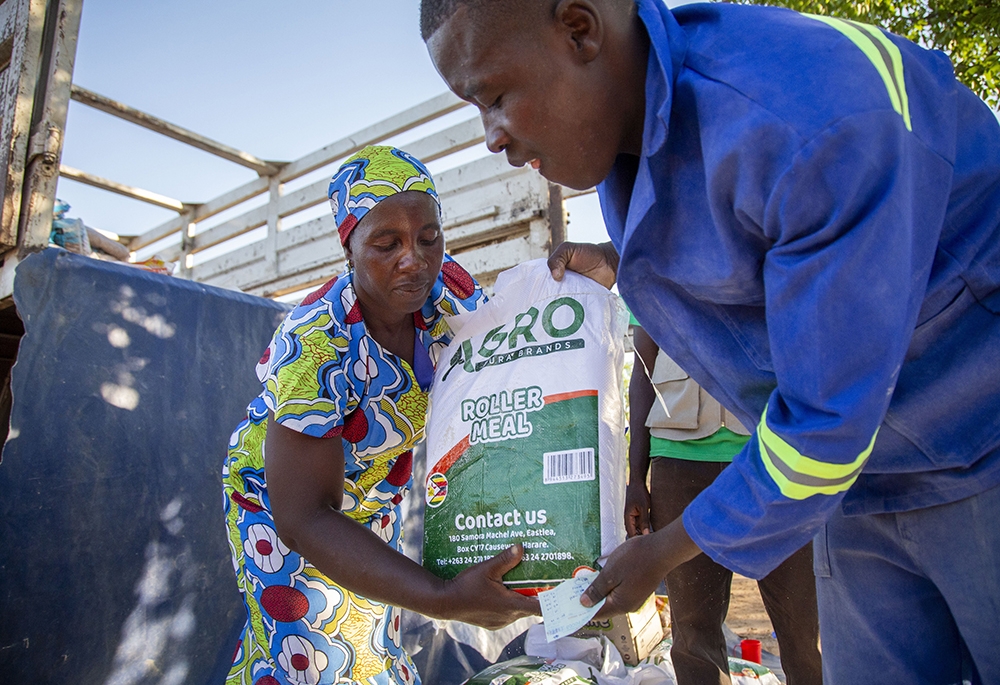
A community member receives food after redeeming her voucher at a distribution center in the village of Masera, Zimbabwe, Dec. 2, 2024. (OSV News/Catholic Relief Services/Dooshima Tsee)

by Sr. Mercy Shumbamhini
Contributor
Editor's note: Welcome to Theologians' Corner, where each week a different woman theologian from around the world offers a fresh reflection on the Sunday readings.

Solemnity of the Most Holy Body and Blood of Christ
June 7, 2026
Some days, the word "bread" feels very real to me.
Here in Zimbabwe, bread is not just a symbol. It is something people wait for, something that runs out, something that is sometimes shared in smaller pieces than anyone would wish. I have sat with women who stretch a meal so that children can eat first. I have seen quiet sacrifices that never make the news, but carry the weight of love.
So when we celebrate Corpus Christi and hear Jesus say, "I am the living bread," I cannot hear it as a distant spiritual idea. It comes to me through the realities of daily life — through hunger, through generosity, through the fragile dignity of those who give even when they have little.
In the Scriptures, the people of Israel remember a time when they did not know where their next meal would come from. They were fed, not with abundance as the world defines it, but with enough for the day. And perhaps that is where the mystery begins: God does not always remove our vulnerability, but meets us within it.
This is not always easy to accept.
There are moments when "enough" does not feel like enough — when the needs around us are overwhelming, when injustice feels too large, when we wonder what difference a small act of kindness can really make. In those moments, the Eucharist can feel almost too simple: bread, broken and shared.
And yet, that is exactly how Christ chooses to remain with us.
Not in grand displays of power, but in something ordinary, something relational, something that depends on being received and given again.
"I am the living bread … whoever eats this bread will live forever" (John 6:51).
To receive this bread is not only to be comforted. It is also to be drawn into a way of living — a life that is quietly poured out for others. A life that notices who is missing from the table. A life that refuses to believe that anyone is beyond belonging.
Advertisement
As a woman religious, I often find that the Eucharist returns me to very simple questions: Who is hungry today — in body, in spirit, in hope? And how am I being invited to respond, not perfectly, but faithfully?
Sometimes the response is small. A conversation. A presence. A willingness to sit with someone in their struggle without trying to fix everything. These moments may seem insignificant, but they are not. They are part of the slow, sacred work of becoming bread for one another.
What gives me hope is that we do not do this alone. The same Christ who calls us to give ourselves also nourishes us. We are fed, again and again, so that we do not lose heart.
On this feast of Corpus Christi, I find myself trusting in this quiet truth: that even in a world where there is not always enough, love shared becomes a different kind of abundance.
And perhaps that is where we begin — not with what we lack, but with what we are willing to offer.
A piece of bread. A moment of presence. A life, gently given.
And somehow, in God's hands, it becomes more than enough.