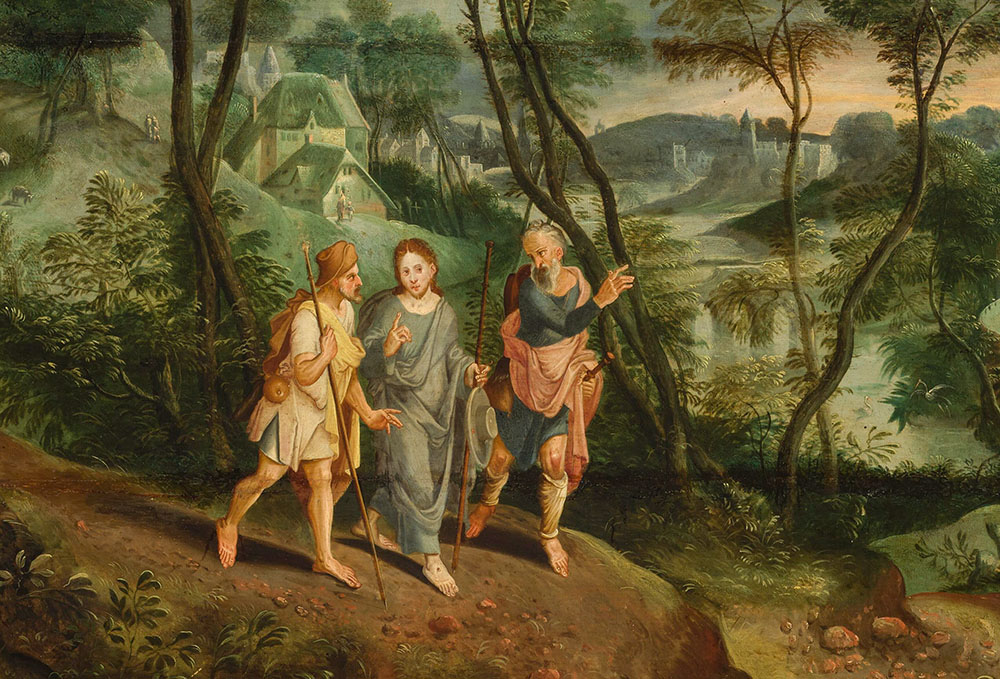
Detail of "Christ With Disciples on the Way to Emmaus" by a 16th-century Flemish painter (Wikimedia Commons/National Museum in Warsaw)

by Sr. Sarah Kohles
Editor's note: Welcome to Theologians' Corner, where each week a different woman theologian from around the world offers a fresh reflection on the Sunday readings.

Third Sunday of Easter
April 19, 2026
Two disciples set out on the road in a state of confusion. Jesus, whom they had followed and believed in, was murdered by capital punishment. This was a shocking and shameful death. That the Messiah would suffer such a death was incomprehensible. Jesus' disciples were undoubtedly grieving and shaken by the violence inflicted upon him.
In the passage immediately preceding today's Gospel, a group of women discover Jesus' empty tomb and converse with angels. The emptiness of the tomb simultaneously highlights the loss Jesus' followers feel and provides a hint of wonder and hope. Can it be that all is not as it appears?
The pair of disciples take this mix of confusion, grief and hope with them as they journey. These two disciples turn toward one another to converse about these confounding events, and, therefore, they share the journey with one another.
They are trying to understand what has occurred when Jesus appears in their midst and joins them on the road. Somehow the resurrected Jesus is not immediately recognizable to them. It seems that they are so stunned that they cannot see what (or rather who) is right in front of them!
Jesus' seeming lack of knowledge about the events of recent days provides an opportunity to the two disciples to explain what they understand. They identify Jesus as a prophet and potential redeemer. They acknowledge that his actions and words were well-known. These two disciples also note that their leaders handed Jesus over to death. But after three days the followers of Jesus are "astounded" by the empty tomb and the report of the women of an encounter with angels declaring that Jesus is alive!
Somehow these disciples managed the action of ongoing hope in the midst of grief and the chaos of death.
When the disciples say, "We were hoping," the Greek verb for "hoping" is in the indicative, meaning that the hope of these two disciples was not a one-time hope. Instead it is a continuous hope. Perhaps these disciples are holding onto a hope that is not extinguished by confusion and death, but remains even with the gaping emptiness of the tomb. Somehow these disciples managed the action of ongoing hope in the midst of grief and the chaos of death.
Yet, Jesus chastises the pair of disciples by calling them "foolish" and "slow of heart." Apparently Jesus' disciples struggled with the idea of a Messiah who would suffer. If Israel's prophets suffered as they spoke to the people on behalf of God, it is logical that a Messiah would also suffer.
The text then tells us, "Beginning with Moses and all the prophets, [Jesus] interpreted to them what referred to him in all the Scripture." Imagine having the opportunity to hear Jesus interpret the Scriptures!
Even though the disciples on the road do not recognize Jesus, they invite him to remain with them. Perhaps they want to continue the hope-filled conversation. Though they do not see that a stranger who supposedly knew nothing of these events is able to interpret the meaning of these events.
Thus Jesus shares the journey, listens to the disciples' fears, and encourages them to recount their experiences and name confusion, hopes and fears. After he unpacks the meaning of the Scriptures with them, they still do not understand. Yet, these two disciples finally recognize Jesus in the breaking of the bread. It is through the ritual action of sharing and nourishment that their eyes are opened and their hearts come to understand.
Advertisement
After Jesus vanishes from their sight, these two realize that their hearts did know Jesus even when their eyes did not. Indeed, their hearts were "burning" throughout their encounter with the risen Jesus. They then return to the other disciples and continue to express wonder as they share their experience of walking with Jesus and hear other similar accounts as well.
Gradually, it is revealed that death had no power over Jesus. Jesus lives! Resurrection and new life have the final word over suffering. Also, Jesus appears to his followers and is willing to be present with them to ensure that their hearts understand and recognize him. The hopes of these two disciples have been affirmed and nourished by the risen Christ.
When do we recognize Jesus?
When do our hearts burn within us?
What helps us hold onto hope?
When was the last time we found ourselves in sacred conversations?
May we trust that Jesus will appear in the midst of our day, our walk, our continual hoping and conversing along the way. The risen Christ is in the unexpected encounter on the journey.