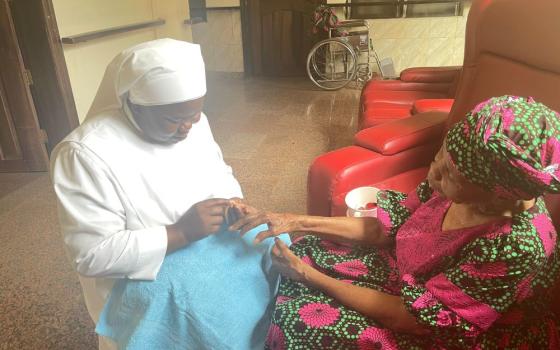
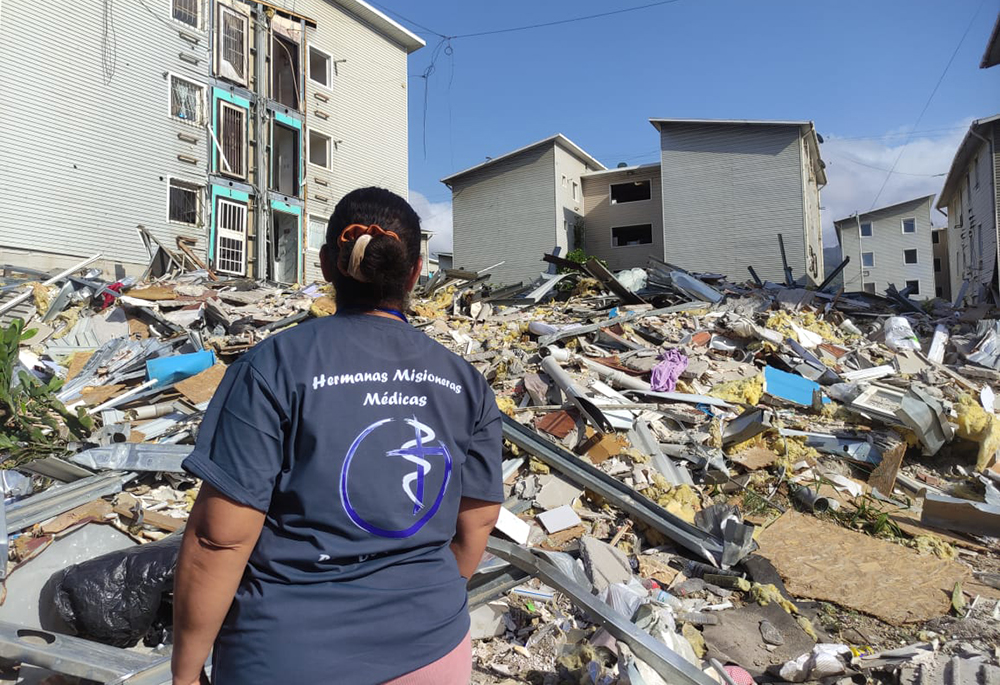
Medical Missionary Sr. Yira Infante is pictured during one of her visits to ground zero, where the impact of the double earthquake in Venezuela was greatest. (Courtesy of Carmen Camacho)
As a Venezuelan, I grew up in a context that defines us as a people rich in culture and traditions, the result of our diverse heritage. We are cheerful, with a good sense of humor, and capable of overcoming any adversity. We are hardworking, creative and supportive of those in need. We have deep-rooted libertarian values, following the example of our heroes of independence, always in pursuit of justice and the common good.
This has always made me feel proud and fortunate to have been born in this marvelous land, where one finds not only human warmth but also great wealth thanks to its biodiversity.
However, as I grew up, I also discovered the less pleasant aspects of my country. I come from a humble family. I grew up in the countryside and was aware of the reality facing my family and my community. I always wondered how such a rich country could have so many people living in poverty, while a few were enriching themselves through illicit means. Perhaps it was then that God began to plant within me the question of what my contribution to this reality might be.
I remember that, before entering religious life, while I was serving in my parish as a catechist and a member of the readers' ministry, the parish priest once told us, speaking about missionaries, that he didn't understand why so many wanted to be missionaries in Africa or other poor countries, as if Venezuela wasn't a place to evangelize.
At the time, I didn't understand his words. But as life in Venezuela gradually deteriorated, they began to make sense.
When I decided to enter religious life, the Missionary Medical Sisters inspired me with their motto: "To be a healing presence at the heart of a wounded world." During my formation, I learned to look beyond our works to discover the new faces through which God speaks to us and cries out for justice.
I also discovered that, in the history of my congregation, the first Medical Missionary Sisters who arrived in Venezuela from the United States, 75 years ago now, did not do so because this country was considered a mission territory.
They were invited by oil companies to run hospitals in Maracaibo and Falcón. However, they soon discovered the reality of the ordinary people living in the areas surrounding the hospitals and realized that they, too, needed healthcare services to which they had no access. That is why they decided to leave the hospitals and integrate into the neighborhoods, living amongst the poor people of Maracaibo and, later on, of Barquisimeto and Caracas.
They realized that Venezuela, too, was mission territory.
During my novitiate, as part of my missionary experience, I used to go with another sister to teach catechism in La Vega, a neighbourhood in Caracas where access and safety conditions were not the best. To get there, we often relied on the priest who would take us on Sundays to the catechism classes and to Mass, which we celebrated in the home of a family from the community. When he was unable to accompany us, we would take public transport and walk a long way.
Even back then, one could already sense the deterioration of public services, the shortages of food and medicines, the rise in violence, political polarization and the economic crisis. Nevertheless, the people in the neighborhood went out of their way to make us feel at home and sought creative ways to get by.
The mission experiences during Holy Week and Christmas were among the most significant in my formation. I was able to discover the face of God in the simplest of people and reaffirm my vocation through the displays of faith and hope with which they also encouraged us to keep coming up every Sunday to share the Gospel with them.
As the years went by, the situation became increasingly difficult. We began to hear talk of a "complex humanitarian emergency," a term used by the United Nations to describe the situation we were experiencing as Venezuelans, which worsened with the arrival of COVID-19.
Advertisement
This emergency forced millions of people to flee the country. From being a country that welcomed everyone who arrived with open arms and made them feel like family, we became a country of migrants and exiles. According to UN Refugee Agency figures, around 7.9 million people are expected to have left the country by 2024.
Those of us who stayed behind also had to learn to reinvent ourselves. Our routines, our expectations and our way of life have changed. These have not been easy years. We have learned to be resilient, hoping to become a prosperous country once more and seeking ways to move forward.
But it seems that circumstances are determined to continue testing our faith.
On June 24, a double earthquake measuring 7.2 and 7.5 on the Richter scale shook Venezuela in a matter of seconds. The quake caused severe damage in several parts of the country and once again left many families facing fear, loss and uncertainty.
Occurring just seconds apart, they struck at 18:04, causing severe damage in several states across the north-central and central coastal regions of the country, primarily affecting La Guaira (declared a disaster zone), the Caracas metropolitan area and neighboring areas in the state of Yaracuy, such as San Felipe and Yumare. Severe structural damage was also reported from Caracas to Puerto Cabello, with widespread building collapses.
This latest event has dealt us a heavy blow; we feel that we have not yet fully recovered from one crisis when another arises. However, amid the pain, uncertainty and grief, as a nation we have done what we do best: drawing strength from where we have none, standing in solidarity with those who have lost everything, clinging to our faith and discovering, in the small miracles of each day, that God continues to work and walk amongst us.
In our community, we have not suffered any significant structural damage, beyond the fear and uncertainty about what lies ahead and how to respond. But we cannot allow ourselves to be paralyzed by fear. Therefore, aware of just how challenging the situation is, as members of a religious order we have joined forces with other congregations and laypeople to support the direct and indirect victims of this tragedy.
We have visited some of the temporary camps to which we are granted access, joined forces with fellow missionaries to deliver supplies, and listened to the people in the communities where we live. Amidst such great need, we continue to seek ways to bring hope to those who have lost everything.
We know it will be a long process of healing and recovery. There will be moments when we feel hopeless and weary of the journey, often asking ourselves why such tragedy has befallen us.
Perhaps, like the disciples on the road to Emmaus, weighed down by so many years of pain and uncertainty, we may not fully realize how Jesus walks beside us. But he is still there, accompanying us through those who share our reality and encourage us with their witness. When we listen to his word, we can find meaning in what we are going through.
This is how I continue to see Venezuela: as a land of mission, where God continues to call out to us amidst our wounds. I also think of the many Venezuelans who have had to leave the country. Perhaps that journey will help us to bring to others what defines us: our humanity, creativity and sense of humor, even in the midst of difficulties.
That is why I continue to believe that Venezuela remains a land of grace. Not because we ignore its wounds, but because, even in the midst of them, God continues to call, to heal and to sow hope.