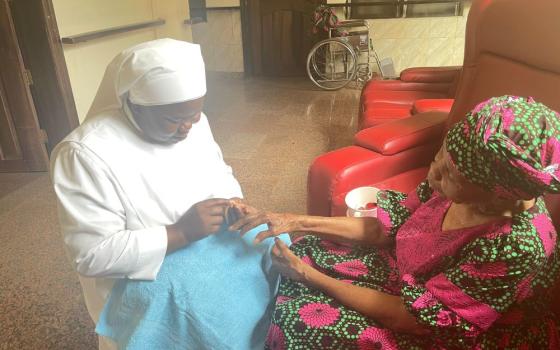
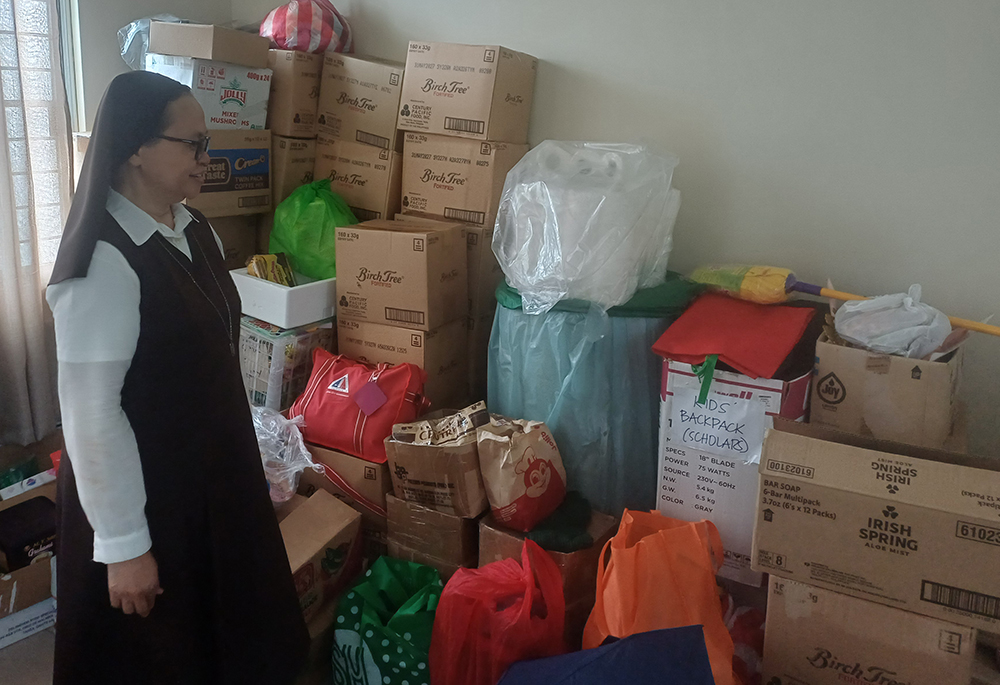
Sr. Milaluna Moralde Arranchado checks donated food, clothing and other supplies for homeless people served by the Carmelite Missionaries in Quezon City, Philippines. (Oliver Samson)

by Oliver Samson
Two years ago, the Carmelite Missionaries met a blind massage therapist in Ozamiz, Mindanao, who lived alone in an unfinished wooden house.
He made a living through massage, but his home was far from complete. Seeing his situation, the sisters helped him finish the wooden house.
For him, the completed house meant more than just a structure. The sisters gave him a place he could call home — a measure of security for someone living alone and making a living despite his blindness.
His story reflects how the Carmelite Missionaries approach people in need: not simply by giving them something for the day, but by helping them regain dignity and build a more stable life.
In Quezon City, that mission takes a different but equally urgent form.
Every Monday, about 60 homeless people gather at the Carmelite Missionaries Pastoral Center in Barangay Tatalon.
Some spend the night beneath bridges. Others sleep outside commercial establishments after they close in the afternoon.
They come for food, but also for formation on human dignity and spirituality — and for an opportunity to begin again.
The sisters help them look for work, secure government documents, access medical and dental care, learn livelihood skills and, whenever possible, find a path toward stable housing.
"We teach the homeless to live not only by begging. Their dignity is not limited to begging only. There's hope," said Sr. Milaluna Moralde Arranchado, superior at the Carmelite Missionaries Pastoral Center.*
The sisters encourage those they serve to earn a living rather than depend entirely on alms. Through their recommendations, some have found employment.
A local architect recently hired six people to clean her home and garage. They were also given food, clothing and payment.
The sisters helped three others obtain National Bureau of Investigation clearances so they could apply for jobs. All three eventually found work as security guards.
Employment gave them more than income. Once hired, they were able to rent tiny spaces for about 500 Philippine pesos a month — just enough space for one person and their belongings.
For people who have lived on the streets, even a cramped rented room can represent a significant step toward stability.
But the sisters have learned that homelessness often has complicated roots.
One woman told them she had borrowed money in her province because she thought she was applying for legitimate work abroad. Instead, she found herself unable to return home and burdened by debt.
Another owns family land in the province, but a sibling allegedly took control of their parents' properties. The sisters are helping the person consult a lawyer.
"They don't understand how they became homeless," Arranchado said, responding to critics who ask why programs like theirs continue to serve people living on the streets.
"They say, 'Sister, you are only increasing the number of homeless.' "
The sisters have also seen the limits of government relocation when housing is not accompanied by livelihood.
Sr. Rebecca Polinar, a Carmelite missionary, has served communities from Metro Manila that were relocated to government housing in Pandi, Bulacan.
Initially, some families found little to sustain themselves. Access to water and electricity was limited, while employment opportunities were scarce. Planting crops or raising animals also takes time before they can earn money.
Some eventually returned to Metro Manila. Back in the city, they were homeless and selling food and cigarettes on the streets to make a living.
Others said they sold their government-provided homes to purchase food.
Sister Rebecca said circumstances in the relocation area later began to change as malls, banks and restaurants opened nearby, creating employment opportunities.
Some families who had left eventually wanted to return, only to find their former homes occupied by others.
For the sisters, these experiences underscored a basic lesson: A house alone does not solve homelessness. People also need a way to live in it.
Advertisement
Therefore, the Carmelite ministry includes livelihood and skills training, particularly sewing for mothers. The sisters also provide food and clothing, while free dental extractions and consultations are offered every Wednesday.
A doctor at St. Luke's Medical Center also volunteers to see the homeless, particularly on Mondays when they gather at the pastoral center.
When the sisters first began gathering homeless people for assistance, they invited their barangay captain. Several of those attending said they had no government-issued IDs.
But what address could they put on an ID when they had no home?
The barangay captain proposed a solution: With the sisters' recommendation, people could use the address of the Carmelite Missionaries Pastoral Center in Tatalon, Quezon City.
For someone living on the streets, that address could become a bridge back into society. With identification, a person can begin applying for jobs and accessing services and find a room. With income, they can have a better chance of leaving the streets.
Still, the sisters know that what many of the homeless ultimately want is something more fundamental. "The dream of the homeless is to have a house, even rent-to-own," Arranchado said.
Astoria Hotel, a recent partner working through Dr. Sheryl Valencia, one of the doctors supporting this ministry, has donated blankets and towels.
But the sisters need more mission partners who can help sustain the program and eventually address the deeper need for housing.
Arranchado said, "I tell them, 'I'm sorry that what we can give for now is only food, vegetables, clothes, blankets and towels.' I hope someone will give housing."
For now, the sisters continue to provide what they can — food, vegetables, clothes, blankets and towels.
Their work suggests that homelessness cannot be solved simply by moving people somewhere else or providing temporary relief. It suggests that a person needs more than a roof: They need identification, livelihood, healthcare, community and the chance to earn again.
And sometimes, the first step toward rebuilding a life can be as simple and as profound as having an address.
*This story has been updated to correct Arranchado's designation as superior at the Carmelite Missionaries Pastoral Center.