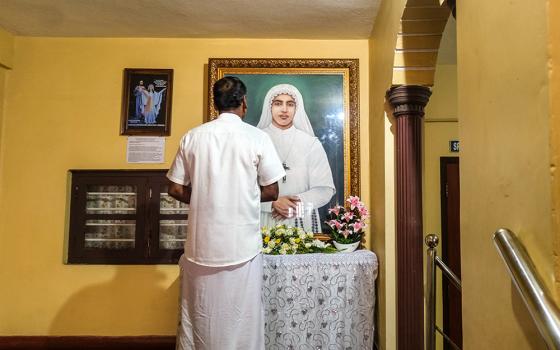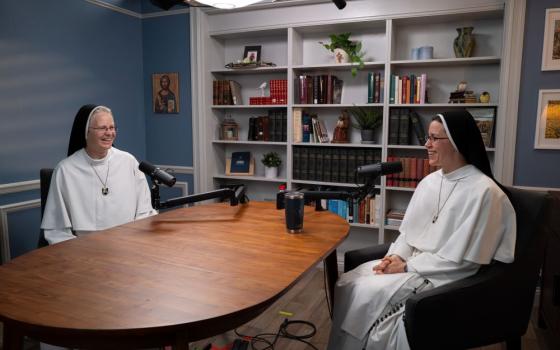
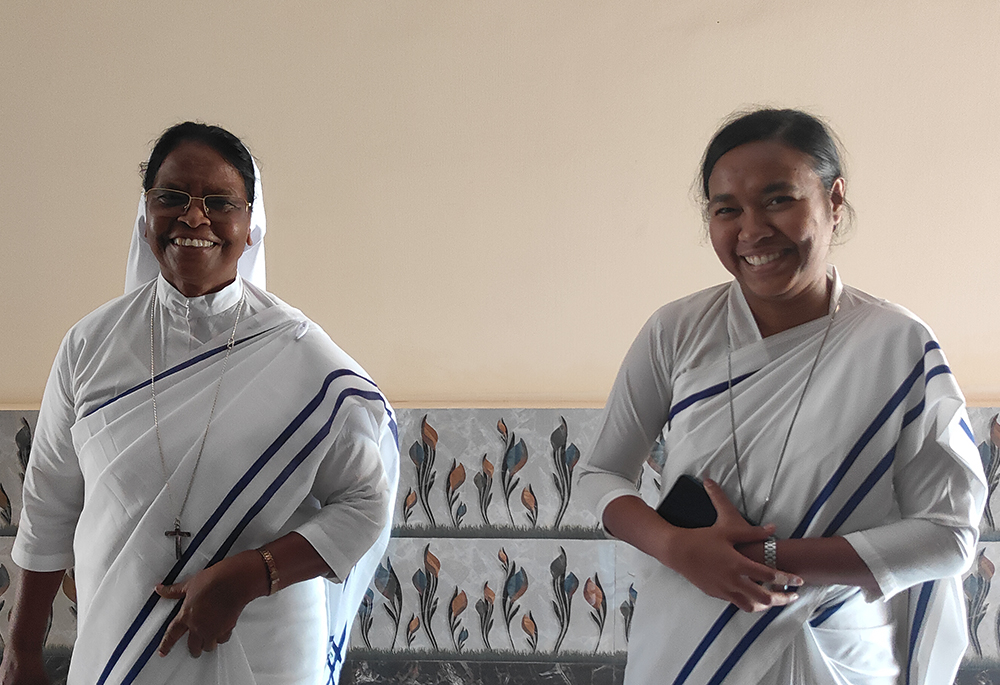
Daughters of St. Anne, Ranchi, Sr. Cicilia Bara, superior of the congregation's motherhouse in Ranchi, capital of the eastern Indian state of Jharkhand, poses with Sr. Rose Kongari. (Thomas Scaria)

by Thomas Scaria
In the eastern Indian state of Jharkhand, Sr. Rose Kongari says that her religious vocation and tribal identity are two sides of the same coin.
"I never wanted to become a nun lest I lose my tribal identity in the convent," said the member of the Congregation of the Daughters of St. Anne, Ranchi.
"However, when I studied at St. Anne's High School in Ranchi, I realized it was the only congregation [that] helped young girls like me balance our tribal identity and religious life," said Kongari, who is in her late 20s.
Kongari, who was given permission by her superiors to speak with Global Sisters Report in April, is among the congregation's 1,075 professed nuns who are tribal members.
She said her congregation was founded in Ranchi, capital of Jharkhand state, in 1897 by Mother Mary Bernadette Prasad Kispotta and three other tribal women "to educate, empower and evangelize local people without diluting their tribal identity."
According to the latest census conducted in 2011, Jharkhand had 1,418,608 Christians, with a majority belonging to Munda, Oraon, Kharia, Santal, Mal Paharia, Sauria Paharia and Ho tribes. These tribes are also referred to as Adivasis (original inhabitants) to distinguish them from other tribal communities in India.
Kongari, born in India's Andaman and Nicobar Islands in the Bay of Bengal, said 28 sisters made their final profession, and 19 made their first vows in 2025. "We are proud daughters of the tribal communities, and we maintain our unique identity while preaching Christ."
Sr. Cicilia Bara, the superior of the congregation's motherhouse in Ranchi, said that the Adivasi communities retain their cultural identity, customs and culture after their conversion to Christianity. "This has helped our healthy integration in society and attract sufficient vocations without special campaigns," said the Oraon tribal member, who is in her late 70s.
She said the congregation inculcates in its members respect for all religions. "This openness and our Indian identity help us avoid being branded as outsiders," Bara said.
Maria Bhajanti Tirkey, one of the younger members, told GSR that "the simple lifestyle and compassionate behavior" of the nuns who taught her at St. Anne's High School attracted her to Catholicism and the congregation.
The 26-year-old Oraon tribal member became a Catholic in 2013 and joined the congregation four years later. She professed her first vows in 2020, and her final profession is scheduled for 2027.
Tirkey, a social worker in Madhya Pradesh, central India, said most of the 30 girls who joined the congregation with her also became nuns.
"I want to follow our founder, who was a bold social reformer," she added.
Bara said the dropout rate in their congregation is less than 20%.
Advertisement
Kongari, who currently studies theology at the Papal Seminary in Pune, western India, said their congregation has tried to integrate tribal customs and values into the evangelization process since its inception.
She said their founder was concerned about the Adivasis losing their Indigenous identity during colonization, as had happened with many communities elsewhere.
"Our founder wanted an exclusive congregation that was by the tribals, for the tribals and with the tribals," Kongari explained.
Mother Mary Bernadette Prasad Kispotta died of tuberculosis in 1961 at the age of 82 and was declared a Servant of God on Aug. 7, 2016, and became the first Indian tribal woman to enter the four-stage canonization process.
The late Cardinal Telesphore Toppo, former archbishop of Ranchi, speaking previously to Matters India in 2020, observed that St. Anne's congregation had provided "a great morale booster" for the Adivasi communities.
He added that Mother Mary Bernadette Prasad Kispotta started the congregation when foreign missionaries serving the tribal region refused to admit their people into seminaries or convents.
Sr. Lalitha Roshni Lakra, a GSR columnist, said the congregation now has four provinces and serves seven archdioceses and 20 dioceses in India and Europe.
The Oraon tribal member and social worker, who also practices law in Ranchi, said their founder used education and social work to liberate tribals from oppression and restore their dignity while encouraging social justice.
She added that the four provinces manage four colleges, six higher secondary schools, 54 high schools, 34 middle schools, and 25 pre-schools in various parts of India.
The nuns are also engaged in evangelization activities. They organize retreats in villages, offer counseling services to families, teach catechism, assist in pastoral services of parishes, and manage women's and children's groups in rural areas.
The congregation has also focused on health services from its inception, Lakra said. "A lot of our sisters are trained in nursing, pharmacy, and paramedical courses and engaged in community nursing."
Some members now study medicine in the Philippines.
Apostolic Carmel Sr. Maria Nirmalini, the president of the Conference of Religious Women India, said the decline in vocations and aging members are significant challenges.
A survey from 2023 showed that 64% of members in Indian congregations that responded were either elderly or lived with various health issues and relied on others.
"What we require is efficient integration and respect for the deep-rooted values and culture of the soil, instead of cultural invasion," Nirmalini told GSR.
She commended the Daughters of St. Anne for giving "a convincing model of community integration and representation for sustainability, with a steady progress in vocations."