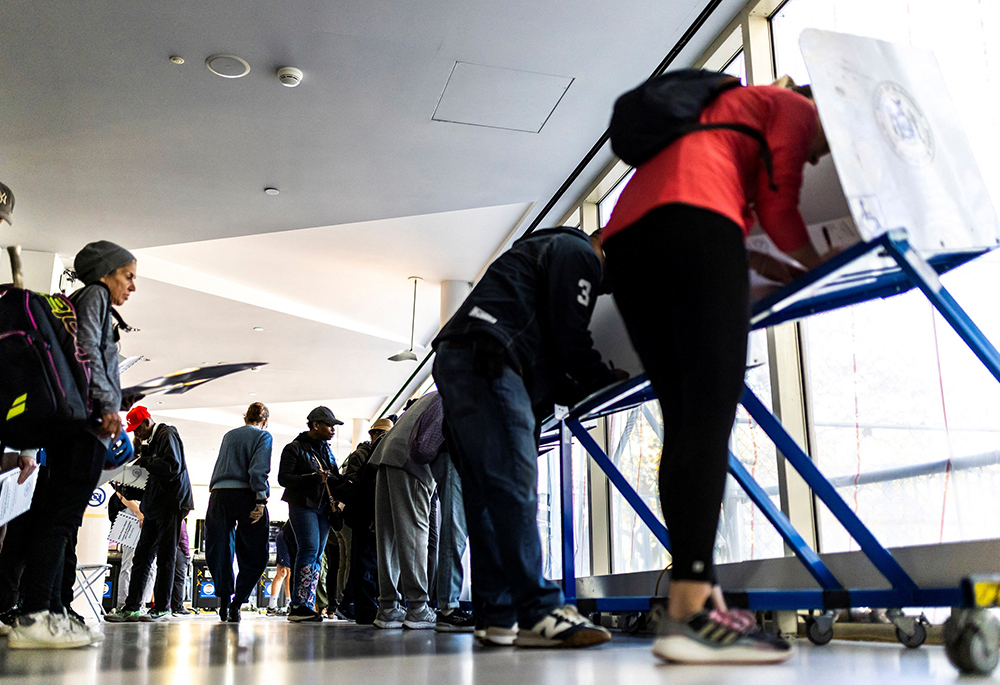
Voters cast their ballots at a polling station Oct. 26, 2024, during early voting at the Brooklyn Museum in New York City. (OSV News/Reuters/Eduardo Munoz)


Editor's note: Global Sisters Report's Monday Starter is a feature from GSR staff writers that rounds up news from or about women religious that you may otherwise have missed.

The U.S.-based Network Catholic social justice lobby's get out the vote campaign continues to grow.
The nonpartisan effort, which began in July, is called "See. Love. Vote." and is inspired by the "See, Judge, Act" framework of Catholic social teaching.
When it began, there were nearly 50 secular and faith-based partners from multiple faith traditions — the launch party featured Sr. Carol Zinn, executive director of the Leadership Conference for Women Religious, as well as a United Methodist bishop and a Muslim Public Affairs Council vice president. Now there are 63 partners, including 33 congregations of Catholic sisters.
The heart of the campaign is postcard writing: Groups order free postcards from Network and then mail them to encourage people to vote.
"By gathering with friends, family, and neighbors to write postcards, justice-seekers can connect with voters of faith to share what we are seeing in our communities, how we are responding with love, and why we are voting in the 2026 midterm elections," the website says.
Network officials say participants are also hosting ballot research events, passing out posters and stickers at parishes, bookstores, festivals, colleges and community centers, hosting roundtables with local leaders, and organizing pizza parties to listen to voters and equip them to be informed voters, and bring others to vote.
The "See. Love. Vote." website also allows you to register to vote or to check your status if you've registered before to make sure you are ready before Election Day.
In Siberian Asia, a Dominican community finds shared values
A recent article in Vatican News profiled a small community of Dominican sisters that has spent more than two decades ministering in a region shaped by extreme climate, religious diversity and the legacy of Soviet repression.
The Sept. 21 story by Sr. Elena Isachenko, a member of the Sisters of Mercy of St. Borromeo, noted that the sisters are "an active participant in intercultural dialogue."
The report focused on the Catholic community in Ulan-Ude — Buryatia's capital — which it said shared the unfortunate fate of other Catholic groups in the former Soviet Union: A parish church, built in 1907, was destroyed during Soviet repression, the story noted. As a result, for many years, "believers were deprived of the opportunity to openly profess their faith."
Isachenko reported that in 2003, government authorities granted a plot of land for the construction of a Catholic church, which was completed in 2005, creating a concrete sign of Christian presence.
The St. Dominic sisters began their ministry in Buryatia in 2000. "At the beginning of our mission," Sr. Bernadetta Gratkowska said, "we were such an unusual sight for the locals that people would run out of shops just to look at the nuns walking down the street."
"The first steps of the new mission were not easy," Isachenko wrote. The sisters, who had arrived from Poland, were no strangers to cold weather.
But they had to become accustomed to the harsh Siberian climate, not only outside but inside, the story noted, as the city heating system broke down. "I remember my first winter in Siberia very well," Gratkowska said, with temperatures dropping to -45°C (-49 F). But in the apartment, "it was between -12°C and +4°C; we had to walk around in our jackets."
More hopefully, Isachenko wrote, "proclamation of Christ in a multi-ethnic region with ancient Buddhist and Shamanic roots took on the character of a dialogue from the very beginning. Initial curiosity gave way to the discovery of shared values."
"Over time," the report said, "certain Buryat traditions have become firmly rooted in the life of Catholic communities."
The Catholic parish in Ulan-Ude has about 100 regular parishioners, half of whom are Buryats, with others being Russian and descendants of Poles and Lithuanians, according to the report.
"My missionary life," Gratkowska said "has taught me that every single person matters. People often do not know how to take the first step toward faith. That is why it is so important to give them your attention."
Advertisement
Oct. 8 webinar will focus on depression among the elderly
The International Union of Superiors General, or UISG, is offering an online webinar Oct. 8 through the Anna Trust Foundation on the theme of depression as experienced in later life.
In its announcement, UISG said that the webinar will focus on the ways depression emerges among elderly people; the factors which may lead to changes in mood; and the ways sisters can support older people when they start to experience depression.
The speaker will be Ruth Watson, consultant clinical psychologist and the lead expert for later life psychology in the British National Health Service. The moderator will be Sr. Siobhán O'Keeffe, a member of the Sisters of the Sacred Hearts of Jesus and Mary who serves as the Anna Trust cognitive impairment program director.
The Oct. 8 webinar will be held at 3 p.m. Rome time, in English, French, Italian and Spanish. Further information and registration can be found here.
The Anna Trust, headquartered in Rome, focuses its work on elder care for Catholic sisters.