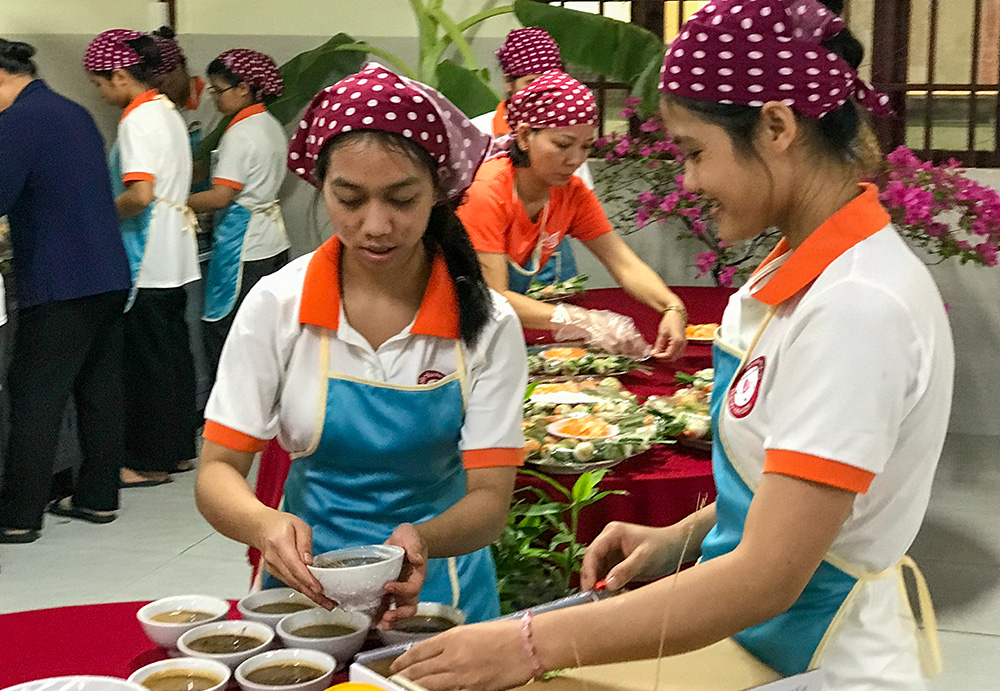
Housemaids prepare food during the 20th anniversary celebration of the Daughters of Charity of St. Vincent de Paul sisters' housemaid training program on May 10, 2026, in Ho Chi Minh City, Vietnam. (Joachim Pham)
After high school, Anna Y Nghin faced a choice familiar to many poor young Vietnamese women: take a factory job for immediate income or spend a year training for a profession many still looked down on.
The 22-year-old ethnic Ba Na woman chose the slower path.
Today, Nghin studies hospitality management at a college in Ho Chi Minh City while working part time for a family at wages nearly three times higher than those typically paid to untrained domestic workers.
"The work gives me stability," she said. "I have time to study, rest and think about my future."
That stability — rather than quick income — is exactly what the Daughters of Charity of St. Vincent de Paul sisters say is becoming harder to persuade young women to value.
On May 10, the sisters marked the 20th anniversary of their housemaid training program at the Salesian-run Phuoc Loc Technology College in the city. The program has trained hundreds of disadvantaged women from across Vietnam in cooking, childcare, elder care, communication skills and personal formation.
But the anniversary also highlighted a growing challenge: Enrollment is falling as factories, restaurants and the retail sector offer immediate wages to poor young women unwilling to spend a year in training without income.
"In today's society, money easily becomes the measure of human worth," said Sr. Pascale Le Thi Triu, who founded the program two decades ago. "Young people want quick money because their families are poor. But many do not see what they may lose later."
Advertisement
Triu believes the lure of fast-paying, low-skill jobs often leaves young workers more vulnerable.
"If they do not invest time learning skills, understanding their rights and forming their character, they can remain trapped in unstable work with low wages," she said. "Many become exhausted very young or cannot protect themselves from exploitation."
Since its founding, about 850 disadvantaged women ages 16-30 have enrolled in the one-year course, according to the program's report. Nearly 500 graduated after meeting the program's demanding standards, while about 100 later continued to college or university.
The sisters say the program's success lies not only in professional training but also in the protections surrounding graduates.
Families hiring graduates must sign labor agreements: Women work eight hours a day if living outside the home, nine if living in the home and receiving proper accommodation, Sundays off and the same food as the household.
"We want them to have balanced lives," Triu said. "Not lives centered only on work."
That concern explains why the sisters refuse to place graduates in round-the-clock caregiving jobs despite rising demand from hospitals and families caring for elderly relatives.
Vietnam's aging population has sharply increased the need for caregivers, especially in cities where adult children often work long hours away from home. Yet Triu considers many 24-hour caregiving arrangements harmful to workers.
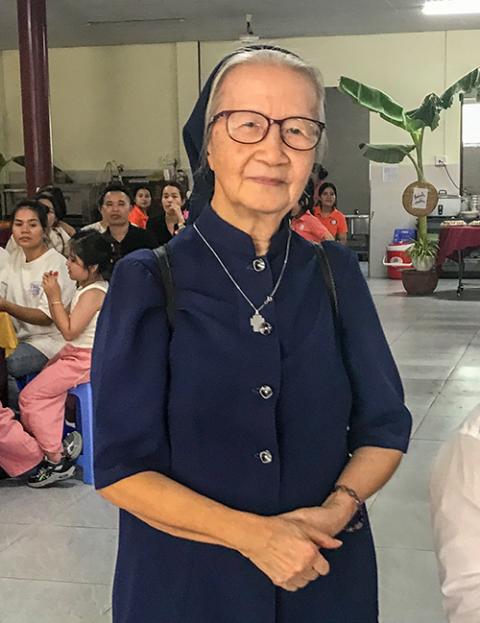
Sr. Pascale Le Thi Triu during the 20th anniversary celebration of the housemaid training program on May 10, 2026 (Joachim Pham)
"The women lose time to rest, study, pray, meet family and friends, or learn new skills," she said. "Some sacrifice their entire youth only to become physically exhausted."
The sisters also continue supporting graduates after training through a housemaid club where former students gather monthly to pray, share experiences and seek advice.
That network has sometimes protected women from abuse.
Triu recalled one graduate who quit after her employer sexually harassed her. The sisters intervened and pressured the employer to pay the woman her full monthly salary so she could safely search for another position.
"The women know they are not alone," Triu said.
Nghin said that support influenced her decision to enroll.
One of 12 children in a Ba Na Catholic family in Kontum Diocese, she said university was financially impossible after high school. But she had already watched her older sister complete the nuns' program and secure stable employment with the same family since 2018.
"At first, I only planned to work one year and then find another job with more money," Nghin said.
Instead, the profession opened unexpected opportunities.
Since graduating in 2022, she has worked for three families while pursuing her college degree. One Singaporean family later invited her to move overseas with them after she spent a year caring for their four children.
Nghin declined because she wanted to complete her studies in Vietnam first.
The work now supports both her education and her dream of returning to her village to open a homestay business and train local people for professional services.
"The sisters protect our rights and help us choose jobs suitable for us," she said. "That is why we trust them."
Mary Vu Hoai Thuong entered the program in 2008 after being referred by a bishop. Though not Catholic at the time, she said the sisters' example eventually changed her life.
Her family could not afford the monthly boarding fee — only 200,000 dong (US$7.59) — but she enrolled anyway and later repaid the sisters after beginning work.
Since graduation, she has never experienced unemployment. Her earnings helped her complete university studies, support her parents and raise her own family.
What employers value most, she said, is integrity.
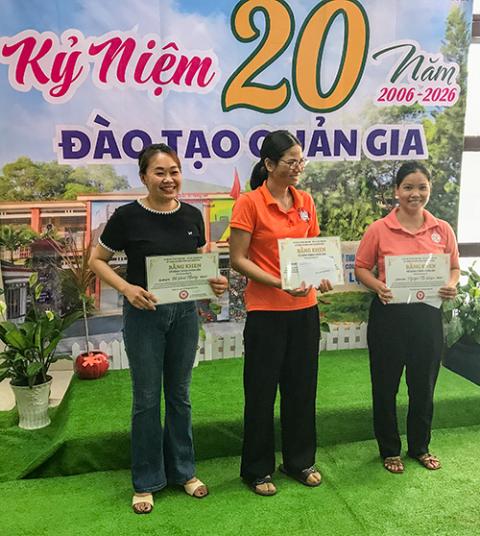
Mary Vu Hoai Thuong, in black, and others receive certificates of merit from the nuns for completing university studies while working as housemaids on May 10, 2026. (Joachim Pham)
"The employers leave money around the house, but I never touch it," Thuong said. "I carefully record every expense because I treat their home like my own."
One employer trusted her enough to leave her alone in the house for six months without security cameras while traveling abroad.
Thuong later became Catholic, inspired by the sisters' sacrifice and care for students. She also collaborates with the sisters in social services.
Pham Thi Tham, who graduated in 2013, said domestic work gave her something factory employment never could: control over her own life.
Now a mother of two, Tham works part-time for several foreign families for 150,000 dong (US$6) an hour while earning more than her husband.
"I still have time to care for my children and my own family," she said.
She also remained employed throughout the COVID-19 pandemic, when millions of Vietnamese factory workers lost jobs after lockdowns shuttered industrial zones.
What she considers the trademark of the housemaid club she belongs to is "honesty, kindness and effective work."
"That is our pride," she said.
For Triu, such stories justify the sisters' insistence on maintaining standards despite declining enrollment.
More than 30 former students have eventually entered religious life — something the sisters never expected.
"We did not train them to become sisters," Triu said. "We wanted them to become women who could live with dignity."
This year, only 14 students are expected to graduate. Many others left the course because they could not meet the demands of the yearlong program or no longer wanted domestic work careers.
Still, the sisters insist they will not shorten the program simply to attract more students.
"A short course can teach skills, but not character," Triu said. "If one day no students come anymore, we will close the program rather than lower our standards."