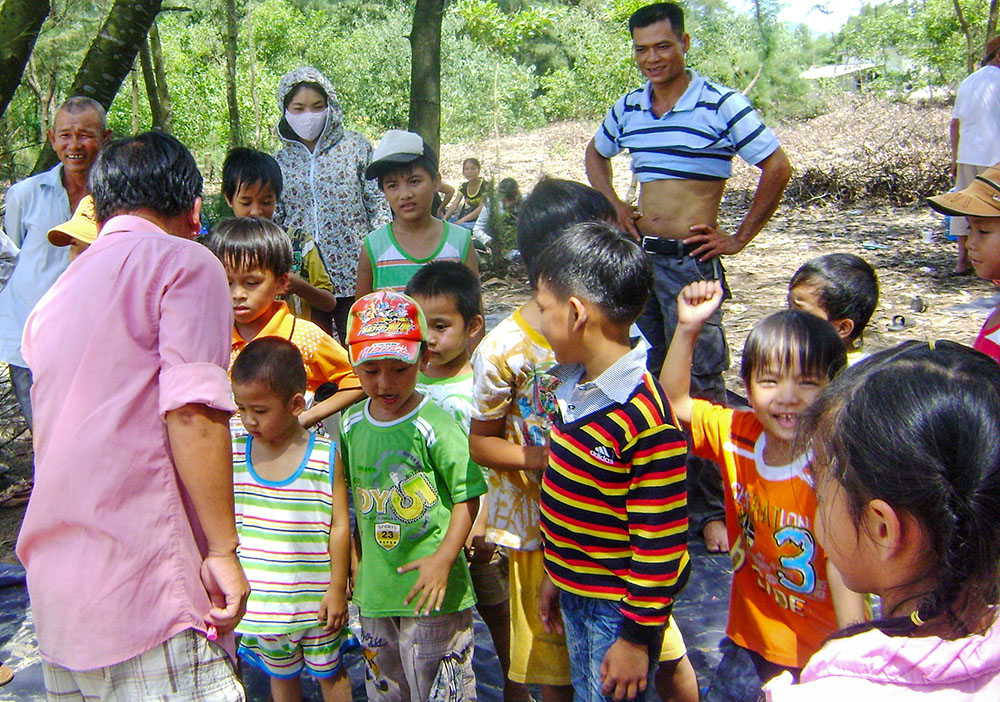
Parents watch their children with autism play games during a beach trip organized by the Lovers of the Holy Cross sisters in Vietnam on Sept. 13, 2025. (Joachim Pham)
When Anna Phan Thuy Trang returned to her home after a year working at a garment factory in Hue, Vietnam, she immediately sensed something about her son.
"He was not as responsive as other children," she said. "He could not speak and did not react when I called his name."
A medical examination confirmed the diagnosis: autism spectrum disorder.
Trang, 31 and frail in appearance, said the news changed everything. She quit her job and committed herself to her son's care, taking him to Hue Central Hospital for treatment.
To pay for his therapy, she sold all four of her family's cows for 23 million dong (about US$875).
After two years, her son showed some improvement, but he continued to experience irregular seizures. Eventually, Trang ran out of money.
In 2022, with no other options, she turned to the Lovers of the Holy Cross. At a small center in Dong Ha, Quang Tri Province, they offer care and basic therapy for children with autism. For just 400,000 dong (US$15) a month, their services cost far less than those of most private centers.
"We came to the sisters because we could not afford anything else," Trang said. "My child has improved in communication and is more flexible in his activities."
Trang and her 7-year-old son now live with her mother in a modest house. To survive, she farms and trades poultry while continuing to support his therapy.
At the heart of the center is Sr. Veronica Truong Thi Binh, who has training in child psychology and oversees the care of 20 children with autism, ages 6 to 14.
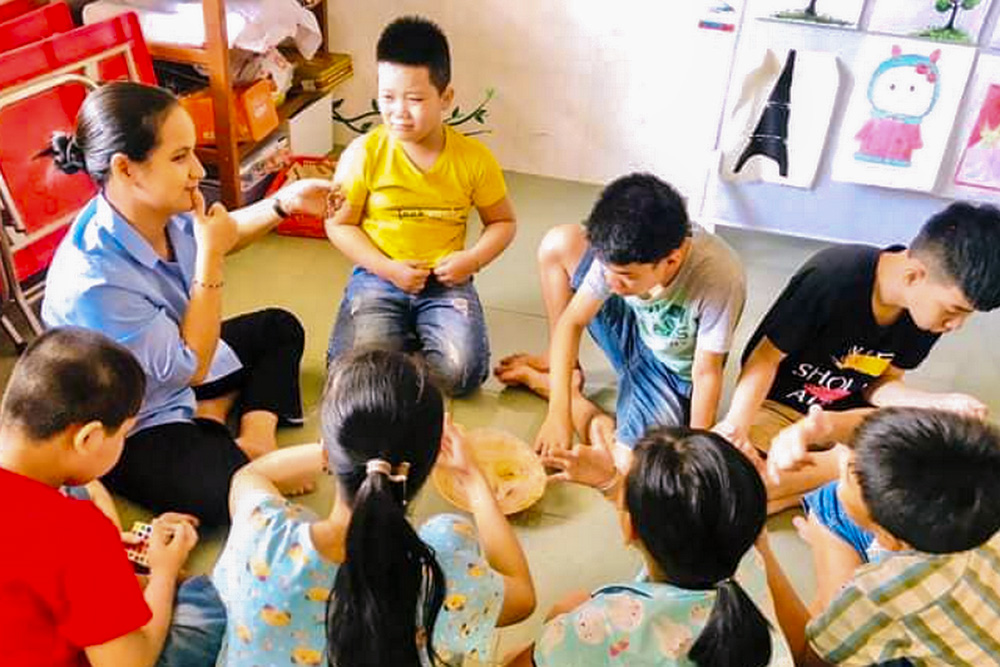
Sr. Veronica Truong Thi Binh teaches simple gestures to children with autism at a small center run by the Daughters of Charity in Dong Ha, Quang Tri Province, Vietnam, on Sept. 22, 2025. (Joachim Pham)
"We try to provide activities helping children engage with the natural environment, communicate with others, reduce stress, and develop motor and life skills," Binh said.
Each day, the children practice simple, essential tasks: imitating gestures, repeating sounds such as "ba" (dad) and "ma" (mom), and playing interactive games like throwing a ball or drawing.
"When we first teach them, they often pay no attention to us," Binh said. "They look elsewhere or refuse to cooperate."
To overcome this, the sisters sit beside each child, play with them and gradually build trust, moving, as Binh said, "from unfamiliar to familiar."
Over time, she said, the results can be striking.
Their ministry began in 2017, when the sisters took in a 6-year-old Van Kieu ethnic girl in Cam Lo district, who could not communicate and often chewed her clothes. After years of care and proper nutrition, she gradually regained her health and ability to communicate and later returned home.
The sisters have since expanded their work to two centers for children with autism. However, their efforts come amid a growing national concern.
Vietnam has been estimated to have about 1 million people on the autism spectrum, with roughly one in every 100 children affected. Over the past 15 years, diagnoses have risen sharply, making autism an increasingly pressing social issue.
Yet awareness and resources remain limited.
Thanh Bui, an education advocate, warned that many parents — and even some medical professionals — still view autism as a "disease treatable with medication." This misunderstanding leads some families to hide their children, causing many to miss the critical early intervention period.
Advertisement
Medical experts stress that early detection is key.
"Children diagnosed early, given proper and sustained intervention, and supported by both families and professionals can significantly improve their quality of life," said Dr. Nguyen Mai Huong. She noted that the "golden period" for intervention is before age 4, when brain development is most responsive.
According to the International Behavior Analysis Organization, which is responsible for training and certifying practitioners in this field, Vietnam has only four International Behavior Therapists for its 100 million people.
At the community level, stigma remains a major challenge.
Binh said many parents feel ashamed or reluctant to acknowledge their child's condition. In some cases, children with autism come from families facing additional hardships — parents working far from home, substance abuse, domestic violence or divorce.
"When children are separated too early from their mothers or lack interaction with others, their condition can become more severe," she said, adding that she believes excessive use of phones and television can also worsen symptoms by reducing attention and social engagement.
To address these issues, the sisters not only care for the children but also guide parents. They emphasize that their children need understanding, patience and consistent support. They also teach that children need to be respected, engaged in conversation, encouraged through play, and praised to build confidence and independence.
For many children, this approach brings visible change.
Tran Thien Tam, 7, struggled to focus or remember simple gestures when he joined the center in 2021. After months of slow progress, he gradually learned to read, write and play with others.
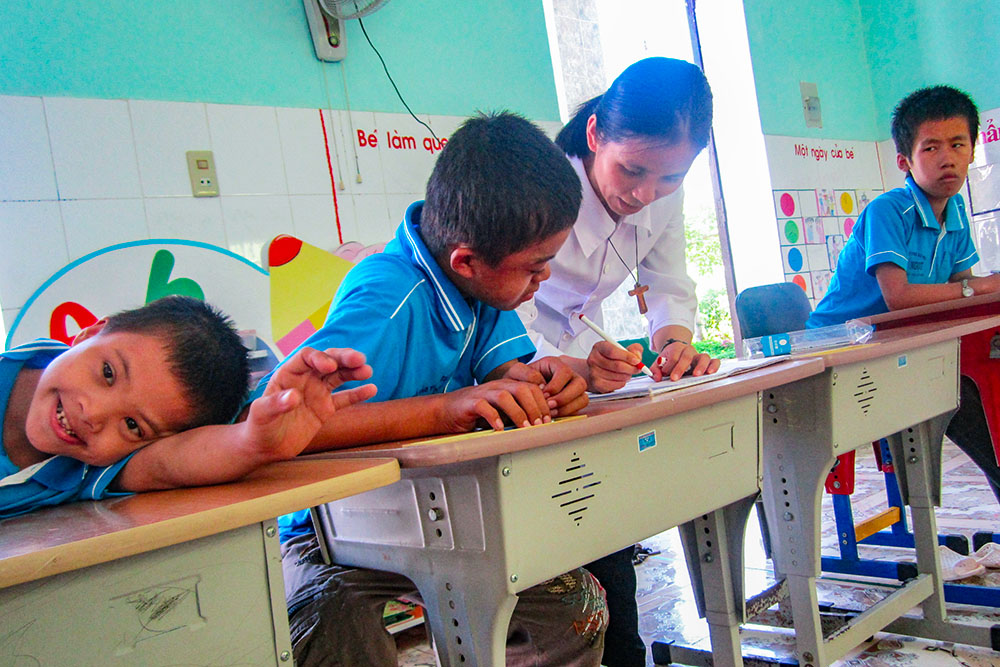
Sr. Mary Bach Thi Loan teaches a child how to write at the center run by the Daughters of Mary of the Immaculate Conception in Hue, Vietnam, on Sept. 22, 2025. (Joachim Pham)
The sisters also organize outings to help children practice social skills. At a beach trip last September, Trang watched her son join other children in games.
"He responded well to drawing and playing ball," she said. "His movements are still slow, but he listens and follows instructions."
For Trang, these moments mark a profound change. She once hid her son's condition from neighbors, ashamed of his behavior — playing alone, scratching others or banging his head when upset.
Today, there is no longer a reason to hide.
"He shares toys, listens to others and is more friendly," she said. "He can take care of himself, dress and manage basic hygiene."
Other congregations are also stepping in. In the Vinh An neighborhood in Hue, the Daughters of Mary of the Immaculate Conception care for 12 children with autism, ages 5 to 11.
Sr. Mary Bach Thi Loan said their ministry began in 2020 after they encountered a teenage girl with developmental disabilities and decided to help.
Today, she added, their congregation runs three centers that care for 32 children.
In a country where resources are limited and stigma persists, the quiet work of women religious is helping children with autism — and their families — find dignity, support and hope.
For Trang, that hope is simple but profound. "They have helped my child become better and given us a future," she said.