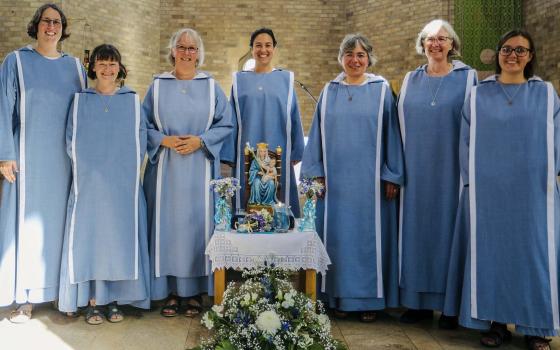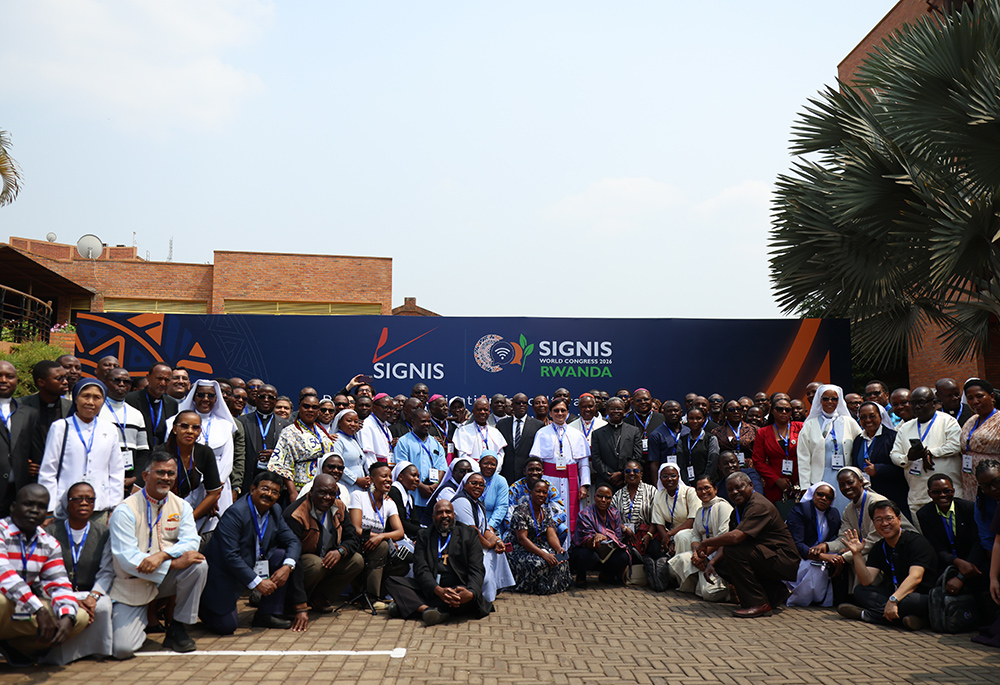
Delegates to the SIGNIS World Congress pose for a group photo; the congress was held Aug. 1-8 in Kigali, Rwanda. (Courtesy of Sr. Rocio Garcia)

My GSR and NCR colleagues and I are all too aware, and even worried, that artificial intelligence is rapidly transforming the contemporary media landscape, raising urgent questions for us about misinformation, public trust and the future of journalism.
For Catholic communicators, including women religious working in various media, these changes present particular challenges: How can they navigate an increasingly unstable information environment while remaining faithful to their mission of communicating truth?
That's why our recent coverage of the SIGNIS World Congress in Kigali, Rwanda, struck me as particularly relevant. The August gathering, convened by the World Catholic Association for Communication, brought together some 300 participants, including about four dozen Catholic sisters, to discuss the challenges and opportunities facing Catholic media. It was also the first time the congress had been held in Africa.
Among the speakers were Sr. Nina Krapić, deputy director of the Holy See Press Office, and Marijana Grbeša Zenzerović, a professor at the University of Zagreb who often collaborates with the Vatican's Dicastery for Communication.
Both addressed the current media landscape with an unblinking, clear-eyed perspective.
"The current media environment is flooded with AI-generated content, a hyperproduction of content that is filled with misinformation and disinformation," Krapić said in our original story.
Amplifying that concern, Zenzerović warned that the rapidly changing media environment poses significant challenges for the Catholic Church and its communicators — challenges that are not always easy to navigate.
First, she said, is the "sheer volume of AI-generated religious content, ranging from AI Bible projects to highly controversial experiments involving AI-generated homilies."
Concurrently, Zenzerović said, the amount of false and misleading content related to the church "is simply impossible to debunk comprehensively."
I recently saw an example of this myself on Facebook. I caught a post showing Pope Leo XIV falling ill in public, sounding alarms about his health. Neither the AI-generated images and the accompanying sensational headline were remotely true — nor are many homilies attributed to Leo.
There is a great irony about this. Leo's recent encyclical Magnifica Humanitas, which addressed many concerns about AI, should be understood, Zenzerović said, as an appeal to all stakeholders, including digital platforms, "to recognize and assume their responsibility in shaping the future of humanity."
But Zenzerović also rightly argued that AI cannot be simply dismissed: we can't now put the genie back into the bottle, nor should we want to.
"Technology and AI," she said, "offer a wide range of benefits, from greater connectivity to educational opportunities that are almost limitless."
A potential benefit of AI, she believes, "is its ability to help reduce the knowledge gap between well-resourced and less-resourced communities. This is something communicators should actively explore and use for the benefit of their communities."

(Unsplash/Michael Carruth)
A troubling media context
If the rise of AI is the chief challenge, Zenzerović said another is the declining influence of professional journalism — something that touches on the work my colleagues and I do.
We at GSR try our best to report fairly and accurately, believing that promotes and protects the truth about people, events and issues.
But Zenzerović argued that the current context is witnessing something troubling, such as the "growing dominance of digital platforms and algorithmic content moderation, which can fuel polarization and contribute to the creation of multiple parallel realities."
Catholic communicators, Zenzerović argued, "have an important responsibility to educate their communities about the risks associated with these developments."
She also raised a very valuable point, noting that the global media-driven public sphere has, "to a significant extent, been captured and privatized by a small number of corporations that possess immense power to influence the direction in which our societies and, ultimately, our civilization develop."
That gets at an essential truth: the interests of such corporations "do not always necessarily align with the public good."
Advertisement
One group that places a high premium on the public good are, of course, Catholic sisters. Krapić spent a good deal of her address reflecting on the role of sisters within the global media environment.
Krapić posed a good question to her audience: What do sisters hear in 24 hours?
Sisters, she said, "have direct access to the real questions of humanity." Together, as a global community and body that is part of the wider church, "they also carry an extraordinary wealth of experience in responding to those questions."
Having witnessed the work of sisters on five continents, I don't think it's an exaggeration to say, as Krapić put it, that women religious "hear the deepest questions humanity asks and accompany people in finding their answers."
These could include questions about life, about "forming a family, education, and discovering one's vocation. Questions about how to build healthy families and stronger communities. Questions from the elderly and their caregivers, questions from the sick and their families."
Sisters hear stories — stories "of persecution, migration, addiction, reconciliation, loneliness, and hope," she continued. But they not only hear stories, they accompany those "searching for meaning, freedom, facing hard decisions, mourning losses, and rebuilding their lives."
Those experiences give sisters a valuable and unique perspective, because their encounters with people are not at all abstract. "For a sister, a refugee is not a distant news story. It is someone she accompanies until they stand on their own feet, and she knows all about why they left, what the journey was like, what their dreams and fears are."
Moreover, sisters know how to help others in a practical way. "For the sisters, the margins are not somewhere far away, they are at the center of sisters' life and mission. This gives sisters a perspective that is profoundly different from the one we usually encounter in mainstream media."
Krapić noted that this deep but often hidden reality stands in contrast to the media portrayals of sisters which too often dwell on "the stereotypical fun" associated with the portrayal of religious life, like group dancing.
That amounts to decoration, Krapić argued, and the role of sisters should not be reduced to that.
Communicating the complex reality sisters live in is not, she said, "secondary to our mission. It is part of our mission. Above all, we communicate because we want to tell the story of God's love for the world."
When Catholic sisters begin to tell their stories, she said, they do not only change the perception of religious life. They are also changing "the perception of the margins, they are shifting the dominant narratives that are often the cause of marginalization."
"They inspire. They are bringing something new and good into the media environment. And they offer the world something it desperately needs: a perspective born from the experience of self-giving and proximity to others."
That perspective is needed more than ever.