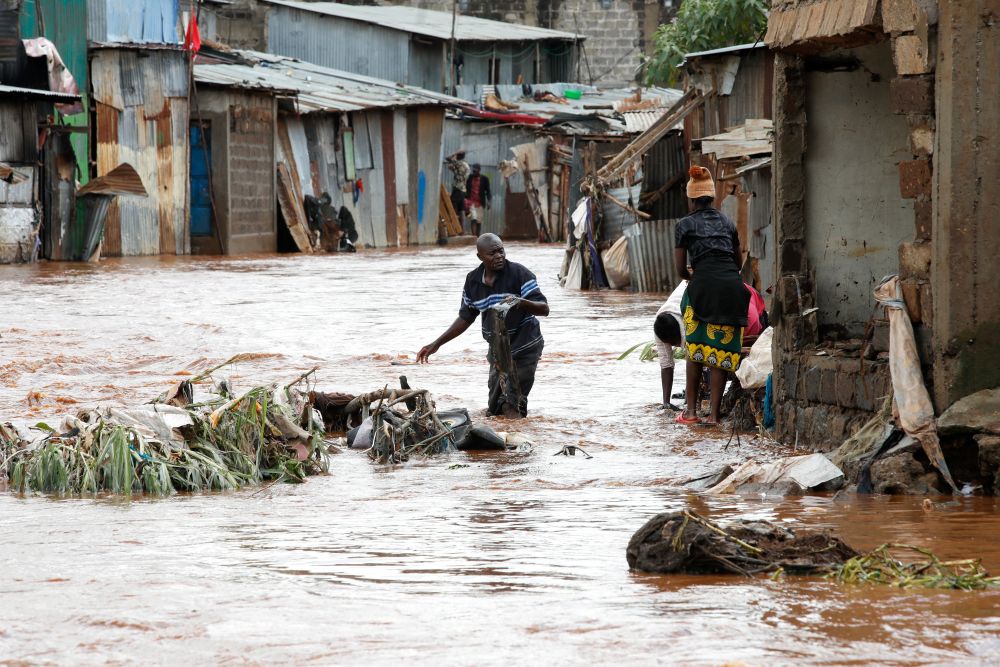
Residents wade through flood waters as they recover their belongings in the Mathare Valley settlement of Nairobi, Kenya, April 24, 2024, after the Nairobi River burst its bank. During West and Central Africa's 2024 rainy season, at least 7.5 million people were affected by flooding across 18 countries, according to the U.N. (OSV News/Reuters/Monicah Mwangi)

by Doreen Ajiambo
Geoffrey Wanjala, 45, is harvesting tomatoes beside his newly built house on land he once had to abandon after floods swept through this farming community near Lake Victoria in western Kenya.
In May 2024, heavy rains caused Lake Victoria to overflow, flooding homes and farmland across Budalangi. Wanjala lost his home and could no longer cultivate his fields. He spent nearly two years away before returning in early 2026, after the government began constructing dikes to protect flood-prone communities.
His return comes as negotiators at COP31, the United Nations climate conference underway in Antalya, Turkey, debate how wealthy countries should help vulnerable nations pay for protection against floods, droughts and other climate-related disasters that threaten food production.
"I am finally here at my home after a long time following the floods," said Wanjala, who chairs a local association of flood victims. "Now we're back."
Since returning, Wanjala has earned about $155 from farming. The dikes have protected fields enough for farmers to harvest crops in April and August, with another harvest expected in December.
The farmers keep some of what they grow, sell some at markets around Lake Victoria and deliver beans, maize, tomatoes and cabbage to neighbors who cannot work their fields and families still living in displacement camps.
But the protection has not reached everyone. Some families remain displaced, and farmers outside the protected areas continue to face the threat of flooding.
Sr. Celestine Nelima of the Sisters of Mary of Kakamega, who has worked with flood-affected communities in western Kenya, cautioned that exceptionally high water can overwhelm the barriers.
"Dikes are a temporary measure for controlling floods, but they are not a sustainable solution," Nelima said.
The question of how to pay for such protection is central to negotiations in Turkey. A Nov. 16 draft from the COP31 presidency proposed at least $120 billion in adaptation finance and called for a plan to follow through on last year's push to at least triple that funding by 2035. Governments had yet to agree on the text.
"Meeting a financial target does not always meet countries' needs," U.N. climate chief Simon Stiell told ministers in Antalya on Nov. 13. "To do that, we need to look at how finance is delivered."
From flooded fields to food markets
For Teresa Akumu, 71, farming once meant investing in crops without knowing whether she would harvest anything.
Budalangi lies in a low-lying area where rivers overflow and water from Lake Victoria can back up onto farmland. Before the dikes were built, floodwaters sometimes reached her fields before the crops were ready.
Before the dikes, she said, "you could farm, and when water from the lake backflow stormed, we could face serious losses after investing resources and time and energy."
Akumu now grows maize, beans and sweet potatoes. She says the soil is fertile enough that she needs little fertilizer. Roads previously cut off by floodwaters have reopened, making it easier to take produce to market.
The broader Lower Nzoia Irrigation and Flood Control Project includes embankments to keep floodwaters off farmland and canals designed to supply water for cultivation.
Motorcycle taxi rider Essau Chimwenyi said reopened routes have shortened journeys and allowed him to earn an income again. And fish trader Susan Nabwire estimates her revenue has increased more than 30%, though she still hopes for better protection at the landing site and facilities to process unsold fish.
Advertisement
In August, while farmers on protected land were bringing in their second harvest, families at Khumwanda displacement camp were still waiting for roofing sheets to rebuild their homes.
Area lawmaker Raphael Wanjala said in an Aug. 26 statement that 213 households remained at Khumwanda, one of several camps housing people displaced by floods.
For families still in camps, food shared by farmers who have returned to their fields offers some relief. But they also need homes and land they can cultivate again.
Different threats, similar needs
At a Nov. 12 meeting in Antalya, representatives from Mozambique, Chad and the COP31 presidency discussed how African countries could direct climate funding toward food and water systems to protect small-scale farmers from floods and drought.
In Zambia's Sioma district, farmer Matuku Lubinda harvested 15 bags of maize after receiving seeds, supplies and training through a program supported by the U.N. Food and Agriculture Organization, Caritas Mongu, and the government following the 2023-24 drought. She sold 10 bags and kept five for her family.
A review of the program found that farmers still faced limited irrigation and difficulties getting crops to market. The harvest had helped Lubinda feed her family and earn money again, but sustaining production would require further support.
In January, floods inundated about 313,000 hectares of cropland, according to the U.N. food agency. By September, the agency warned that irregular and below-average rainfall could reduce yields in parts of the country as families' food stocks dwindled.
Around Greater Maputo, the agency reported in July that 14 field schools had trained 377 farmers, most of them women.
The groups received seeds and hand tools and used shared plots to practice growing vegetables and managing soil and water.
The experiences in the three countries point to different needs: flood protection in Kenya, reliable water supplies in Zambia and support for farmers confronting changing rainfall patterns in Mozambique.
Who pays for protection?
The U.N. Environment Programme reported this month that developing countries received between $28.2 billion and $31.7 billion in international public adaptation finance in 2024. It estimates they will need about $305 billion annually by 2035.
Even tripling public adaptation funding would meet only 20% to 29% of projected needs, the agency said.
East African Community governments entered the talks seeking predictable grants and easier access to funds. The European Union's published position supports raising money from public and private sources.
The U.N. human rights office told ministers on Nov. 13 that public funding was especially important for adaptation projects unlikely to attract private investment. A dike can protect roads, farms and homes without generating revenue to repay an investor.
Stiell cautioned that financing terms must reflect what countries can afford, particularly as disasters increase recovery costs and strain government budgets.
Sr. Constance Nsofwa, a Salesian sister in Zambia, told Global Sisters Report that communities should be able to use grants to protect local food supplies, healthcare and access to affordable energy.
She said communities should also help decide how the money is spent.
Filipe Martins, director of the Belgium-based Jesuit European Social Centre, said complicated application procedures can prevent local organizations and authorities from accessing available climate funds.
The Rev. Fletcher Harper, executive director of GreenFaith and an episcopal priest, pointed to the debts developing countries already owe.
Asked how climate funding could reach communities without adding to their financial difficulties, he replied: "There's a two-word answer to this question: debt cancellation."
The Nov. 16 negotiating draft proposes work to identify more predictable sources of public funding and ways to track what governments deliver. Some of that work would continue into next year's climate summit.
In Budalangi, Wanjala is preparing for another harvest in December. If the crop succeeds, he and other farmers will have more food to take home, sell and share with displaced neighbors.
He hopes the flood protection that allowed him to return home will eventually reach families whose land remains exposed.
"That's why we are advocating to have all areas covered to enable all our people to get back to profitable engagements," he said.