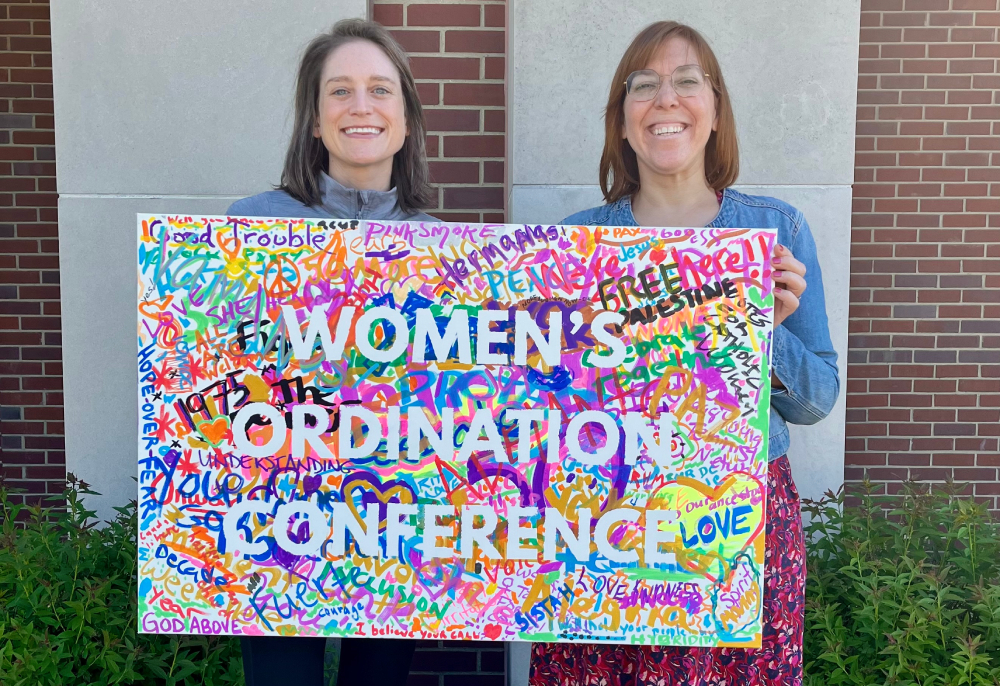
Women's Ordination Conference (WOC) Executive Director Kate McElwee and WOC Programs Director Katie Lacz pose with artwork made collectively during the organization's 50th anniversary event held May 22-24 in Detroit, Michigan. (Courtesy of Christine Schenk)
by Sr. Christine Schenk
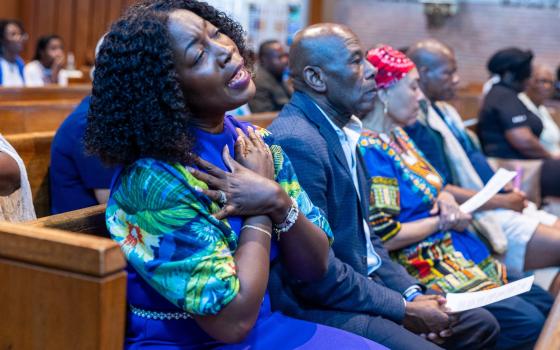
There were so many uplifting and energizing things to celebrate at the 50th anniversary of the Women's Ordination Conference (WOC) held over Pentecost weekend in Detroit, Michigan. Coalition work is key to any movement, and this one is no exception. So it was wonderful to see and celebrate the blessed diversity of women's ministries — and advocacy — in the women's ordination movement, including pastoral ministers, parish justice leaders, LGBTQ+ advocates, parish priests, Catholic high school teachers, campus ministers, women religious, pastoral musicians, liturgists, scholars, women priests, theologians, biblical experts, spiritual directors and leaders of church reform organizations of every stripe. It was also a bit of an "old home week" to reconnect with many dear "mothers of the movement" with whom I had served as FutureChurch's founding director.
Pentecost joy was palpable, hard to contain, and arrived unexpectedly to fill my own heart as well as those of my siblings in the struggle. The distance of years allowed me to see blessings heretofore hidden when serving in the trenches. Not least of these is the gift of solidarity with likeminded sisters — and more than a few brothers — committed to the full inclusion of all the baptized in church ministry and decision making. Yes, Pentecost joy was palpable. And so was a renewed determination to change the church we love.
Which brings me to the real subject of this column. It was my privilege to moderate a panel addressing a subject dear to my heart: How do we systemically transform institutional structures? The brainchild of WOC Executive Director Kate McElwee, the "Not if, But How — Reforming Institutions" panel gathered two sociologists and a political scientist to explore concrete strategies for changing institutions. It was a brilliant concept to bring the lens of their research in sociology and political science to bear on discerning where WOC might wish to go in the next five years if not the next 50. The panel did not disappoint.
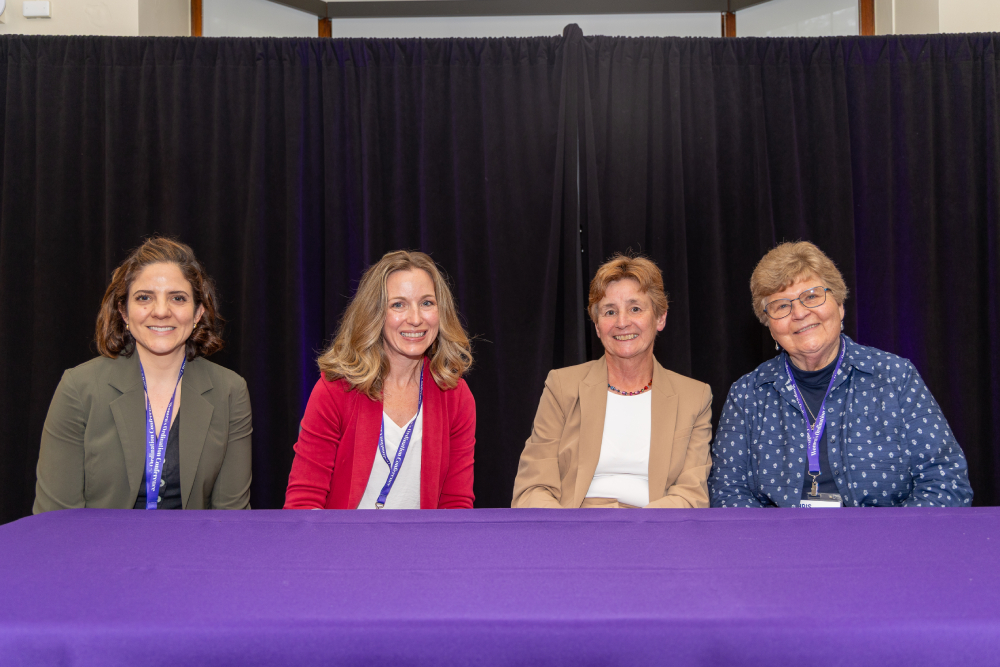
Pictured left to right are the panelists at the 50th anniversary celebration of the Women's Ordination Conference held May 22-24, 2026 in Detroit, Michigan: Consuelo Amat, Tricia C. Bruce, Dr. Michelle Dillon, and Sr. Christine Schenk, CSJ. (Courtesy of Christine Schenk)
Panelists were first asked to address the question: How do institutions really change, and what examples from your respective disciplines indicate that change is possible?
Michele Dillon, Professor of Sociology at the University of New Hampshire, and a leading scholar of religion and social change, observed that "advocacy and activism does matter. It does drive change." She pointed to successful movements in secular society such as Mothers Against Drunk Driving and marriage equality advocacy that relied on transforming consciousness. MADD changed the focus from drunk drivers "seen as the victim who couldn't help themselves" to focusing on the victims who were killed or badly injured in drunk driving accidents. Applying her sociological observations to women's ordination, she suggested a need for a continuous dialogue between "the realities we have and all the complexity of doctrinal ideas." At the same time she observed it is important to ask that since "for the most part," the church is Western-centric, "how are we going to shift opinion elsewhere given the emphasis on unity?" She expressed hope that "the new synodal processes will allow for those really tough conversations and questions."
Tricia C. Bruce cited the extensive research in her first book, Faithful Revolution: How Voice of the Faithful is Changing the Church, which chronicled the efforts of parish-centered Catholics to leverage structural change — especially transparency and accountability — in the wake of the clergy sex abuse scandal. A sociologist of religion and U.S. Catholicism, Bruce is a Senior Research Fellow with the Institute for Advanced Catholic Studies and served as a papally appointed consultant to the Synod on Synodality. She found that one of the first challenges Voice of the Faithful parishioners faced "was having to legitimate themselves as Catholics … now mind you, these were folks who had been singing in the choir for 20 plus years." Bruce's subsequent research led her to conclude that "Parishes become places of real structural change in the church." She cited the creativity of lay Catholics, priests and bishops who used canon law to create some personal parishes that permitted the Latin Mass, and others to meet the needs of Vietnamese Catholics.
Consuelo Amat shared fascinating insights from her study of the Catholic Church in Chile during the Pinochet dictatorship of the 1970s. A Professor of Political Science at Johns Hopkins University, Amat's work focused on state repression, nonviolent resistance, and the Catholic Church's role in authoritarian regimes. During Pinochet's brutal reign, the Chilean church "made the choice to stand up for human rights," Amat said. Cardinal Raule Silva Henriquez created "Vicariates of Solidarity" to document human rights violations and to address the immense poverty and unemployment ravaging the country by providing local services such as soup kitchens, education, health clinics, employment training and other programs. The Chilean church had three types of clergy at the time: leftist, moderate, and conservative. The mainstream church adopted a moderate stance. It allowed certain concessions to the military such as permitting the government to use the Cathedral for celebrations. This enabled it to continue documenting over 40,000 human rights abuses and offering desperately needed services to millions of people. Because these services were open to everyone, regardless of military-political leanings, "people who actually hated each other politically came together for the first time in decades," Amat said. These newly created open spaces were foundational to the development of a more stable political alliance that resulted in Pinochet's ouster in 1988.
Advertisement
Next, panelists were asked: What advice would you have for reformers? What key strategies could ordinary Catholics, reform organizations, parishes and other Catholic groups consider?
"One of the big challenges for WOC is that I don't think most Catholics see it as a salient enough issue to get worked up about," Dillon said. "Yes, there is support but it's not intense enough … How can we reframe the issue both for the Western audience, then also more globally?"
Bruce observed, "Knowledge is power … one of the massive strengths [women bring] is to learn — be educated, be curious, ask questions … it's kind of amazing how many women have used education to open doors that are not open to them via ordination." She also noted the strength of storytelling as "a powerful agent of change." While waiting for change can be frustrating, she observed, "We can also look back and see that in fact, things do slowly emerge and change."
"Sometimes change and reform occur as a consequence of contingent events in history, but the key is that the agents of change, the political entrepreneurs, are in the right place at the right time taking action," Amat said. She believes it is important to keep in mind the moderates — people in various networks that "bring different kinds of sectors and people together." She also suggests: "There's a lot to be said for bringing what you would like to see in the Catholic church on a grand scale to reality — and informally — at the local level …"
The final question was: Where can we find hope? Are there signs of progress to watch for in the next five years? Are we being too optimistic about the synod on synodality?
"Pay attention to the small, tiny changes and how they accumulate and make a visible difference," Dillon advised, pointing to women leaders at Vatican dicasteries and the female voting members at the synod. She also reflected: "Oftentimes it's the women who are the lay ministers who really are exemplifying all that we might wish for in the priesthood. So there is hope."
Bruce quoted paragraph 60 of the Synod's final document: "What comes from the Spirit cannot be stopped," noting that the paragraph "actually has a lot of hope in it with regard to women's roles in particular." She finds hope in "knowing how to use structures that are already there, including even canon law." Lastly, she pointed out that lived experiences of the faith can look different from the Church's formal structures, observing that the two "can't be thought of separately." She finds hope in synodality as "a radical invitation to see the life of the church as both codified, structured, institutionalized and lived and felt and experienced."
"Not to be a Debbie Downer, but it is important for movements to be prepared for backlash," warned Amat. She grounds her hope "in developing enduring structures for change and in demonstrating to the Catholic hierarchy that the movement is here to stay. And it is here to continue persuading and creating the public opinion it needs worldwide …"
Indeed. Happy Anniversary, WOC. And thanks for developing a powerful Spirit-led "enduring structure for change."