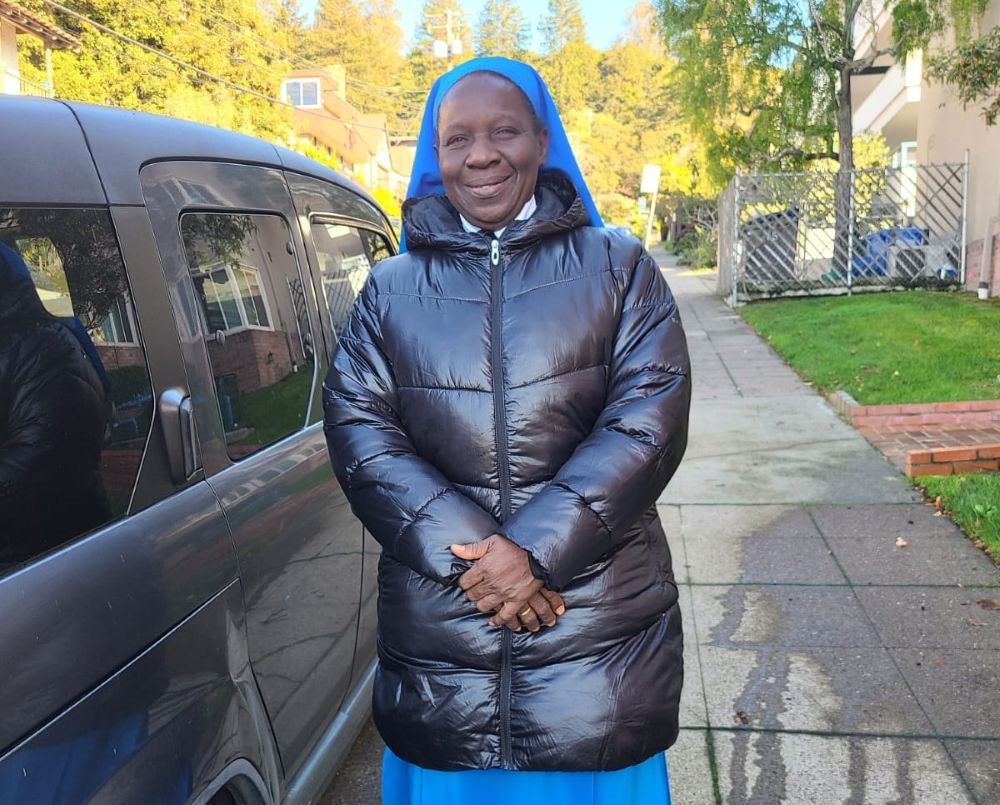
Daughter of Divine Love Sr. Mary Brendan Ezigbo works at the Enugu Custodial Center in southeastern Nigeria, where she attends to the spiritual needs of inmates. She provides counseling, teaches catechism and prepares them for sacraments, among other tasks. (Ekpali Saint)

by Ekpali Saint
In February 2023, Sr. Mary Brendan Ezigbo was appointed to head the catechetical commission of her congregation. With this role, the 61-year-old member of the Daughters of Divine Love learned to teach catechism in Nigerian prisons.
She had never before taught catechism in prisons. However, she believes her abduction in 2022 in southeastern Nigeria's Anambra state helped her to learn not to condemn offenders but to "see Jesus in them." She told Global Sisters Report that on her way to her father's house, five armed men whisked her away into the bush and demanded money. Since she had nothing to give them, they dropped her off near her father's house and took her car. They did not physically hurt her.
At the Enugu Custodial Center, she attends to the spiritual needs of inmates by counseling them, teaching catechism classes, preparing them for sacraments, reconciling them with their families and helping them receive job training after completing their jail terms.
Ezigbo said over 16 inmates were confirmed in 2023. To help them on their spiritual journey, she also introduced monthly eucharistic adoration and a devotion to St. Jude Thaddeus, a patron saint of hopeless causes and desperate situations. So far, she said, the inmates' commitment is encouraging.
Ezigbo shared with GSR about her prison apostolate and how her catechetical work and sacramental preparation of inmates over the past three years have "borne a lot of fruit."
GSR: What is the inspiration behind your work?
Ezigbo: My congregation was founded by Bishop Godfrey Okoye during the Nigeria-Biafra war. He intended that we commemorate the infinite love of God. He did not joke around with catechesis. He said, "Whatever you do, you must undertake catechesis; it is important for the church."
Through catechesis, you hand down the faith. Through catechesis, you teach what Christ has taught. Through catechesis, you win souls for Christ, make disciples for Christ, and help people encounter Christ, building their faith and deepening their relationship with God.
In February 2023, during our general day of prayer, the mother general said I should coordinate the catechetical commission of the congregation. I went to pray about it, and the Lord gave me some inspiration. Included in my terms of reference were that I would teach catechism in our formation houses, the novitiate, the scholasticate and a prison. That was a concern. I didn't know how to handle inmates because I had only visited a prison once in Awka to bring the inmates food for Easter.
I had taught catechism, for example, in secondary schools since my profession, but not in prisons. So far, the journey has been good. I give thanks to God that it has borne a lot of fruit. The inmates are interested, and I bought a mini catechism book for each of them so that after the class, they can read.
What impact has your apostolate had on the inmates' spiritual journey?
It is the Lord who transforms. When they gave me the assignment to teach catechism in the prison, I said, "Yes, the Lord wants to use me as a contact point to talk to these people."
I believe that those who have received the sacraments and have been taught will not go back to who they were. Some have said, "Thank God I came to prison, otherwise I wouldn't have known God." Some have joined pious societies and are faithful to that.
I also introduced adoration of the Blessed Sacrament every third Saturday so they can have that encounter with the Lord for two hours. I invite a priest who comes to expose the Blessed Sacrament. Sometimes I do a novena with them, and I journey with them. It is the Lord's work; we are just mere instruments.
They are committed to church activities. There is a change in their character. I get reports that some of them have really improved their behavior and the way they do certain things. Some of them also tell me that they are making an effort. It's not going to be a one-day thing, but they are consistent and making an effort to improve.
I see Christ in them. Jesus tells us that "anything you do to the least of my brothers you do it to me."
How does seeing inmates receive sacraments make you feel?
I am happy when I see them. I don't hide my feelings. Before they received the sacrament of confirmation, I went to their families' houses to collect their baptismal cards. I also went to the market, bought white fabric, and called a seamstress to take their measurements and sew clothes for them. On the day they received the sacrament, they looked like angels in their white clothes. It gives me joy. Their families are happy too.
In 2024, we celebrated the first-ever Christmas carol at the custodial center. I bought materials, and we decorated the compound so it had a Christmas feel. And they enjoyed it.
Advertisement
How did your prayer life and religious formation shape your approach to this work?
We are to commemorate the infinite love of God. Our founder said that Christ emptied himself to become man. You have to imitate Christ by being humble. If you want to serve God's children, you have to be humble because you are ministering to Christ in these people. My formation helped me to realize that this is what Christ needs. If you begin to see Christ in people, it will change some of your ideologies and your behavior towards people.
Apart from catechism, I listen to their personal problems, counsel them, and in cases that I can't handle, I ask them to see the priest. Some whose parents don't know their whereabouts, I ask for their contacts. If the inmates don't have one, I ask for their house or village address, and I go out to look for their family to tell them that their son or daughter is in prison. Then I encourage the parents to visit.
What challenges do you face in your apostolate?
Teaching basic prayers, the sign of the cross, and the "Come, Holy Spirit" prayer can take two hours. They are adults, so you have to be very patient with them. Their environment is a challenge. It is the same small hall at the center that we use for every religious activity, catechism classes and meetings. Sometimes, these activities happen simultaneously, so there is noise in the hall.
What is your message to young women who feel called to religious life or this ministry?
The first thing is discerning your call or vocation. Not everyone must go into the prison apostolate. What is your gift? Where are you drawn to? If you want to become a religious, there are different congregations. So, ask yourself where you are called to. Learn about their charism and the apostolate they undertake. Find out, make enquiries, then pray.
Religious life is not about what you want to do. I tell the younger ones to dispose of themselves. If you want to do the work well, you have to detach yourself from yourself and cling to God so his grace will work in you.
It is not about yourself. Put yourself aside so that God can work through you. As a religious, you are now representing the church, and you become an instrument through which God will work.