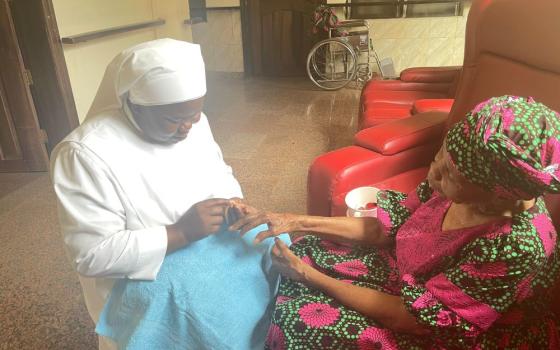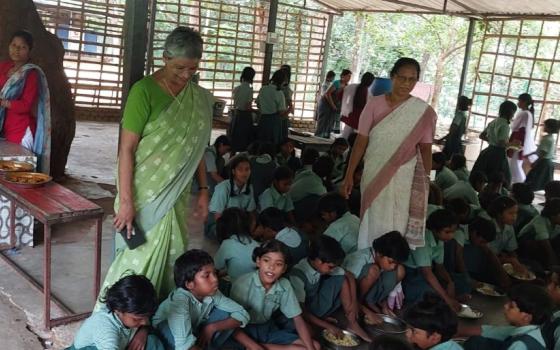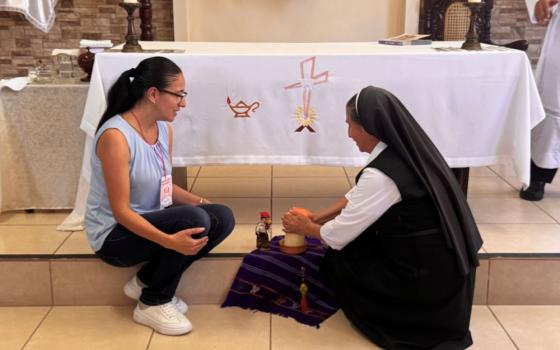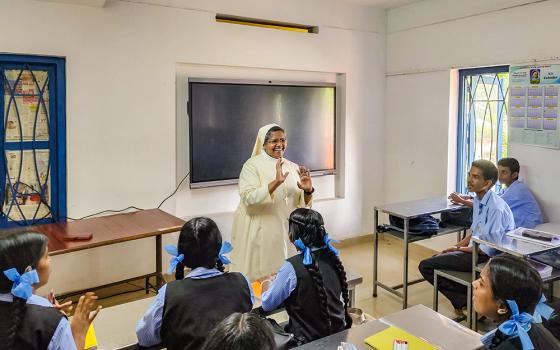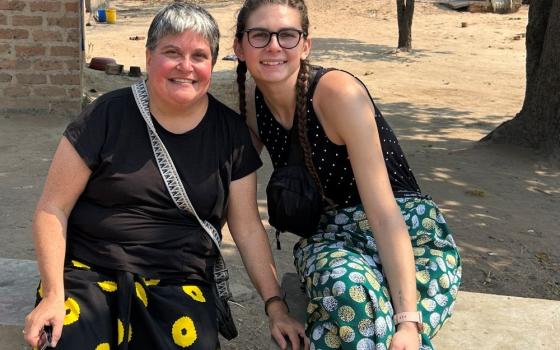
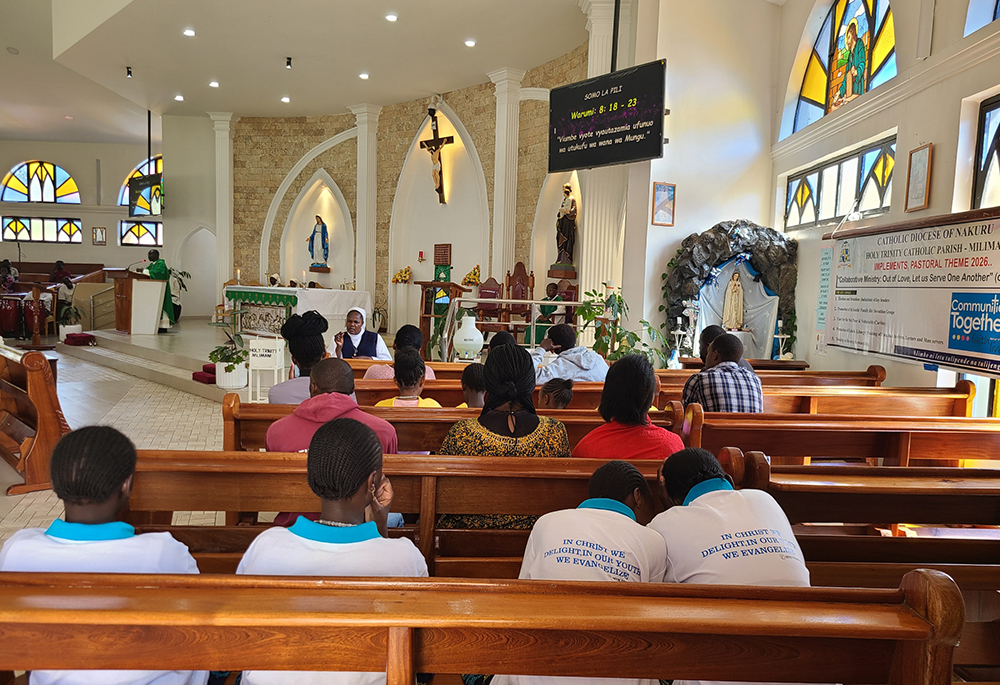
Sr. Mary Josephine Adhiambo Ogutu of the Franciscan Sisters of St. Ann interprets the homily in sign language for members of the deaf community during Holy Mass at Holy Trinity Catholic Church, Nakuru. (Mourine Achieng)

by Mourine Achieng
As a child, Sr. Mary Josephine Adhiambo Ogutu watched with confusion as her grandfather offered food and shelter to the poor, people with mental illness, and outcasts who would often make their way into their roadside compound. As a teenager, she witnessed her mother serve porridge from a jug that seemed never to run dry to anyone who entered their home. Little did she know that these acts of generosity would one day shape her vocation.
During her formation years with the Franciscan Sisters of St. Ann, Ogutu felt a deep and almost instinctive connection to the congregation's ministry among persons with disabilities. In her first posting, as a post-primary instructor for the deaf-blind, deaf and visually impaired at St. Oda School for the Visually Impaired in Siaya County, Kenya, she not only trained students in handicraft but also made it her personal mission to scout the villages to ensure persons with disabilities were safe and well taken care of.
Her passion for the safety and protection of persons with disabilities continued through the years. It was evident in her work at St. Anthony Integrated School in Awasi, where she ensured disabled people were not hidden at home.
Later, as the principal of Mater Dei Nakuru Hospitality College, she introduced a department of languages with a strong focus on sign language. Ogutu trained over 80 sign language interpreters to bridge the gap between the deaf community and the general public. Her graduates are working in different parts of the country and beyond. She also offered free vocational training courses to persons with disabilities and street children.
She proceeded to open a sign language school at Holy Family Catholic Parish in Utawala, and another one at St. Patrick's Catholic Church in Mavoko. Currently, as a quality and standards assurance officer for Vocational Training Colleges for Nakuru County, Ogutu has continued her apostolate with those with disabilities.
She spoke with Global Sisters Report about her passion for persons with disabilities and her apostolate work to promote their inclusion, safeguard their rights, advance their access to education and economic opportunities and ultimately ensure their self-reliance.
GSR: What opened your eyes to the struggles faced by persons with disabilities?
Ogutu: As a child, I watched my grandfather welcome poor and vulnerable strangers into our home, offering them porridge and sometimes a place to sleep. My mother showed the same generosity by serving porridge to passersby, while caring for my bedridden grandmother, which taught me patience and compassion.
Looking back, I believe these experiences planted the seed of my lifelong passion for serving the less privileged, particularly persons with disabilities.
Seeing capable men, women and children with disabilities excluded from opportunities, basic services and meaningful participation in society stirred my heart to do something about it.
What are some of the challenges that persons with disabilities face before they come in contact with your ministry?
They are stigmatized. A home would be referred to as "that home of the deaf." They are not addressed by their names. It's like the disability becomes who they are. Most of them are in a pathetic state, poverty-driven and disengaged. If they're deaf and strong without additional conditions like autism, they're manual laborers at their own homes or for others. They're often paid poorly or not paid at all. In fact, most people provide meals as compensation.
When you identify a person with a disability, what does your intervention look like from beginning to end?
Because [persons with disabilities] are prone to abuse, the first thing I look into is their safety. Are they in a safe place? Are they protected? Next, I assess whether their basic needs are met.
It's only after these that I establish their level of education. If they didn't go to school, I enroll them at the American Corner at the National Library here in Nakuru. The American Corner is a spot at the national library where they are trained in handicrafts like beadwork, knitting and mat-making. Once enrolled, I find a place where they can live as they attend the workshops. I have placed several with my friends within Nakuru.
For those who completed class eight [equivalent to eighth grade in the USA], I enroll them in vocational training courses. The government of Nakuru, through Gov. Susan Kihika, pays Kshs. 30,000 ($231) directly to the vocational training institutes for each student with disability. I talk to the principals to offer them boarding.
What happens after they complete their training?
I ask Christians here, at Holy Trinity Catholic Church, Nakuru, if they have any job opportunities to offer them. I contact people in my cycle. Right now, one of the deaf's masonry contract ended. Starting next week, I'll scout building sites for masonry opportunities.
I'm always on the lookout for job advertisements in the county. When I see one, I visit the Nakuru public service board chairperson to talk about the 5% inclusion of [persons with disabilities] in employment. Then, I encourage people with disabilities who meet the requirements to apply. I follow up to find out if they got feedback, check the shortlisting and even confirm the interviews.
The Catholic Small Homes, an NGO run by the Diocese of Nakuru, offers start-up kits for those who've completed their training. This helps some get started. The county is also planning to do the same after every graduation. I'm optimistic they'll do it.
Your main goal is for people with disabilities to access education or some form of training. Why is this crucial?
It's the only way out. These days, there are no shambas to inherit. Even when they are there, parents rarely give their children with disabilities a land inheritance. They depend on their parents for everything. Once these parents die, they are struck with depression. If they are educated, trained or have a skill, you're sure they can have a source of income.
Looking back, what impact has your work had?
By the grace of God, I've been a safe space for counseling any [persons with disabilities] in distress. Secondly, I've been teaching the Catechism of the Catholic Church to the deaf community. Over 50 of them have received the sacrament of baptism through these classes. In addition, I have prepared two couples for the sacrament of holy matrimony, and they were wed in the church. Currently, I have five more in the pre-Cana class.
I've taken them on spiritual retreats. Last year, we got a sponsor and attended a retreat at Vincentian Retreat Center, Thika. One of the [persons with disabilities] who was born deaf got her hearing back during the retreat. She's currently in formation to become a nun. This year, we also got sponsors, and we'll be going on the retreat in August.
Advertisement
With your commitment to the welfare of persons with disabilities, what sometimes frustrates you the most about the way society treats persons with disabilities?
People who should be at the forefront championing the inclusion and synodality of persons with disabilities are still waiting. Some deaf people want to be sisters, but no one wants to take them.
I requested the pastoral office to celebrate Mass for them and to provide lunch afterward because many would have walked there and, considering their economic situation, might not have had anything to eat. The office said the Mass could be held in the afternoon, so I asked whether they could at least provide snacks after the Mass. Unfortunately, I never received any feedback, and my calls have gone unanswered. It has been frustrating because I believe the church should be at the forefront of caring for vulnerable people.
You've dedicated years to advocating for persons with disabilities. What keeps you motivated?
My motto is Matthew 6:33: "But seek first the kingdom of God and His righteousness, and all these things will be added unto you." So, I live one day at a time. What I can do today. I will do it even if it isn't perfect. I'm determined to see them self-reliant.
My dream is that we'll have a home for [persons with disabilities], a rescue center, where they can run to for refuge. With a home, I don't have to place them with friends. I can be assured of their safety. It would be easier to track their progress and also ensure continuity.