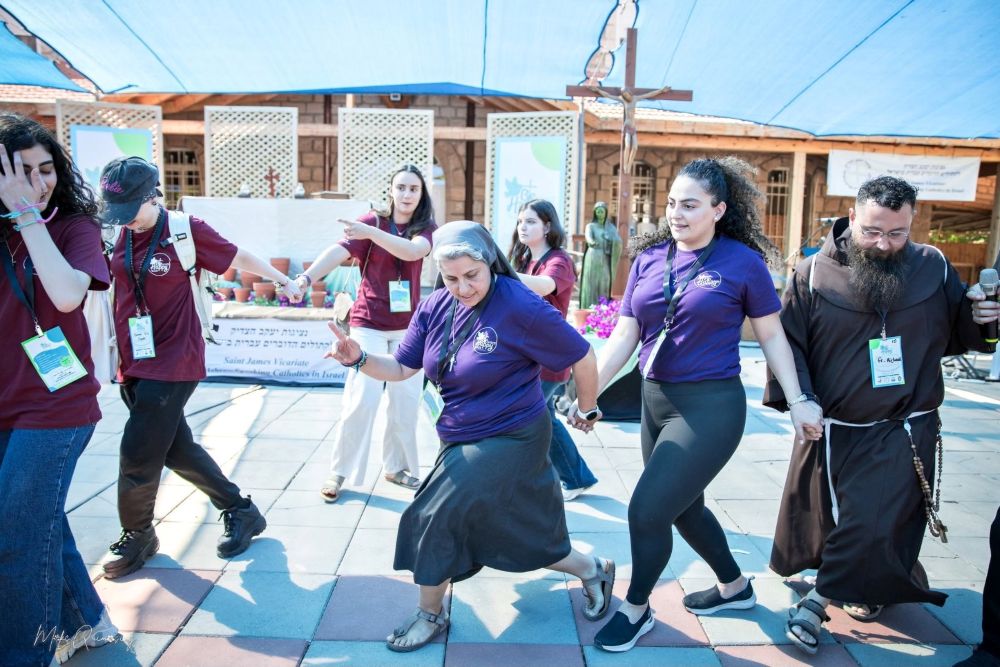
St. Joseph of the Apparition Sr. Muna Totah, center, dances at a festival that brought together youth from Galilee and youth from the St. James Vicariate in Jerusalem in October 2025. (Courtesy of St. James Vicariate)

by Judith Sudilovsky
Sr. Muna Totah's vocational journey is a powerful testament to faith, resilience and a deep commitment to unity and reconciliation amidst complex political and social landscapes.
Born in the Palestinian city of Ramallah to a devout Catholic family, Totah, 40, has spent the last decade serving with the Sisters of St. Joseph of the Apparition in the mixed Jewish-Arab Israeli city of Ramle, not far from Tel Aviv, and working with the youth of the St. James Vicariate of the Hebrew-speaking Catholic community in Israel, who are mostly children of migrant workers from the Philippines. Both of these would have been unimaginable growing up in the West Bank as a self-described "girl of intifada" during the first and second intifadas. In those turbulent times she actively took part in protests against the occupation, including throwing rocks at Israeli checkpoints as a university student.
She has always maintained a strong relationship with God and recalls her first Communion as "the best day" in her life. She discovered her vocation just before graduating from Bethlehem University with a bachelor's degree in preschool education. At the time, she was deeply affected by her favorite uncle's immigration to Canada when he was released from Israeli prison.
Totah went through a profound transformation after the Oct. 7, 2023, Hamas attacks on southern Israeli communities and the subsequent war in Gaza, and today, she is dedicated to bridging divides between the diverse Catholic communities in the Diocese of the Latin Patriarchate of Jerusalem. With her infectious smile and boundless energy, she is beloved by both Arab students of the St. Joseph of the Apparition School in Ramle where she serves as director, and by youth from the Hebrew-speaking Catholic community, who live within the reality of Jewish-Israeli society.
One day she also hopes to be able to find common ground between Israelis and Palestinians, but knows that may be a far-off dream.
GSR: You discovered your vocation at 22 and first served in Jordan and Malta before ministering in dangerous settings: Lebanon during the 2006 Israel-Hezbollah war, Egypt during the 2011 Arab Spring, where you and other sisters escaped from the Muslim Brotherhood disguised as Muslim women after Hosni Mubarak's fall, and Iraq in 2014, where you narrowly escaped ISIS. Yet you have said that being called to Ramle felt like the hardest assignment of all. Why was that, and what made it so difficult for you?
Totha: I lived a lot of difficult things since my childhood as a Palestinian girl of intifada, but I never was scared because I always felt Jesus next to me. When I came back to the St. Joseph Hospital (in Jerusalem) after (escaping from) ISIS, the call came for me to go to the St. Joseph School in Ramle. Ramle in Israel, for me, as a Palestinian, it means a Jewish city. Can you imagine me as a Palestinian with this politically active background, with the Palestinian identity, just going to Israel?
I remember I cried for two weeks begging the sisters: How can you drop me there? It was the worst of everything for me. It was the end of the world. But the mother provincial at that time, she saw a lot of things in me. She told me: "Muna, just be who you are there, and Jesus will lead you." I've been there for 10 years now.
What is the St. James Vicariate and who does it serve?
They are Catholics who live in Israel but are originally from the outside. Their parents are mostly migrant workers who have come from the Philippines. They were born in Israel, but they are not Jews, they are Christians.
Now according to the law, they don't have any status. They live here illegally but can go to school until the age of 17. They live everything like the Jewish Israelis who live (alongside them.) So really they are in between. In the Gaza war, three young members who were serving in the IDF (Israel Defense Forces) were killed in the war.
The St. James Vicariate helps them to have an identity as a church, in a body of the church, to get their catechism. They help them in their daily needs because some of them, they go astray in their way, to drugs, to whatever, which is normal. I can say the St. James Vicariate is saving them because we do weekly meetings for them, camps, we visit them in their houses. We have good communication with their parents.
How did you get involved with the St. James Vicariate?
I was at the World Youth Day event in Portugal (in 2023), and I was with the Arab youth, with the Palestinians. Obviously youth from St. James Vicariate also went and they had the Israeli flag. And from this there was a big, big conflict between the two groups. Why were Christians holding an Israeli flag? Because normally the Arab Christians from Galilee hold the Terra Santa flag because they don't feel represented by the Israeli flag. All of a sudden like a bomb exploded in front of me. You know, we are Christians, we are in the same church but we are so different from each other. I was so sad because both sides were hurt by the confrontation. Since then I prayed that I would be able to do something.
Then after two years, I received a call from the Latin Patriarch: "Muna, I need your help in Tel Aviv." At first, I was shocked. I couldn't breathe but I told him, OK, though I hardly learned the language. But I learned it. I said: Yes, Jesus is leading me toward something that maybe it would be greater than what I thought. I know how to read, to speak in Hebrew … but to preach Jesus and the catechism in Hebrew, this is difficult for me because it's not a language of faith for me. My language of faith is Arabic and French, because my congregation is French.
What have been some of the ways you have been able to be a bridge for the Catholic youth in Israel from both the Arab community and from the Hebrew-speaking Catholic community?
I had this idea, why can't we do a Christmas concert with my kids in the St. Joseph School, who are Arab Christians, and the St. James Vicariate kids? It was not just a genius idea, it was the idea of the Holy Spirit, just to put the kids together. We did a concert in Notre Dame (in Jerusalem) in 2024 and 2025. It was magnificent. It was living together, the kids together.
Advertisement
One of my kids (from the school) said to me: "They are just kids like us, even if they speak Hebrew and English." My kids were communicating in Hebrew and English with them. It was such a beautiful moment that really in this diocese, unity can be done not just looking between Catholics and Orthodox.
So last October we went one step beyond. We said it's not enough to work with young ones, let's work with youth. Then came the other idea of the youth festival between youth from the Galilee and youth from the St. James Vicariate. I was part of it. It was such a beautiful experience, as the Latin Patriarch said in his homily, we were living the unity together. It was not just talk. There's no difference between each other, because we are all children of God. I was so happy to be part of this festival and hopefully I will continue.
How did Oct. 7, 2023, affect you and your understanding of your identity as a Palestinian and as a Christian?
What really helped me to be part of all this is that during the 7th of October war, I lived very, very hard emotions. Only when I discovered my vulnerability as a human being and I met the weaknesses of the Jews around me, did I reconcile (with myself). Only in weaknesses do we meet our human level (and realize) that no one religion matters (more than another). We are just human beings who suffer. Only then I was really reconciled with all my past … as a Palestinian, with my identity, because I had felt myself at moments like a traitor. Now I felt compassionate with the Jews.
In this dilemma that I had in me, I found the mercy of Jesus touching me, that I'm just a human being like them. I suffered. I am my suffering. Only when we open up, when we talk about all these sufferings, will we be reconciled. Then forgiveness comes.
Has your work taken on a new meaning for you now?
Now I see a wider vision of our diocese, because those in the diocese who live in the West Bank only know themselves. The ones who live in Galilee are with themselves and we in the center, we are lost, more or less.
I think now, with me as a Palestinian being in Ramle, it's good, first of all, for the Palestinian priests and sisters to see how we have a great role in uniting the people in the diocese. It is not just the patriarch who's sitting there and who's preaching, who is doing masses. We are also responsible for so many movements. So first, it's a work of the heart.
Second, it's work of the mentality. Because it's true, we were raised on some things, like Jews are the enemies. So I have to just reconvert from inside to outside to make this transformation. It's not easy because not all the Palestinian priests, my family, my friends, are OK with what I do. They are not happy because they look from the outside. They don't look from the inside. A lot of time, I invited them to come to see, and some of them, they are OK. Some of them refused me even to go to speak to the youth there about my experience. But it's OK because I can understand. Their suffering is different from the suffering which is here, so sometimes among us, even as religious, it's not easy.
I cannot ask a Palestinian priest living in Birzeit under occupation, with all the humiliation, with all these circumstances, to come to understand me that I am working with the Hebrew-speaking Catholic community, that we are praying in the Hebrew language. This is too much because for them, they are looking from another point. Only when you change the way that you look at things, are you able to see the other.
What is the most important insight you've gained from serving the past 10 years with the St. James Vicariate and Arab youth in Ramle?
To tell you the truth, the conflict will never end. This is part of our life. We must just learn how to live peacefully in this conflict without it affecting our human values, our Christian values; to be good Christians, wherever we are, this is our challenge. Sometimes it succeeds, sometimes not.