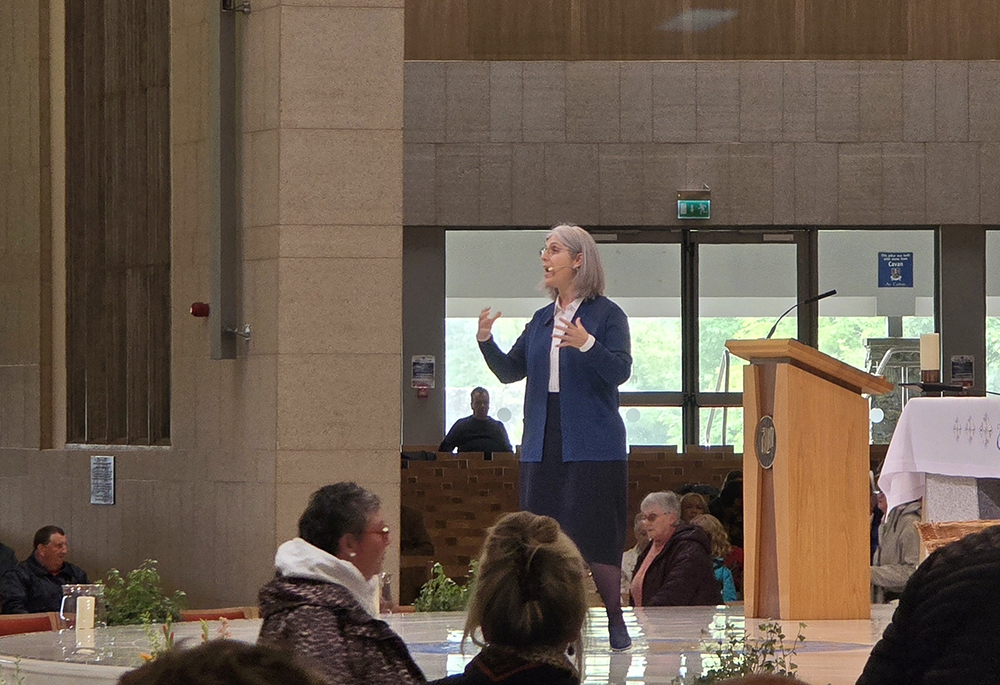
Sr Ângela de Fátima Coelho da Rocha addresses pilgrims at the All Ireland Rosary Rally 2026 and tells them about Fatima's call to promote peace in the world through praying the rosary and the First Saturday devotion. (Sarah Mac Donald)

by Sarah Mac Donald
Sr. Ângela de Fátima Coelho da Rocha is a Portuguese medical doctor and a Sister of the Aliança de Santa Maria (Alliance of Holy Mary). The congregation was founded in Portugal in 1966 and officially recognized by the church in 2002. The core of their charism is promoting the message of Fátima and, through it, personal holiness and evangelization, especially through the rosary.
Born in Porto, Portugal, in 1971, Coelho earned a degree in medicine from the University of Oporto before she entered the Alliance of Holy Mary in 1995 at age 24. In 2009, she was appointed postulator of the causes of Fátima visionaries, Sts. Francisco and Jacinta Marto. They were canonized by Pope Francis in 2017, the youngest non-martyred saints in church history. In 2014 she was appointed vice postulator for the cause of the third Fátima visionary, Sr. Lucia dos Santos.
An expert on the messages of Our Lady of Fátima, Coelho frequently gives lectures and retreats on the subject and on the child visionaries who first saw her on May 13, 1917. Her book, Inside the Light: Understanding the Message of Fatima was published in 2020. The 55-year-old is currently superior general of her order and also president of the Union of European Conferences of Major Superiors (UCESM), a network representing approximately 185,000 religious brothers, sisters and priests from 28 countries across Europe.
Global Sisters Report spoke with Coelho about the relevancy of Our Lady of Fátima, her work as a postulator for saints and the role women religious can play in the changing religious landscape of Europe.
GSR: Is Fátima's message still relevant today?
Coelho: I think Fátima is even more relevant today than it was when it happened, not only because of the question of wars and insecurity but also because of the relativization of faith in a self-centered and secularized society. So many aspects of this message connect with the most important problems of our societies and cultures. Fátima answers these problems of secularism with the cult of eucharistic adoration. For peace in the world, Fátima answers with the prayer of the rosary and First Saturday devotion.
Fátima also helps us to become aware that our life has a purpose, it has a meaning, which is to participate in the history of salvation and building peace in the world through our daily prayers and our little daily sacrifices that we can offer up.
From the beginning, the angel taught the children the prayers of adoration and the great call to adoration, that this is in itself the greatest call in order to prevent our world from destroying itself, not only with this egocentric self-centered mentality, but all the different threats that distract us from who is really the essential one: God.
Advertisement
Can you tell me a little about the Alliance of Holy Mary?
We are a religious congregation founded in Portugal and approved by the Archdiocese of Braga. We are sisters with vows and community life. As a religious congregation we were approved in 2002 by the Archdiocese of Braga but as a pious association of lay faithful, which was our first step, we were approved in 1979. We currently number 50 and continue to receive vocations mainly from Portugal but also from other Western countries. Our average age is less than 40.
How did you discover your vocation?
As a child I knew my vocation was to be a medical doctor and a sister. The idea of being a medical doctor was always with me. The idea of being a sister, not as much. I had some struggles. But through discernment, prayer and spiritual direction, especially when I was in the fifth year of medical school, I became totally sure that as soon as I finished my medical studies I would join the convent. I worked for 20 years as a medical doctor and as a sister. But right now I am not working as a doctor because I'm the general superior, so I just don't have the time.
How did you become vice postulator for the then Blesseds Jacinta and Francisco Marto and later postulator? They were canonized by Pope Francis on May 13, 2017.
My predecessor as vice postulator, Fr. Louis Kondor, a Divine Word Missionary, oversaw the process for many years and they were beatified in 2000. But he was getting older and then he became very ill. He died on Oct. 28, 2009. Before he died, the bishop of Fátima, [Bishop Antonio Marto] relieved Fr. Kondor of his postulator duties in view of his poor health. The bishop knew me and the charism of my order to evangelize through the message of Fátima. I was therefore familiar with the children's story and the bishop felt I could do this role, so he presented me as vice postulator in 2009. Then our Roman postulator, Fr. Paolo Molinari, SJ, who was getting older, also died and so my bishop asked Cardinal [Angelo] Amato if I could become the Roman postulator. I was appointed to this role in 2012.
What skills were important in the decision to choose you?
I think the main reason was the fact that I was immersed in the story of Fátima. It is my vocation as a member of Alliance of Holy Mary and our mission. That's what we do: We spread the message of Fátima by giving talks all around the world. I have traveled to the United States, Brazil, Colombia, Chile, Argentina, Philippines, and many countries in Europe to promote the message of Fátima.
Did you study theology and/or canon law in order to become a postulator?
I already had a degree in religious sciences; you need to have an ecclesiastic degree and the prefect of the dicastery needs to approve you. I also did a specific three-month formation program to become postulator in 2013. That course now takes a year. Part of the course was focused on the study of canon law for the causes of saints.
You are now the vice postulator of the cause of Sr. Lucia dos Santos, the third visionary and eldest of the three shepherd children. She became a Carmelite nun in 1925. You met her five times before she died on Feb. 13, 2005, at the age of 97.
I was nominated to this role in 2014. The postulator is Fr. Marco Chiesa OCD who is postulator general for the Discalced Carmelites and is based in Rome. So after my duties as general superior of the Alliance of Holy Mary, my main mission is to take care of Sr. Lucia's cause.
I met her five times. She could not speak about Fátima; the church had asked her not to speak about it, mainly about the secrets, so she was very discreet. The biggest impact she made on me, and this might surprise people, was that she was so normal. I was expecting a mystic-like attitude … in fact I don't know exactly what I was expecting but it was not such a down-to-earth normal person with a good sense of humor. At the same time, she was very faithful to her vocation, and you could see that.
You are president of Conferência dos Institutos Religiosos de Portugal, the Portuguese conference of religious men and women, and president of the Union of European Conferences of Religious Men and Women. What do you think is changing within the European context specifically for women religious?
I think the role of the woman within the church is becoming clearer. This is a change. We are being designated for roles with more responsibility. The church is taking steps with this synodal mentality which Pope Francis started. But it is a process that was already started by the Vatican Council and so it is not totally new. The path of synodality is the church becoming aware that there are some missions that women can take and if they can take, then why not? I think we are moving toward the essential, and the essential is Christ in our lives — in our lives in Christ.