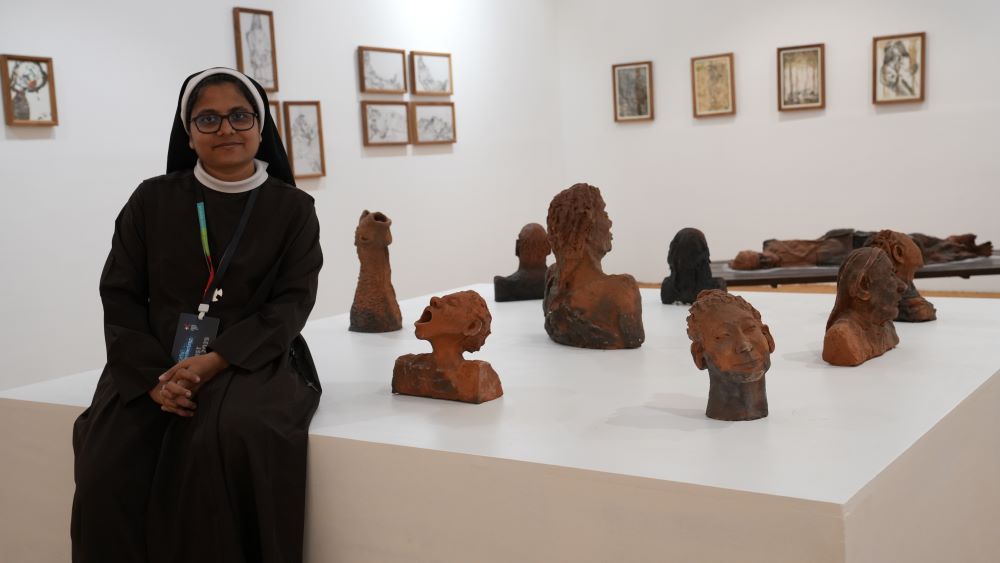
Sr. Roswin Joy, a member of the Congregation of the Mother Carmel, poses at the Kochi-Muziris Biennale pavilion in Kochi, Kerala, southwestern India. Her sculptures and drawings are on display at India's largest contemporary art exhibition featuring 66 artists from across the world. (Courtesy of Roswin Joy)
by George Kommattam
Sr. Roswin Joy, a member of the Angamaly province of the Congregation of the Mother of Carmel, was the first nun selected to participate in India's largest international exhibition of contemporary art. The event is held every two years, serving as a major platform for artists, curators and cultural dialogue.
Trained in sculpture and drawing, Roswin is among 66 artists from across the world featured in the Kochi-Muziris Biennale, running Dec. 12, 2025, to March 31, 2026, in Kochi, the commercial capital of Kerala, southwestern India.
The 35-year-old nun recently earned a bachelor's degree in fine arts and shared with Global Sisters Report how faith, formation and creative freedom come together within her vocation.
GSR: What are your thoughts about being the first Catholic nun artist at the Kochi-Muziris Biennale?
Roswin: It gives me immense joy and gratitude. It is a lifetime opportunity to connect with renowned artists from across the world and engage deeply with their works and creative processes. Every artist dreams of being in such an international contemporary art exhibition.
I am among the 10 Indian artists selected. For me, it is also humbling, as it allows my life as a nun to enter into dialogue with the global art community.
How did you get the chance? What did you gain from it?
In March 2025, I organized an art exhibition in my college, and the biennale curators visited, interacted with my work, and encouraged me to submit my portfolio. I sent it, and after two months, I was informed that I had been selected for the sixth edition of the Kochi-Muziris Biennale.
At the exhibition, I had the rare opportunity to engage with international artists, understanding their journeys, thought processes and artistic languages. Hearing others speak about my work helped me understand its depth and clarity. It gave me confidence, inspiration, and the joy of knowing that what I express through sculpture and drawing is truly communicated and received.
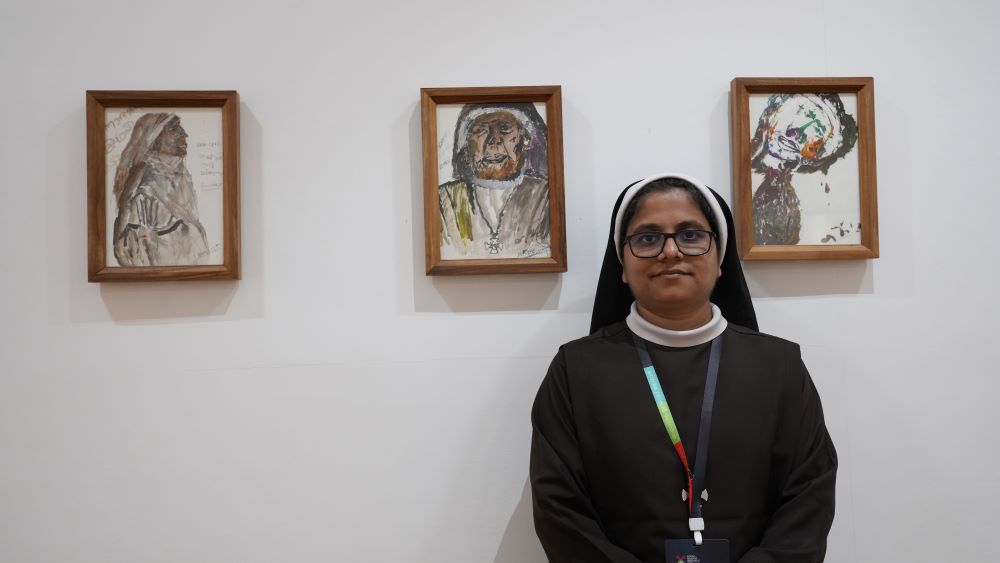
Sr. Roswin Joy, a member of the Congregation of the Mother Carmel, said the Kochi-Muziris Biennale "became a space where the language of my drawings and sculptures could be understood beyond cultural boundaries." (Courtesy of Roswin Joy)
One artist I met was Ghanaian Ibrahim Mahama, whose works I had seen online.
The biennale became a space where the language of my drawings and sculptures could be understood beyond cultural boundaries.
What was your focus at the exhibition?
Through my drawings and sculptures, I focused on the inner conflicts, emotions and moods of the human person. Rather than highlighting external beauty, my work pointed to the inner goodness of humans — their struggles, vulnerabilities, resilience, and capacity for adaptation and growth.
I sought to portray the human journey from within, allowing viewers to reflect on their emotions and experiences.
At the biennale, I exhibited 10 sculptures and 30 drawings, each inviting contemplation on the deeper layers of the human spirit and the quiet strength that shapes our inner lives.
How did you become an artist?
My father was an [innate] artist, and from childhood, I watched him decorate our home, gardens, and sculpt statues using clay and wood.
So, art came to me almost naturally, through observation and inheritance. Although my parents recognized my talent early on, it was only after I became a nun that my artistic abilities were truly nurtured.
How?
During the COVID-19 period, I had more time for reflection and creativity, and I began sculpting and painting more seriously.
My community members noticed this and informed the superiors, who later decided to send me to RLV Fine Arts College in Kochi. I think I may be the first nun to study there [so far].
I am deeply grateful to my superiors and community for recognizing my talent and supporting its growth.
What influences your artwork?
When I create sculptures or do drawings, I look inward — at emotions, inner conflicts, psychological states and human resilience.
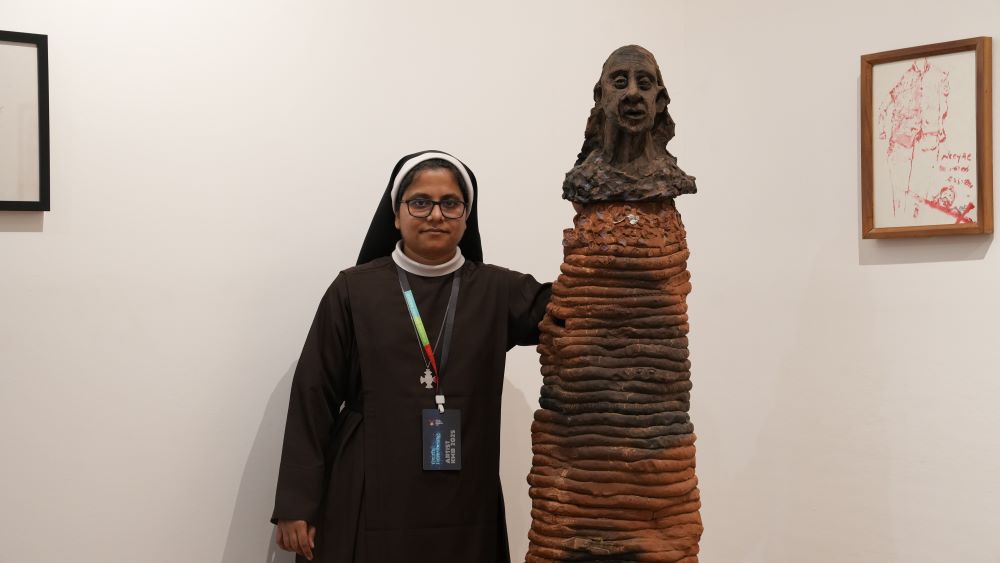
Drawings and sculpture by Sr. Roswin Joy, a member of the Congregation of the Mother Carmel, are among the work by 66 artists at the Kochi-Muziris Biennale. (Courtesy of Roswin Joy)
I have studied psychology, which helps me understand the inner struggles and growth of humans. My work's central theme is resilience: how a person overcomes challenges, grows in goodness and moves forward in life.
Does your identity as a Catholic nun influence your creativity?
Yes, very deeply. As a nun, I have the freedom and space for meditation, which strongly influences my creative process. When I encounter a visual idea, I reflect on it and connect it with prayer. Creativity flows from that contemplative space. Meditation helps me see more deeply, and art emerges as an extension of prayer.
What challenges do you face as both an artist and a nun?
As a nun, I experience a deep freedom that supports my artistic expression. The freedom of religious life and the freedom of art complement each other and help me focus on inner realities. However, challenges do exist — especially the need for long, uninterrupted periods of concentration to complete projects, which can sometimes conflict with community schedules.
That said, my community supports me fully. They adjust schedules and encourage me to complete my work, reminding me that my art itself is a form of prayer. Their understanding makes it possible for me to grow both spiritually and artistically.
How does your work help evangelization?
In a quiet but meaningful way, I believe. My sculptures and drawings focus on humans' inner beauty. As said earlier, these works emerge from meditation and prayer. They do not preach directly, but touch the inner life of the viewer.
Many visitors at the biennale told me that my work had spiritually awakened them. One person said, "I see my own face in your drawings and sculptures." That response touched me deeply. It showed me that the art reaches people at the soul level, helping them recognize their own emotions, struggles and hopes. Even some sisters who saw my work said, "This is me."
In that sense, my art expresses human and Gospel values — compassion, resilience, inner goodness and hope. It invites people to reflect on their own lives and find the strength to move forward. For me, this is a form of evangelization: revealing God's presence through the shared human experience.
Advertisement
Tell us about your family and why you chose to be a nun.
I come from a devout Catholic family of three daughters, including my twin sister. The sisters are married.
I was involved in parish life from childhood. My congregation managed my school at Chengal, Kalady, Kerala's Ernakulam district.
During my school years, I became curious about the life of priests and nuns and had a growing desire to know God more intimately. My mother's younger sister is a nun who helped me understand religious life better.
After the 10th grade, I attended a vocation camp that confirmed my inner calling. I joined the same congregation, drawn by its spirituality and mission. I made my first profession in 2013. Later, I completed a degree in sociology and a diploma in psychology. I am currently studying for a bachelor's in education to become a teacher.