(GSR graphic/Olivia Bardo)

by Thomas Scaria
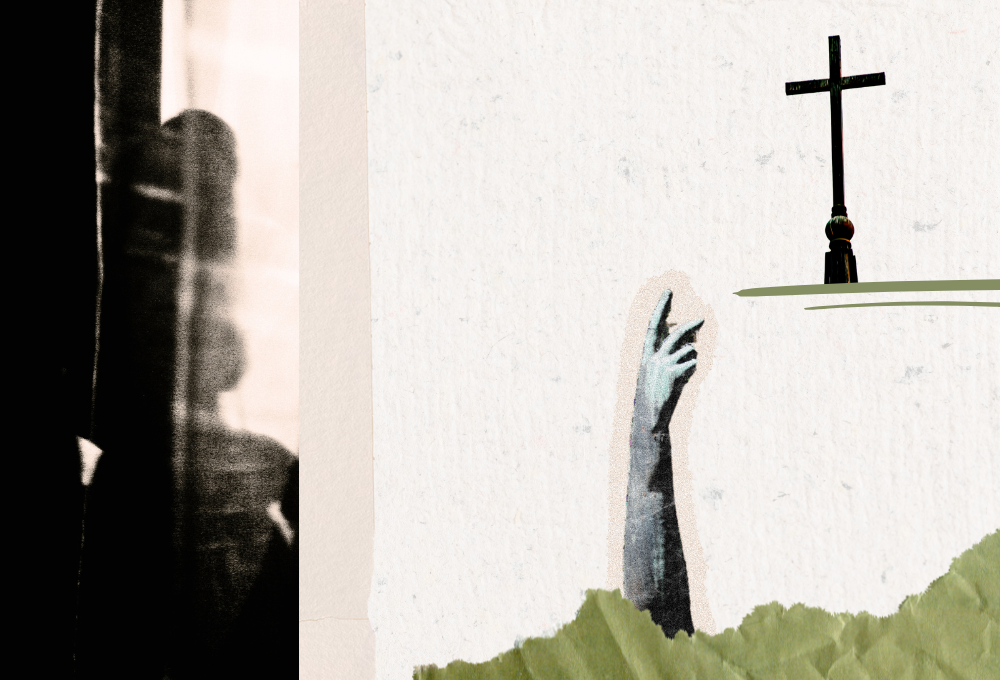
The Catholic Church in India has set up an exclusive mental health ministry amid increasing reports of suicide and depression among priests and nuns in the country.
"Unfortunately, the church's healing ministry was centered on physical health until recently. We had conveniently forgotten the mental wellness of our own workers," said Medical Mission Sr. Joan Chunkapura, the national secretary of the Association of Catholic Mental Health Ministers formed under the Catholic Bishops' Conference of India.
At least 25 nuns and 13 priests aged 30-50 have died by suicide in the past two decades due to depression, other mental health issues or sexual exploitation, suggesting a growing crisis, explained the 75-year-old nun who has played a key role in establishing the national network of mental health professionals.
She acknowledged that the Indian church has a sufficient number of mental health practitioners. "Instead of working in isolation, we needed a coordinated effort and a wider network," Chunkapura told Global Sisters Report.
The association organized a national conference Oct. 10-11 as part of the World Mental Health Day celebrations at Changanacherry, a town in the southwestern Indian state of Kerala.
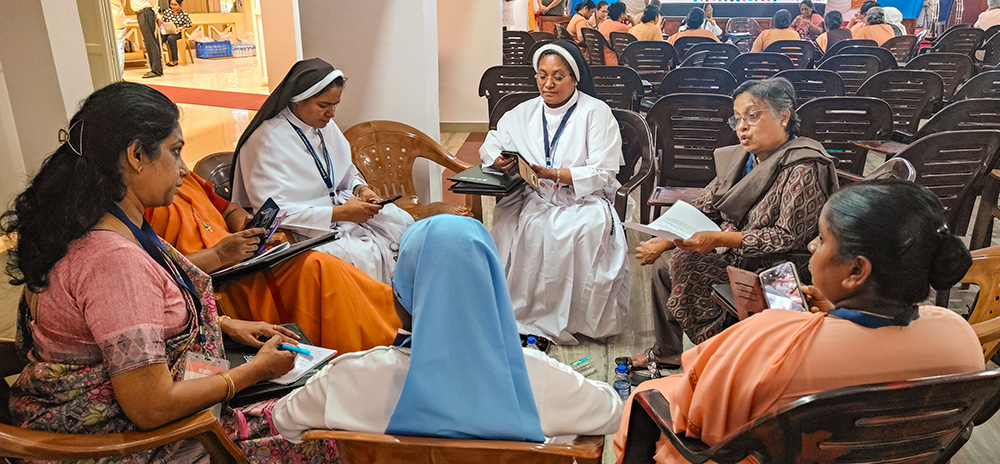
The participants discuss integration of mental health practices into various ministries in their regional groups during the Oct. 10-11, 2025, mental health conference at Changanacherry, a town in the southwestern Indian state of Kerala. (Thomas Scaria)
More than 200 Catholic mental health professionals, mostly nuns and priests, along with several bishops, attended the conference that sought ways to integrate wellness components into the church's every ministry, including religious formation.
Addressing the conference, association chairperson Archbishop Thomas Tharayil of Changanacherry said, "Our parishes should integrate mental health and wellness into all its pastoral ministries, if we have to build a vibrant church with hope."
The archbishop underscored mental health and spiritual health as inseparable. "But they are not the same, but two different entities leading to holistic mental wellness," he said.
Archbishop Lumen Monteiro, the chairman of the bishops' Office for Health Care, too acknowledged the need for integrating mental health and wellness into the church's healing ministry.
"We are not here for treatment, but accompanying people like a good shepherd," Monteiro said, adding, "Empathy and compassion are the best medicine for any illness, and real healing starts with mental wellness."
Advertisement
The Catholic Church in India has more than 3,500 health care institutions, with at least 80% of them in rural areas.
Bishop Alex Vadakumthala of Kannur, a former executive secretary of the bishops' commission for health care, said that the new ministry on mental health should collaborate with the existing health care network to integrate mental wellness into the church's healing services.
Chunkapura said St. Dymphna National Institute of Wellness, a therapeutic center for religious sisters in Bengaluru, southern India, is the association's initiative for training nuns.
Adorers of the Blood of Christ Sr. Jessie D'Souza, a psychologist and trainer, said she has addressed more than 270 nuns in three batches during September-October at the Dymphna Institute, named after the Irish saint and patron of mental illness.
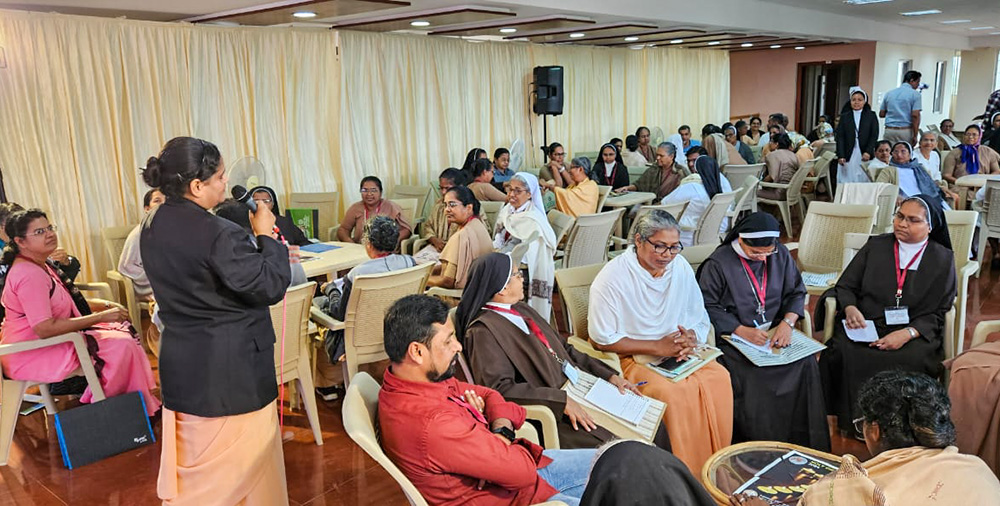
Mission Sisters of Ajmer Sr. Rani Augustine addresses a group of sisters on mental health as part of the Bengaluru-based St. Dymphna National Institute of Wellness programs for religious sisters. (Courtesy of Rani Augustine)
D'Souza, assistant director of the institute, said it conducts personal counseling using techniques such as art therapy, transnational analysis, cognitive behaviour therapy, and psycho-spiritual integration.
"We not only train them with a basic understanding of mental health and counseling skills, but heal their mental health issues," said D'Souza, who has observed post-traumatic stress disorders, depression and anxiety-related issues in several nuns.
D'Souza has conducted mental health workshops for the members of the Carmelite Sisters of St. Teresa, St. Joseph of Tarbes, Adores of the Blood of Christ, Apostolic Carmel, and the Congregation of the Sisters of St. Joseph.
"We do not single out anyone in a group, but deal with them collectively in training and individually in therapy."
Baptistine Sr. Sally John, a psychiatrist who manages "Treasure," a mental health network for women religious at Wardha in the western Indian state of Maharashtra, too takes classes at the Dymphna Institute.
"It is a good move for sisters like me to come under a larger umbrella," she told GSR.
At the national conference, John conducted a session on mental health and community support in religious life. She observed that at least 10% of India's more than 100,000 nuns have mental health issues, but social stigma restricts them from seeking help.
"For them, mental illness is a result of spiritual or moral failing and seeking help was understood as a sign of weakness. So, it is our duty to reach out to them," John added.
Mission Sisters of Ajmer Sr. Rani Augustine, a psychologist and the national director of outreach programs under the Dymphna Institute, has carried out mental health training and therapy sessions for more than 300 nuns, especially those working in education ministry.
Augustine, who is a teacher, warden and vice principal of the Sophia College at Ajmer in the northwestern Indian state of Rajasthan, said that most nuns managing schools or colleges face several threats from extremist religious groups. "Many sisters are mentally affected," she told GSR.
Observing that children too face stress because of fast-changing family systems, unhappy parents, and social media, Augustine said nun teachers at times double up as counselors.
"But before entering into the mental health services for others, we have to set our home in order," she said.
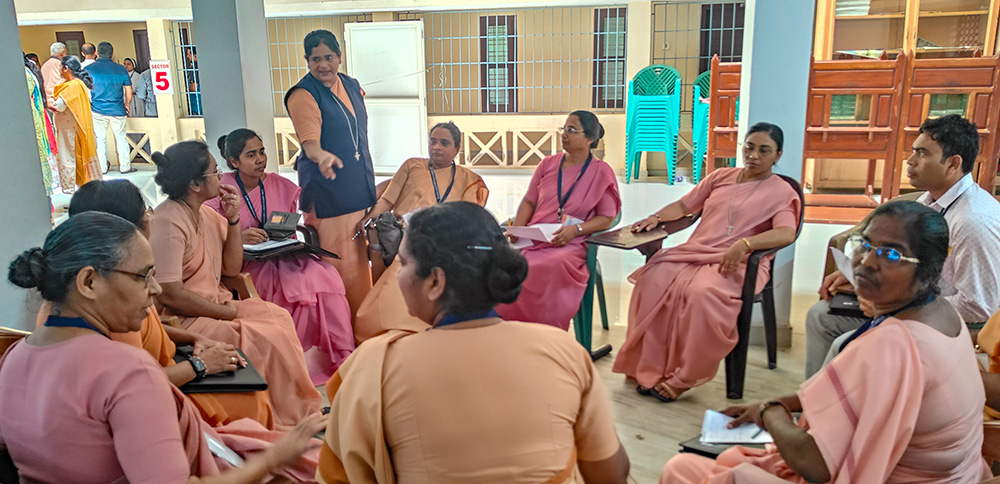
Nuns from various regions in India prepare action plans for local implementation during the mental health conference Oct. 10-11, 2025, at Changanacherry, a town in the southwestern Indian state of Kerala. (Thomas Scaria)
Tharayil applauded the Dymphna Institute's services but stressed the need for a similar center for priests and religious brothers serving the church.
In the past few years, Kerala witnessed six cases of suicide of young priests because of mental health problems.
"A priest listens to everyone's problems, but he has no one to listen to him," said Fr. Shinto Mathew, the president of the Association of Catholic Mental Health Ministers in India.
The member of the Order of the Discalced Carmelites told GSR that the health ministry will start a center to offer emotional support and training for the diocesan priests, religious priests and brothers in Kerala.
Deacon Ed Shoener, the president of the International Association of Catholic Mental Health Ministers, presented the organization's statutes that stressed promoting mental health among the church workers before reaching out to others.
He told GSR that the Indian network of mental health workers has grown faster than other countries and can provide a good example of how efficiently the network can be coordinated.
"The sisters play a crucial role in the mental health promotion in any country and they play a convincing role in India too," Shoener said.
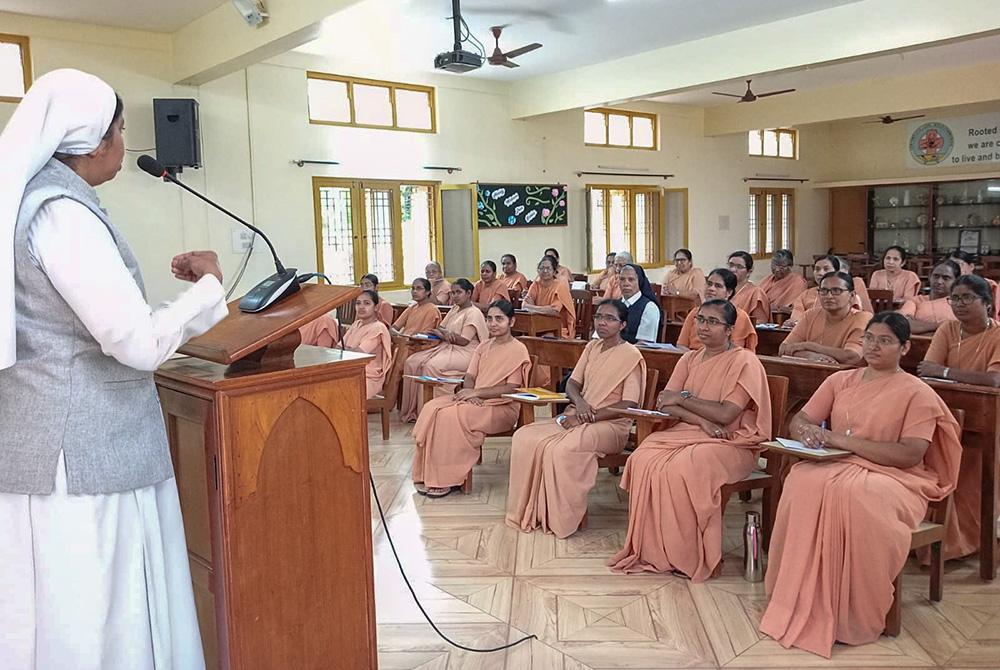
Adorers of the Blood of Christ Sr. Jessie D'Souza, a psychologist and trainer, addresses a group of sisters from St. Joseph of Tarbes on Oct. 11, 2025, at Mysuru, Karnataka state, India. (Courtesy of Jessie D'Souza)