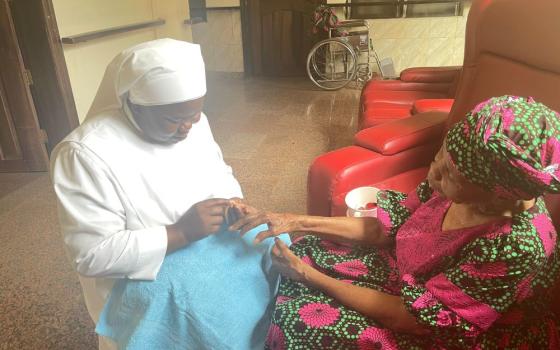
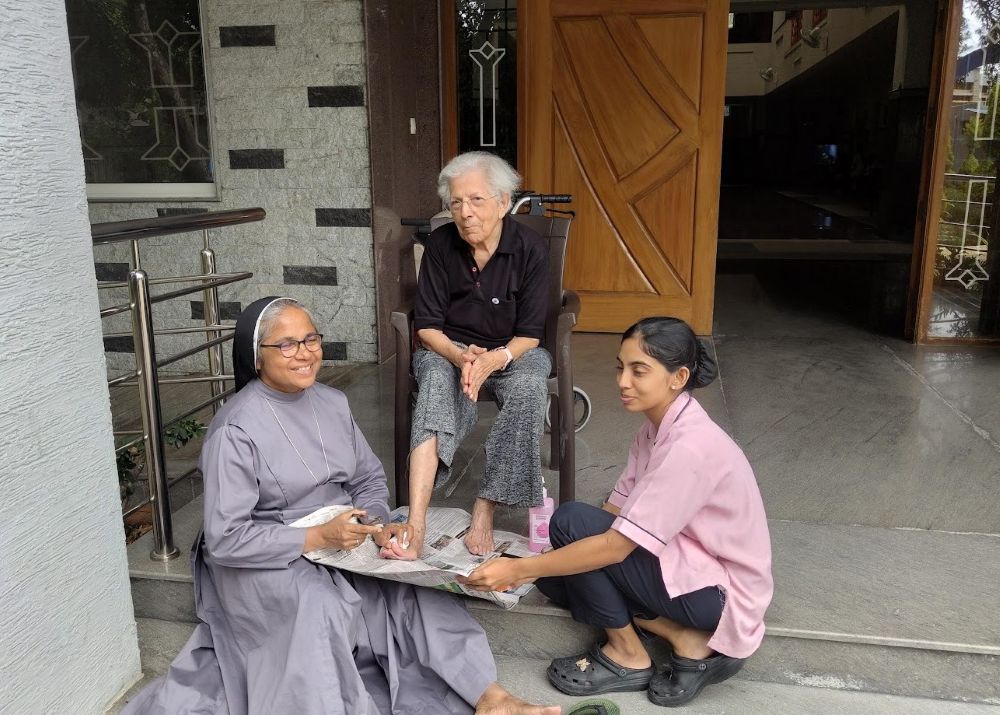
Sr. Suchita Kavumkal, a staff member at Elizabeth Care Home in Bengaluru, southern India, managed by the Augustinian Sisters, helps care for Jessie Pai, an 88-year-old resident. (George Kommattam)

by George Kommattam
Every morning, 88-year-old Jessi Pai waits for Augustinian nuns for coffee, exercise, quiz sessions and chat.
"I have a lot of fun with these sisters," Pai told Global Sisters Report in July.
Pai, an unmarried Christian, is among 52 elderly laypeople living with 11 retired Augustinian nuns at Elizabeth Care Home in Thaverekere, a suburb of Bengaluru, capital of the southern Indian state of Karnataka.
Sr. Prema Packumala, the home's administrator, said her congregation created a community where elderly nuns and laypeople enrich each other, instead of operating separate facilities.
Pai said the arrangement has turned her old age into a life filled with friendship and purpose.
"It is like my own home. We can talk and share whatever we want with the sisters," she said as Sr. Suchita Kavumkal, who attends to the residents, gave her a pedicure.
The laypeople occupy the lower three floors of the four-story building while the nuns live on the top. Their days naturally overlap in prayer, conversation and quiet moments of companionship, Packumala said.
Elizabeth Home is the only one of three eldercare centers the Augustinian Sisters operate in Bengaluru that accommodates both sisters and laypeople, the administrator said.
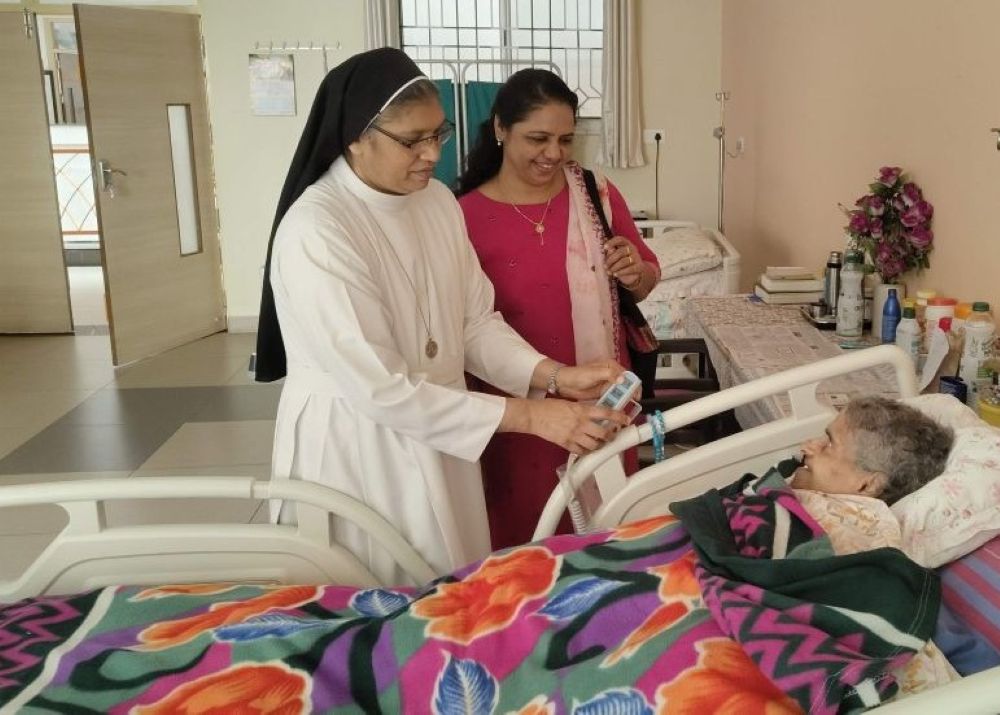
Sr. Roseline Koonthanishiriyil, coordinator of the retired sisters' community at Elizabeth Care Home in Bengaluru, southern India, cares for a bedridden sister as a visitor looks on. (George Kommattam)
"Our old-age homes are always full," said Packumala, who was formerly the congregation's superior general. "The demand is higher, and we are unable to admit any more."
Sr. Arpana Patani, a former provincial councilor of the congregation, said the biggest obstacles to opening more eldercare homes are the high cost of establishing a new facility, limited land, a shortage of sisters to run such centers, and the increasing staffing and medical resources required to care for elderly people.
She said the demand is also rising because many families can no longer care for their elderly parents at home. "With both husband and wife working, smaller families, and children living abroad or in other cities, many older people are left without full-time caregivers," she said.
While the government supports homes for destitute and abandoned senior citizens through government-funded and NGO-run institutions, such facilities are limited and cannot meet the growing demand, she said.
The congregation's nearby Cletas Home, opened in 1992, houses 127 elderly people. As more residents required medical and palliative care, they built Elizabeth Home in 2020 and transferred medically dependent residents there. Each resident gets a separate room.
"It was to care for elderly nuns and elderly people together," said Packumala. "We realized such an arrangement would help everyone have each other's company."
Pai said the sisters come to their rooms and share their feelings. "We celebrate life and suffering together," she said.
The elderly nuns find the arrangement equally enriching.
"Our pain goes away when we interact with the elderly downstairs. We are beneficial to each other," said 81-year-old Sr. Daisy Punnackapadavil, who had served as a nurse for decades.
She said retirement has opened a different kind of ministry.
"A smile or a small conversation makes both of us happy," Punnackapadavil told GSR.
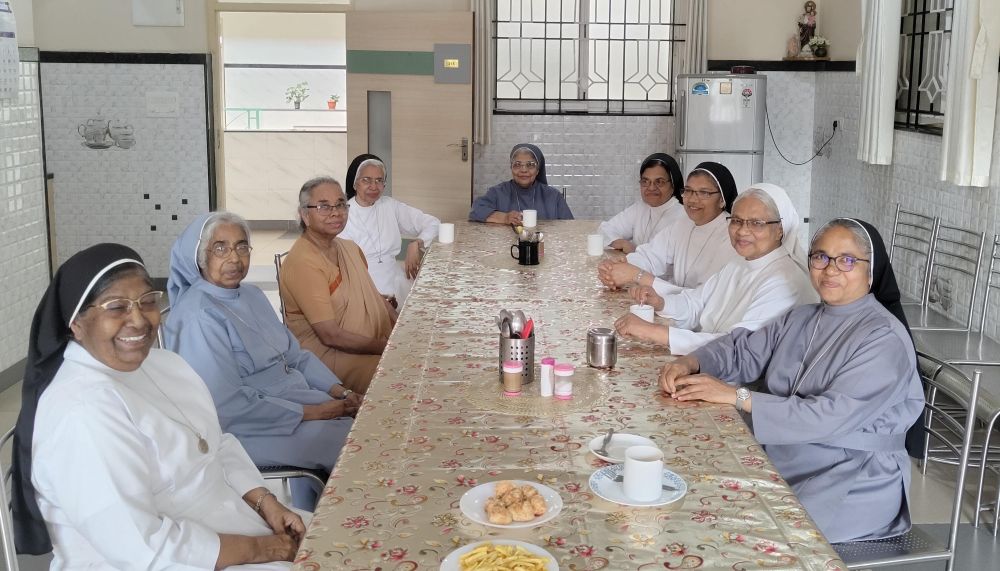
Members of the retired sisters' community pose for a photo in the dining room at Elizabeth Care Home in Bengaluru, southern India. (George Kommattam)
Her companion, Sr. Philippine Munduvelil, 80, said the unique community has lifted one of old age's greatest burdens.
"There is no loneliness. When we see others, we are happy. We take part in all programs. We are all children of God."
Retirement has not ended the elderly nuns' ministries, said Sr. Stella Kanjiramkalayil, a former nurse who helps with meals, accompanies residents to physiotherapy sessions and pushes wheelchairs whenever needed.
"I help wherever I can," the 80-year-old nun said. "We are all happy helping each other."
Retirement, Packumala said, should not mean withdrawing from ministry or community life.
"Our presence gives courage to the elderly people," she said. "At the same time, their presence keeps our retired sisters active, joyful and connected."
The nuns' care has left a lasting impression on Padma Vijayanath, an 80-year-old Hindu woman who came to Elizabeth Home after her husband died eight years ago.
"I have one daughter at home," she said. "Here I have many sisters."
Thresiakuttymm Elappumkal, a 91-year-old retired teacher, moved into Elizabeth Home after her children decided she should not live alone. Her daughter lives in Canada, while her son works in Bengaluru.
"When I came here, my plan was to return home when my daughter came back from Canada," she said. "Now I think twice before leaving this place."
She credits that change to the relationships she has formed with nuns, besides the care received at the center.
"Here I have everybody. Who can give all this at home, even with a home nurse?"
Packumala says the retired teacher's experience reflects the vision behind Elizabeth Home.
"We wanted a place where elderly people would not simply receive medical care. They also needed relationships. Many elderly people today have someone to feed them or give medicines, but they have no one to listen to them."
The home has also earned the trust of families.
Isaac Francis, a Protestant physician living in the United States, said his family visited several eldercare institutions before admitting his mother to Elizabeth Home.
"After interacting with the nuns, my mother told my brother, 'I am going to live only here,' " Francis said.
He said the nuns offered something no modern facility could guarantee.
"There may be places with more comforts, but money cannot provide genuine care all the time," he said. "These sisters are exceptional. They know every resident by name. Their patience and care are genuine. They look after everyone equally. There are no restrictions based on religion."
The experiment, however, has not been without challenges.
Sr. Jacobine Pullankavumkal, among the congregation's earliest Indian members, enjoys spending time with the residents but admits that living alongside a medical care unit has its drawbacks.
"Sometimes the noises from the medical unit disturb us," the 80-year-old nun said. "Personally, I feel it would be better if retired sisters had a separate home."
Advertisement
Packumala said she understands the concern.
Caring for medically dependent residents means alarms, emergency calls and constant activity throughout the day, she said.
"I sometimes wonder whether our sisters get enough silence for prayer and rest," she said.
Even so, she believes the benefits far outweigh the inconveniences.
"The elderly receive positive energy from the sisters," she said.
That conviction is rooted in the congregation's history.
The Augustinian Sisters, formally known as the Cellitinnen Augustinian Sisters, were founded in Cologne, Germany, in 1838 to care for people with mental illness, people with disabilities and others living on the margins of society.
Their Indian mission began in Kerala, Karnataka's southwestern neighbor state, in 1967, and today serves 10 states through hospitals, schools, rehabilitation centers, eldercare homes and social outreach programs, Packumala said.
Their guiding principle, she added, is to respond to "the signs of the time."
For the congregation, India's rapidly growing elderly population has become one such sign.
Every morning, that vision quietly comes alive outside Pai's room.
After visiting her sister, Amy Lobo, 97, who lives in another room, she spends the rest of the day with "my nuns."
"We are a blessing for each other," Pai said.