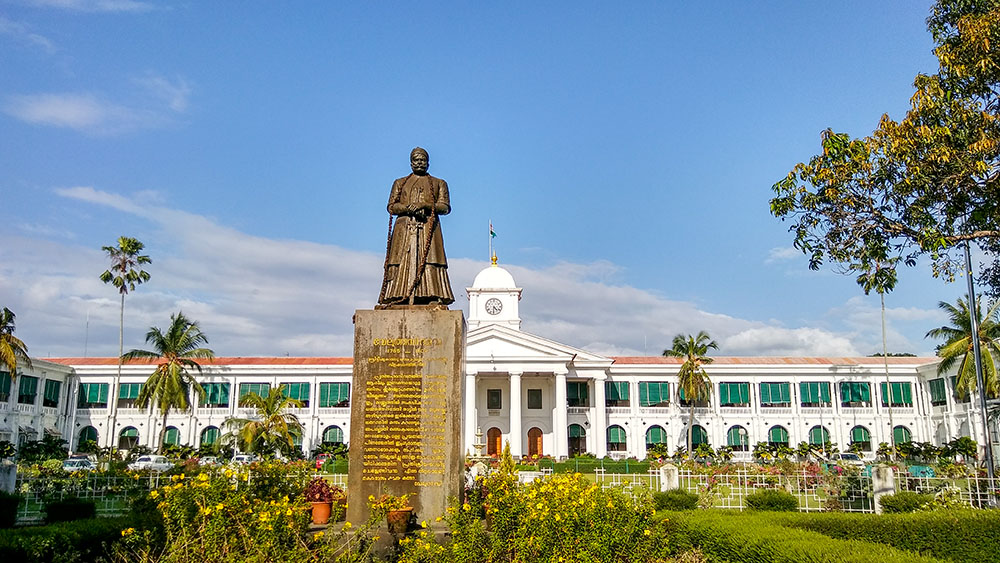
The Kerala Government Secretariat in the Indian state's capital city, Thiruvananthapuram. The Kerala government has decided to allow pensions for unmarried women above the age of 50, including those living in religious institutions. (Wikimedia Commons/Syed Shiyaz Mirza)

by George Kommattam
A southwestern Indian state's decision to extend social security pensions to unmarried women above the age of 50, including those living in religious institutions, has sparked a debate in the church.
While some say the Kerala government move has set an important precedent in India, others dismiss it as a political stunt.
Access to pensions for sisters "is long overdue. It is not a special privilege but a rightful entitlement for any unmarried woman who meets the criteria," said Sr. Ardra Kuzhinapurathu, the first woman to head the Kerala unit of the Conference of Religious India, an association of religious priests, brothers and nuns.
"As a nun, I welcome the government decision," Kuzhinapurathu, a member of the Sisters of the Imitation of Christ, told GSR.
The Kerala cabinet on Jan. 28 decided to remove the requirement of documentation that prevents women in faith-based institutions such as convents, monasteries and ashrams from accessing state welfare benefits.
A government order in 2001 had demanded women provide income and unmarried status certificates to receive government welfare programs. The Jan. 28 move puts women with no salary, pension or other government aid into a special category.
The Kerala decision could set an important precedent at national level, said Apostolic Carmel Sr. Maria Nirmalini, who heads India's more than 103,000 Catholic nuns as the president of the Conference of Religious India's women wing.
"I welcome the Kerala decision not just for religious women, but for all women. I really hope this is the beginning, and that other states will follow, especially where there is no such provision," Nirmalini told Global Sisters Report.
Advertisement
However, Capuchin Fr. Suresh Mathew, president of the Indian Catholic Press Association, said women religious should examine carefully the implications of accepting state pensions.
"This is a trap, and women religious must reject it," said Mathew, arguing that one should not view the government move merely as a welfare measure. "If you welcome or accept it, you are contradicting yourself. Such policies could weaken the church's long-standing position regarding institutional responsibility and state accountability for social welfare."
Kerala is scheduled to elect its state legislative assembly for five years before May.
Kerala accounts for more than one-third of India's Catholic women religious, many serving in education, health care and social ministries without fixed salaries or retirement benefits. While congregations often provide internal support, long-term financial security remains uncertain, particularly for elderly nuns and those serving in remote or marginalized settings, Kuzhinapurathu said.
However, the success of the government move will depend on how it is implemented.
"What truly matters now is fair, transparent and timely implementation. Announcements must translate into concrete and practical steps," she added.
Kuzhinapurathu also pointed to a deeper issue of exclusion religious persons face.
"Religious women have often been denied their rights as citizens because of their committed way of life," she said. "Even basic entitlements such as ration cards became accessible only in recent times."
Meanwhile, the Kerala Catholic Bishops' Council's Jagratha (Awareness) Commission has underscored the need for inclusive welfare steps to reach women in nontraditional living arrangements, including religious.
However, Irinjalakuda Bishop Pauly Kannookadan, chairman of the Kerala bishops' Commission for Religious, said he would comment on the matter after "properly evaluating the provisions."