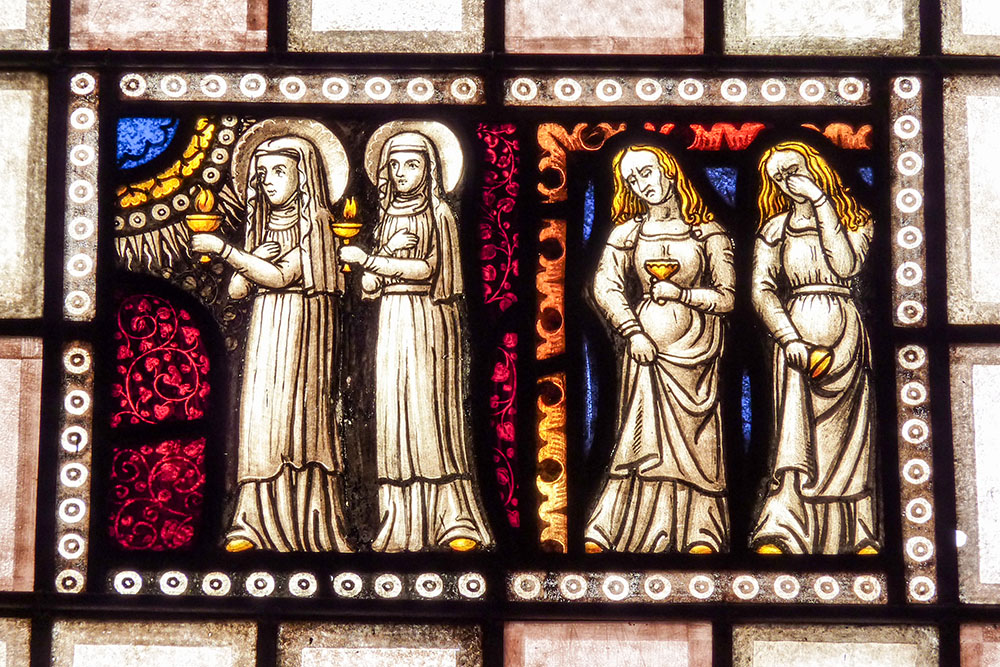
The wise and the foolish virgins from Jesus' parable are depicted in stained glass at the Church of St. Ägidius in Oberdrees, Germany. (Wikimedia Commons/Reinhardhauke)

by Sr. Sarah Kohles
Editor's note: Welcome to Theologians' Corner, where each week a different woman theologian from around the world offers a fresh reflection on the Sunday readings.

32nd Sunday in Ordinary Time
November 8, 2026
As we near the end of a liturgical year, the Gospel of Matthew encourages us to reflect on what it means to be wise and what it means to be foolish. Wisdom and foolishness are presented as an either/or dichotomy for the purpose of encouraging us to make a wise decision. Of course, we all want to be wise. However, like all dichotomies, real life doesn't always fit into one of two clear categories.
I know that I can be both wise and foolish within a span of 10 minutes. So, wisdom and foolishness can coexist in the same individual.
This parable of the wise and foolish virgins, like so many of Jesus' parables, is startling. Every child has been taught the importance of sharing. Yet, here Jesus advocates against sharing! Naturally, this raises questions:
- Why don't these women share their resources with the others?
- Is Jesus suggesting we should be selfish?
- What does it mean to be watchful and ready?
The story takes place in the context of a wedding celebration. What young women waiting at the bridegroom's house would be unknown to the bridegroom? The women are likely members of his family. How can he say he does not know them? Could they be young women known to the bride instead? Is it their lack of readiness that makes these women unknown?
The call to stay awake and be prepared is clear; the need to have enough fuel to keep our lamps lit seems essential. The purpose of a lamp is to provide light in the darkness. The light of the lamp prevents stumbling and helps us to find our way even in the darkest times.
What are we waiting for? Why do we need to be prepared?
Immediately preceding this passage in Matthew's Gospel, Jesus prepares the disciples to hear that a lot of things will happen before the Son of Man comes (24:29) and that there will be signs that the Son of Man is indeed coming — including the sun darkening and the moon ceasing to shine. No one knows the day or the hour in which the Son of Man will return — not even Jesus (24:36). Jesus also tells a parable about the prudent servant — who is behaving rightly when the master returns and the one who is not (24:45-51).
Advertisement
The parable of the wise and foolish maidens is one of many focused on anticipating the return of Jesus and encouraging the kind of preparedness that will soon carry us into the Advent season.
Just as we long for the coming of Jesus again, we also look forward to the kingdom of heaven being fully realized. The kingdom of heaven is mentioned 32 times in Matthew's Gospel. The followers of Jesus are encouraged to repent to prepare for the kingdom of heaven, but what can they expect?
In Matthew's Gospel, Jesus tells us what to expect in parables (13:44-46), in his comments about children (18:1-3), and in the Beatitudes (5:3-12). He upends our expectations regarding who is invited and how they are treated (22:1-14) He tells us there's a grand sorting involved — whether it is seed and weeds (13:24-30) or fish (13:47-50).
This sorting into wise and foolish, good and bad, is supposed to help people make good decisions. It sets up distinctions between behavior that is preferred and obviously undesirable action. The stark choices offered to Jesus' followers are supposed to persuade us regarding how we should act in the world, too.
Since one of the characteristics of the kingdom of heaven is to upend our expectations, let's invite such an unexpected reading of the wise and foolish maidens.
It seems that the church gives us a Gospel reading on wisdom and foolishness the first Sunday after the United States' midterm election. There will, no doubt, be many examples of wisdom and foolishness in the coming days and months as the country, and perhaps the world, grapples with the election results.
In this context, in light of this Gospel reading we might ask:
- What helps us to see clearly?
- What gets in the way and prevents us from seeing clearly?
- What actions would Jesus praise?
- What behaviors are utterly unrecognizable to Jesus?
- Do we have enough fuel no matter how long the wait?