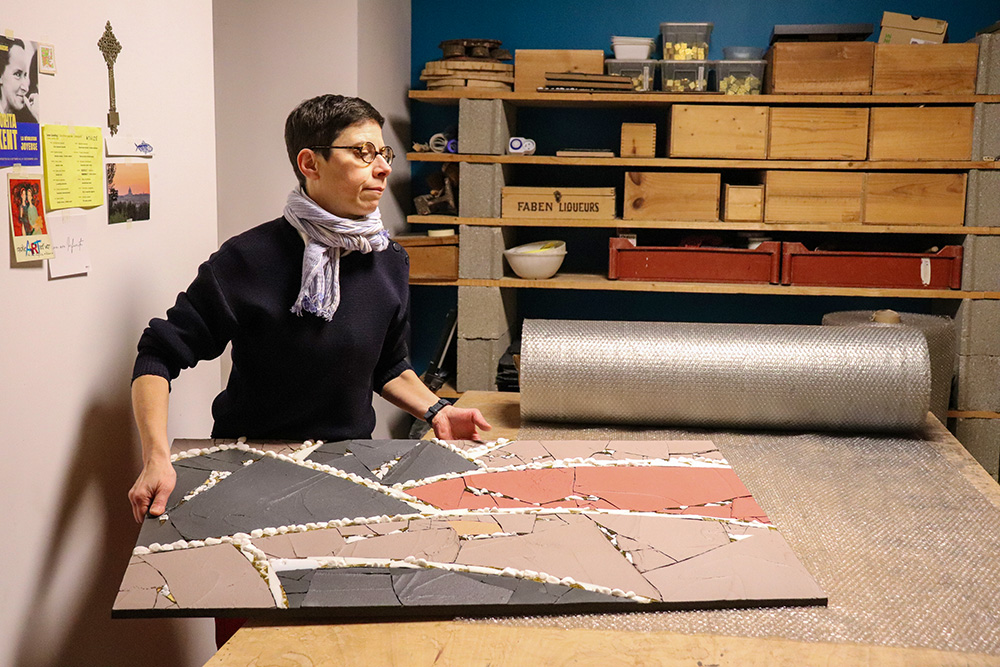
Mosaic artist Sister Samuelle in her workshop in France. Samuelle, who accused disgraced priest artist Marko Rupnik of abuse, is now a hermit and the creative lead on "Rebirth," a monumental mosaic dedicated to the victims of spiritual and sexual abuse in the church. (Courtesy of "Rebirth: The Tesserae Symphony")

by Sarah Mac Donald
A major new artwork dedicated to the victims of spiritual and sexual abuse in the church is to be displayed at locations where disgraced priest artist Marko Rupnik's mosaics are still exhibited.
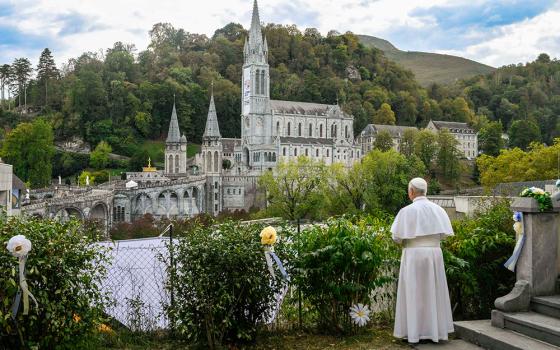
Rupnik, a former Jesuit, is accused of sexual, spiritual and psychological abuse by more than 20 women, including a number of nuns. His work adorns high-profile sanctuaries in Lourdes in France, Fátima in Portugal, Our Lady of Aparecida in Brazil, the St. John Paul II National Shrine in Washington, D.C., the Sanctuary of St. John Paul II in Kraków, Poland, and the Vatican.
"Rebirth" is a monumental mosaic measuring 12.5 meters by 4 meters. It was designed by French artist Sister Samuelle, who alleges Rupnik abused her. Between 2008 and 2014, Samuelle lived at Centro Aletti, which Rupnik established in Rome to bring artistic creativity and religious life together. Samuelle was one of three women who went public in 2023 and 2024 revealing Rupnik's abuse.
For Samuelle, "Rebirth" offers a counternarrative to the abuse she and other survivors suffered. It is a "monument to the living" and an act of restoration. It aims to help survivors "piece the fragments back together and give them a new face: the face of a new life, or at least a life that can still be lived." It is contemporary sacred art at the service of survivors to transform their suffering into rebirth or resurrection.
On the back of each piece of the mosaic are prayers, names and messages from survivors and those who assist survivors of abuse in different countries around the world.
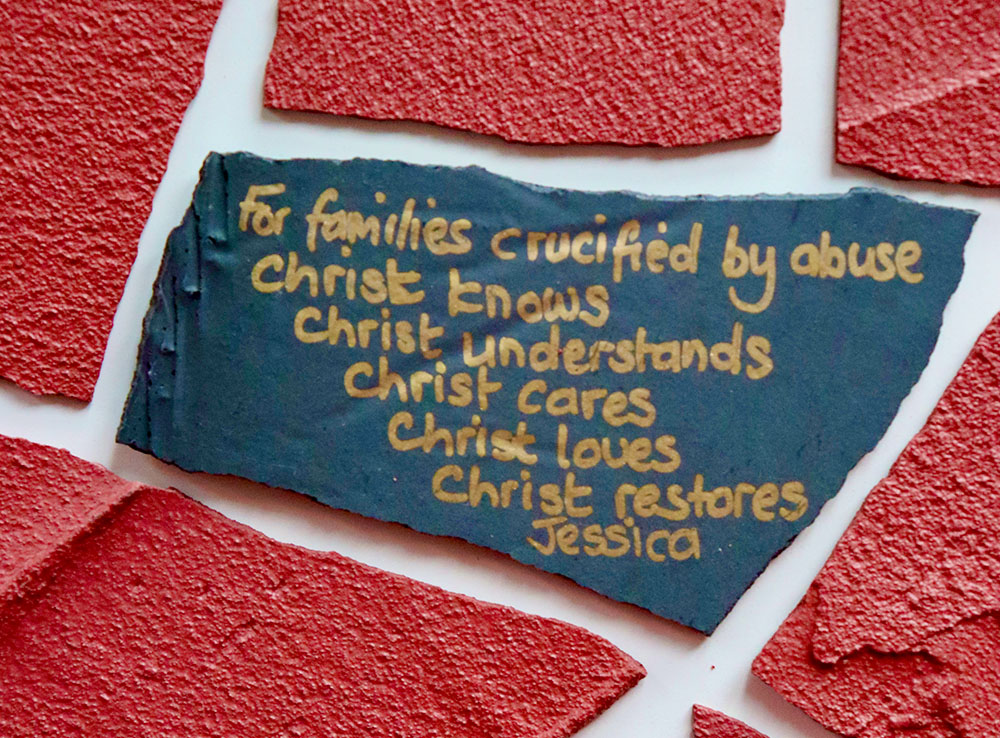
An example of one of the messages of solidarity from a survivor of abuse or someone who has accompanied a survivor on their journey. The messages will be incorporated into the reverse side of the "Rebirth" mosaic. (Courtesy of "Rebirth: The Tesserae Symphony")
The "Rebirth" project came about after a meeting between Samuelle and French film director Quentin Delcourt to discuss her experiences with Rupnik.
"It was an encounter between two universes that are totally opposite — a filmmaker and an abused hermit nun," Delcourt told Global Sisters Report. "We managed to create an artwork focused on the rehabilitation of survivors and which people will be able to learn about in 200 places around the world."
In an interview recorded by Delcourt for his documentary film, Samuelle explained, "Having been a victim — subjected to control and abuse in silence, fear and shame — having been a survivor — working to rebuild and reunify what was shattered and broken apart — it is now time to be reborn. 'Rebirth' is a moment which is now open to life, where one can live, not in spite of but through wounds that remain present. For Christians, it also evokes the Resurrection, where the living Christ is recognized by his loved ones through the wounds of his body — the very ones that caused his death."
Delcourt said that Samuelle's design symbolizes "a person that has been a victim of abuse, which has been broken, and starts to reconnect all the pieces, to stand up and access rebirth." She told Delcourt it represents dry ground that little by little finds its beauty again, finds its way of breathing, its way of living.
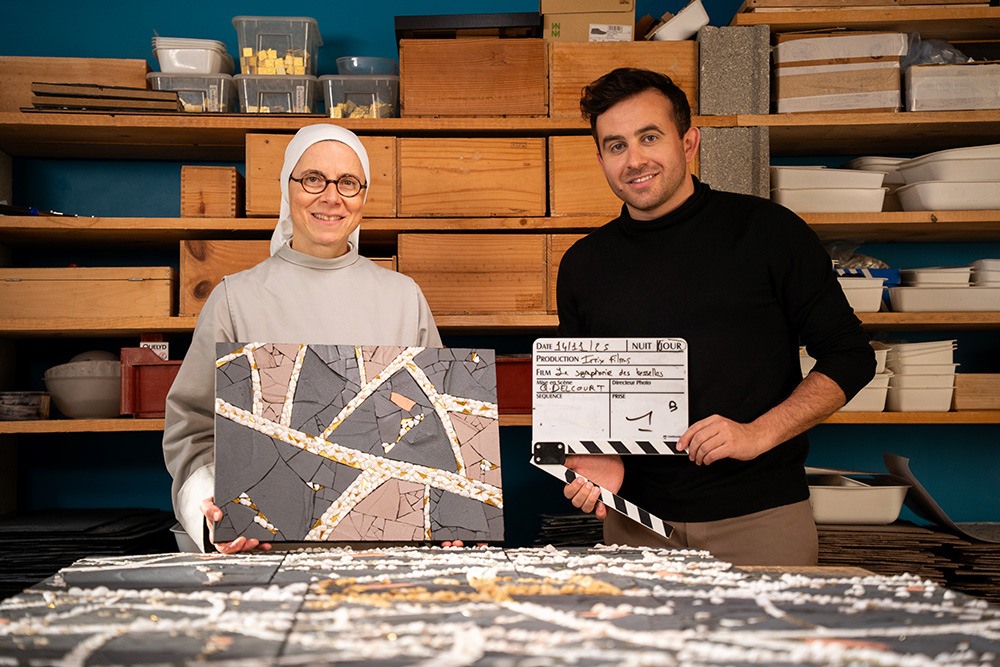
French mosaic artist Sister Samuelle with French film director Quentin Delcourt (Courtesy of Antoine Menard)
In the documentary, Samuelle talks about how "Rebirth" allowed her to forge a new path beyond the shadow of Rupnik.
"I feel like I've moved on, I'm less focused on this story of Rupnik's mosaic," she said. "The 'Rebirth' project allowed me to talk about it from another perspective."
Formerly a member of a religious community, in the wake of Rupnik's abuse Samuelle became a hermit.
"Today, I am a hermit. That doesn't mean I live in a cave in the woods where a bear brings me a picnic basket," she said in the documentary. "It means that I lead a religious life; I am a sister, but without belonging to a congregation. All the traumas I experienced prevented me from living in a religious community for psychological reasons."
The "Rebirth" project has so far sent thousands* of tesserae, or mosaic tiles, to survivors of abuse around the world to allow them to inscribe a message on the back. Others have been sent to those advocating on behalf of survivors or offering help and rehabilitation through counseling, legal services or telling their stories.
As they are returned to Samuelle, she and other nuns incorporate them into the mosaic's design. The tesserae are inscribed in languages like Vietnamese or Italian and may end up in a fragment of "Rebirth" exhibited in Belgium, Great Britain, Quebec or Togo. The overall mosaic is due to be completed by early summer.
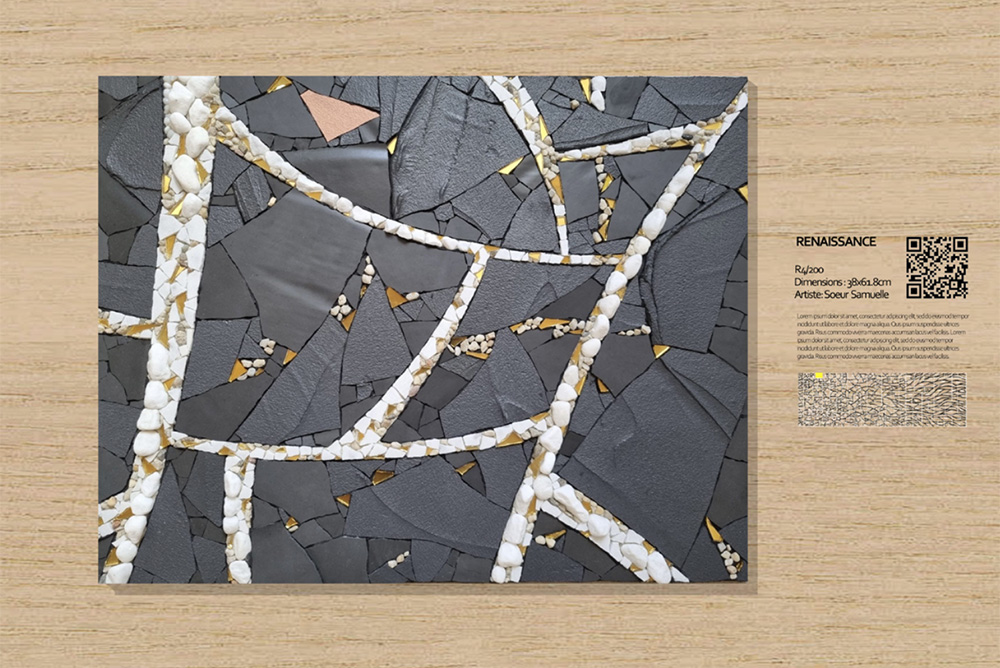
An example of one of the 200 fragments that the overall mosaic will be broken into and sent to locations around the world, notably to those shrines where Marko Rupnik's works remain on display (Courtesy of "Rebirth: The Tesserae Symphony")
It will then be divided into 200 pieces — "breaking the silence" — that will then be sent to exhibition locations associated with Rupnik's work and other venues suggested by survivors. A QR code will allow viewers to see the complete work and locate each fragment at its final destination.
The mosaic is part of a multidisciplinary project coming to fruition under Delcourt's guidance. The project also includes a feature documentary film, "The Tesserae Symphony," directed by Delcourt, as well as a specially commissioned music score composed by Baptiste Capitanio, and a book, Behind the Tesserae, that will accompany the film's release.
Delcourt, a 35 year old acclaimed screenwriter, producer and film director, is co-founder of the annual Festival Plurielles, which celebrates women and inclusion in contemporary cinema. In July 2023, he was introduced to Samuelle by a colleague who "knew I liked my films to focus on women and empowerment," Delcourt said.
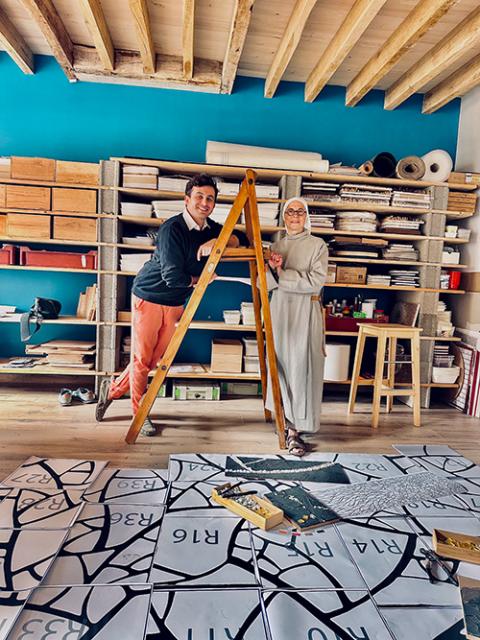
Quentin Delcourt with Sister Samuelle in her workshop in France (Courtesy of "Rebirth: The Tesserae Symphony")
"I went to her Atelier and the first thing I saw was her artwork, and I fell in love with it. Then we sat down and started to talk. I had read about her in the newspapers but it's not the same when someone tells you their story of abuse face to face."
Over a period of a year and a half they remained in contact, during which time Delcourt continued his other film work and also made contact with other nuns and ex-religious who had experienced abuse.
"They were from Italy, Spain, England, Vietnam, and we also have the voice of the nuns in Africa as well," he said. "One witness recalled opening a door in Africa and finding a priest raping a child and the priest said, 'Please close the door.' Unfortunately, we know that it will take so long for those countries to deal with abuse. That is why we are trying to put some fragments of the mosaic in churches in Asia, Africa and South America."
Delcourt's film is not an investigation into clerical abusers; rather, it recounts the coming to fruition of the "very first major art project about abuse and survivors reclaiming their voices through art." The film includes the stories of a number of nuns who were abused.
"I met dozens and dozens of nuns," he said. "While Sister Samuelle has made most of the mosaic by herself, there are moments when some of the nuns whose testimonies we collected collaborate with her on the mosaic. It was very important for me to show that the nuns are real women — engineers, artists and teachers who have dedicated their lives to God. The film will only be 90 minutes. The book will be for those who want to dig a little bit more about abuse."
Advertisement
At the heart of this multifaceted art project is a respect for faith, because, as Delcourt explains, "faith is not the question and will never be the problem for a victim. Faith is an arm for the aggressor. God has nothing to do with abuse and God should never be used as a weapon to destroy people who believe in him or the woman who decides to dedicate their life to him."
Rupnik, in Delcourt's opinion, "used" art to create a space for abuse.
While many have called for Rupnik's art to be covered or removed, Delcourt admits he is "not a fan of cancel culture" because "destroying or removing Rupnik's work would allow us to forget."
"A mosaic is a collective work of art and the victims are in that art piece," he said. "Removing it because of an aggressor also removes the existence of the victims. Let's answer the art of rape with the art of reparation. Let's give Sister Samuelle the opportunity to bring her voice and the voices of thousands of victims around the world directly to the same places as the aggressors."
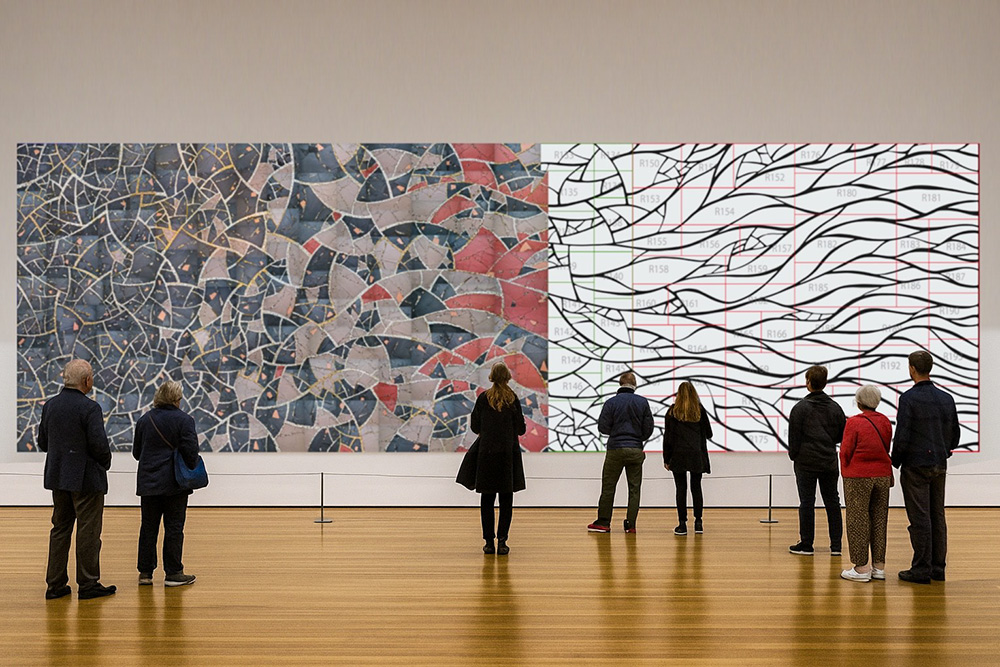
The half completed monumental "Rebirth" mosaic (Courtesy of "Rebirth: The Tesserae Symphony")
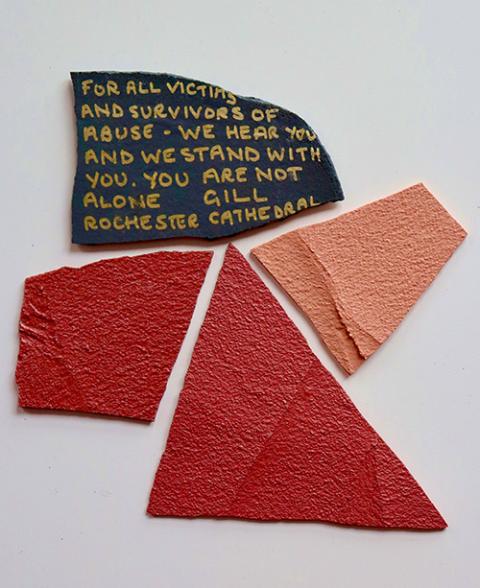
An example of a message of solidarity that will be incorporated into the mosaic (Courtesy of "Rebirth: The Tesserae Symphony")
So far, over half the "Rebirth" mosaic has been created, measuring more than 25 meters square.
"The pieces get bigger through the evolution of the mosaic in the same way as a victim gets stronger," said Delcourt. "At the same time, the mosaic is becoming more colorful as it evolves so it is visually like a movement towards rebirth. With more color, there is more joy."
Delcourt hopes he can interest Pope Leo XIV in this initiative so as to open up the possibility of sending fragments from the completed mosaic to countries where abuse remains shrouded in silence. The filmmaker also has a fundraising campaign to help defray the project costs, which he personally has covered up to now.
"We did not ask for any money from the church for the creation of the mosaic. When I got the idea in December 2024, I felt that if we pitched the project on paper, people would not believe it or understand it. It would have seemed like a crazy idea," he said. "I knew from the beginning that people needed to see something concrete, which is why I put my own money into it so that Sister Samuelle could draw and get materials and I could start filming because if you film a documentary about the making of a mosaic, you cannot wait until the mosaic is finished."
Delcourt's team started working for free because they loved the project and wanted the victims to be able to speak their truth, he said.
"They have contributed to something for free to allow people who have been injured and who have been silenced for centuries to finally speak their truth. It is important for the nuns to know that they are loved, they are seen and they are listened to."
*This article has been edited to correct the number of tesserae.