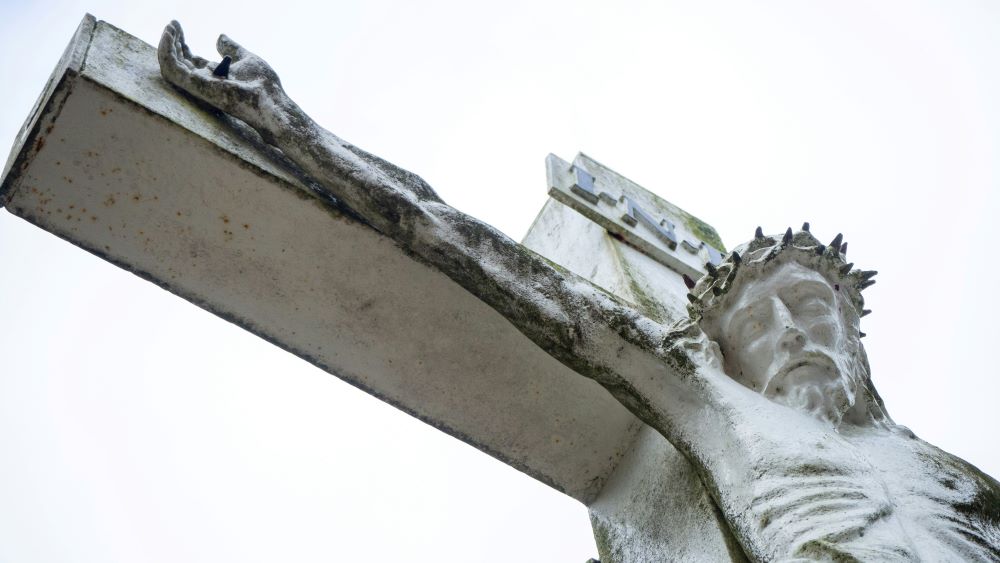
(Unsplash/Wim van 't Einde)

by Sr. Nodelyn Abayan
Good Friday invites me into a different kind of knowing.
Not the kind that comes from answers or explanations, but the kind that emerges when I choose to stay — when I do not turn away from suffering and when I allow silence to speak. In the stillness of this day, I find myself drawn into the contemplative heart of Jesus, a presence that does not rush toward resolution, but remains, endures and abides.
As I walked through Holy Week this year — from the cries of "Hosanna" (Matthew 21:9) to the quiet intimacy of the table where Jesus broke bread and said, "Do this in remembrance of me" (Luke 22:19), to the deep anguish of Gethsemane — I began to notice something that feels very close to my own life. Jesus was never in a hurry. Even when everything around him was moving toward betrayal and death, he stayed present.
I see this tension in my everyday encounters — with students, with families, with the sisters in community, even with the children whose rhythms do not follow schedules but presence. There is always an invitation to rush — to respond quickly, to fix, to move on to the next need (seemingly in this Western culture). But Jesus shows me another way.
Reading Practice the Pause by Caroline Oakes during this sacred time has deepened this awareness. One line stayed with me: "The pause is not a break from the sacred; it is where the sacred becomes visible." I began to notice this in the most ordinary moments — in the way a child lingers before letting go of a parent or caregiver, in the quiet after a difficult conversation, in the stillness of early morning prayer. These pauses are not empty. They are full.
In the stillness of this day, I find myself drawn into the contemplative heart of Jesus, a presence that does not rush toward resolution, but remains, endures and abides.
On Good Friday, this feels especially true.
There is no spectacle here. Only a slow, painful unfolding. And yet, it is precisely here that something sacred becomes visible.
In the Garden of Gethsemane, Jesus embodied this pause most profoundly. According to the Gospel, "He began to be distressed and agitated" (Mark 14:33). Jesus said, "My soul is sorrowful even to death" (Mark 14:34). He did not rush past his fear. He did not hide it. He prayed, "Abba, Father … remove this cup from me; yet, not what I want, but what you want" (Mark 14:36). There is such honesty, such surrender.
This is not the image of a distant, invulnerable savior often emphasized in Eurocentric theology. This is a contemplative Jesus — deeply human, fully present, rooted in relationship.
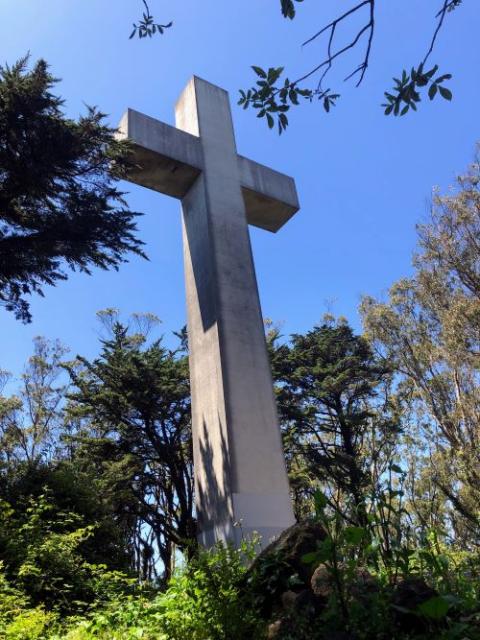
The Mt. Davidson Memorial Cross in San Francisco memorializes the 1.5 million victims of the 1915 Armenian genocide. (Courtesy of Nodelyn Abayan)
And yet, much of the theology I have inherited has emphasized Jesus primarily as redeemer — the one who saves, fixes, restores. While this holds meaning, I am beginning to see how, within Eurocentric and colonial frameworks, it can also create distance. Jesus becomes someone who acts upon us, rather than someone who walks with us.
But Good Friday does not allow that distance.
Here, Jesus is with us in the most vulnerable way — stripped, wounded, exposed. "They crucified him" (Luke 23:33). And still, he speaks words of connection: "Father, forgive them" (Luke 23:34). "Today you will be with me in Paradise" (Luke 23:43).
He remains in relationship, even in suffering.
A decolonial lens invites me to ask: What if salvation is not only about being rescued, but about being invited into this way of being — this way of presence, of connection, of deep belonging?
Another line from the same book echoes within me today: "In the pause, we remember that we belong — to God, to ourselves, and to one another." I see this belonging in Jesus' final moments. Even in his cry, "My God, my God, why have you forsaken me?" (Matthew 27:46), there is still relationship. He is still addressing God.
Good Friday teaches me that maybe I am not meant to fix.
And I think of the people I encounter daily — those carrying burdens that cannot be quickly resolved. The parent who is overwhelmed. The student who feels unseen. Their grief that surfaces in unexpected ways. So often, there is nothing I can fix.
Good Friday teaches me that maybe I am not meant to fix.
Maybe I am meant to stay and stand, like those at the foot of the cross (John 19:25), even if I do not have answers, just offering my presence.
The pause, then, becomes a decolonial act. It resists the Eurocentric theological imagination that centers control, urgency and resolution. It challenges the subtle "Messiah complex" within me — the part that believes I must intervene, must solve, must carry what is not mine to carry.
But Jesus does not hold on to control.
Instead, he releases.
"Into your hands I commend my spirit" (Luke 23:46).
This is the deepest pause.
A letting go.
A trust that even here, especially here, God is present.
As I sit with Jesus on Good Friday, I realize that his contemplative life is not separate from his mission. It is the way he lives it showing that his power is not found in domination or in fixing but in faithful accompaniment and in presence
And I begin to see this not only in Scripture, but in creation itself. I see it in the steady rhythm of the ocean, in the persistence of trees, and in the way the day gives way to night without force or urgency. God's presence is not hurried. It unfolds.
"Pausing," as Practice the Pause reminds me, "is how we make space for what is already here." And what is here on Good Friday is suffering, yes, but also love — a love that "endures all things" (1 Corinthians 13:7). A love that remains.
Advertisement
This day invites me not to explain the cross too quickly, not to rush toward Easter.
But to pause.
To stay.
To behold.
Because here, in this sacred stillness, I encounter not only a savior, but a companion.
One who does not stand above suffering but enters into it.
One who does not rush to fix but remains to love.
And in that presence — quiet, faithful, and real —
I am slowly being transformed.