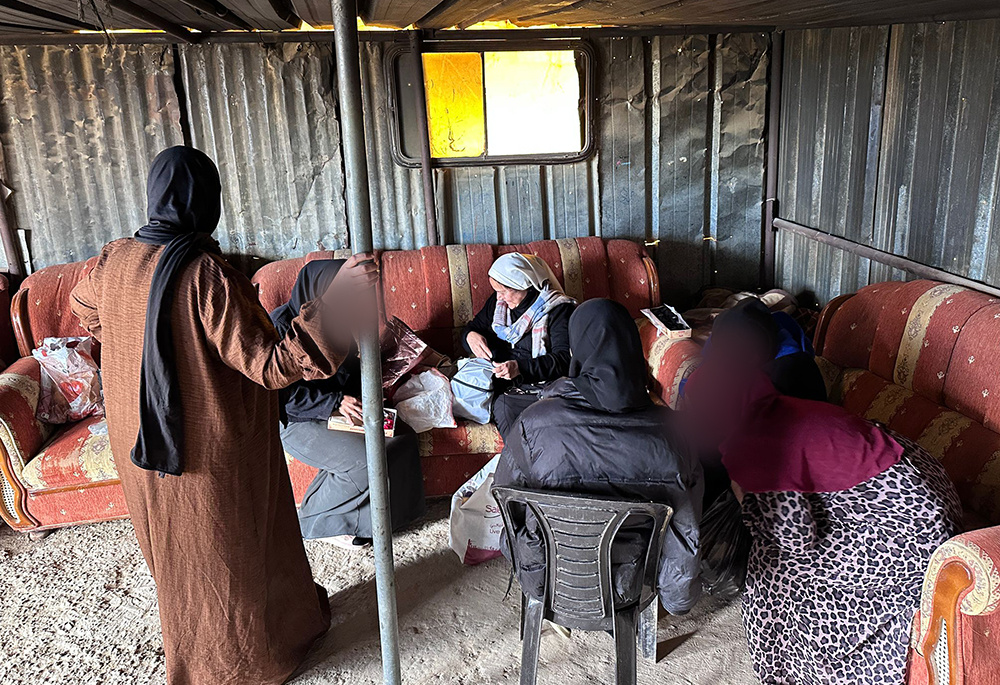
Women meet at the Tabana Bedouin camp near Al-Azariyeh, in the West Bank, for a "Threads of Peace" embroidery workshop on Feb. 28, 2026, as part of the Comboni sisters' accompaniment of Bedouin communities living with daily uncertainty. Sr. Maria Cecilia Sierra Salcido is pictured, white veil, center. The image is obscured to protect identity. (Courtesy of Sr. Maria Cecilia Sierra Salcido)
by Sr. Maria Cecilia Sierra Salcido
Since the morning, after Mass, the sirens have not stopped.
And still, we went into the desert.
A few days ago, Bedouin communities endured incursions by settlers. We could not remain at a distance. We wanted to be present, to carry fabric, zippers, thread and sweets — small, tangible signs of care. Items with which to sew bags, to learn, to refuse surrender.
We, Comboni Missionary Sisters, have been present in Israel and Palestine since 1947 — first in Mount Zion and Nazareth, later in Bethany. We chose this land for its centrality in the history of faith and for our mission: to be with the most vulnerable. Our work spans education, spiritual accompaniment, social support, and the promotion of women. In Jerusalem we run a center of spirituality and a kindergarten, while in Al-Azariyeh we accompany 12 Bedouin communities. (Al-Azariyeh, biblical Bethany, or Al-Eizariya in Arabic, is located in the occupied West Bank.) The project "Threads of Peace" supports over 200 women through tatreez, traditional Palestinian embroidery recognized by UNESCO.
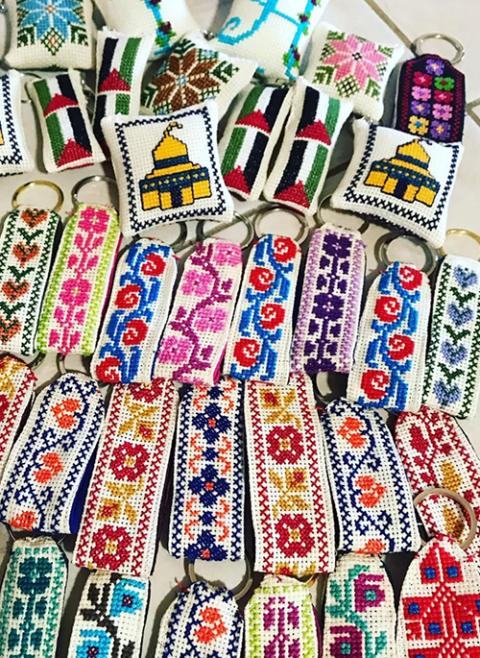
An example of tatreez, traditional Palestinian embroidery, on keychains (Wikimedia Commons/Noormalfoof)
This is not simply "women's empowerment." It is daily bread. It is support for wounded family economies, where often women are the only ones able to contribute to the household. And in times of conflict, learning is far more than acquiring a skill: It is keeping the mind afresh, kindling creativity when everything else seems to go dark. It is survival. It is resilience stitched, seam by seam.
Nearly 30 women were waiting for us, surrounded by their children. Beneath a communal shelter fashioned from heavy, worn blankets — offering modest protection from heat and cold — we shared words and silences. They were recounting what had happened in recent days, when the first blasts of missiles tore through the desert's stillness. Then came the whistles again. More missiles.
The children ran out to look. Eyes fixed on the sky. For them, there is no difference — inside or outside is the same. There are no shelters. No safe rooms. One hundred percent exposed. We stayed with them, sharing the same vulnerability, the same uncertainty suspended in the air.
Through this daily life, we learn resilience, hospitality, and faith persevering in the face of the uncertain. The families we accompany teach us to remain present, even when the future is unclear. We share their routines: visiting homes, organizing workshops, accompanying women and children, celebrating faith, and listening to their stories.
On the way to another village, more explosions — closer this time. The sirens from the settlements continued to wail. The Bedouin women, almost impassive, as those who have learned to live alongside the unimaginable. "Will you hide under the bed?" We teased one of the women, who loves to sleep. We laughed, knowing her "bed" is a thin mattress on the ground, and her tin home offers no refuge at all.
Advertisement
On the road back, toward Jerusalem and the settlements, the highway was nearly empty. At the entrance to Al-Azariyeh, however, life went on as usual. Staying home changes nothing. In Palestinian towns and cities there are no shelters. People move on. They work. Struggle to survive.
It is Ramadan. Those who have fasted since dawn prepare what they can for iftar. Life continues, even beneath the sirens.
Living near Jerusalem but barred by checkpoints and walls, we experience a closeness imposed by geography and a distance imposed by restrictions. Jerusalem is the spiritual heart, but often inaccessible. This reality deepens our solidarity with the suffering of the people.
We also witness how culture and tradition are preserved: through family, faith and embroidery. Women, as pillars of their families, guard both memory and dignity, sustaining hope and passing it to the next generation. Children and young people face insecurity, limited educational spaces, and fear, yet they continue to dream.
We returned home — to prayer. To waiting. Fully aware that this may be only the beginning of something that will make even more vulnerable the lives of those already living under siege and precarity.
In this land that has known so much pain, we believe in the Resurrection. We remain with these communities as a humble sign of hope, convinced that peace, too, can be stitched, point by point.
It is Ramadan. It is also Lent.