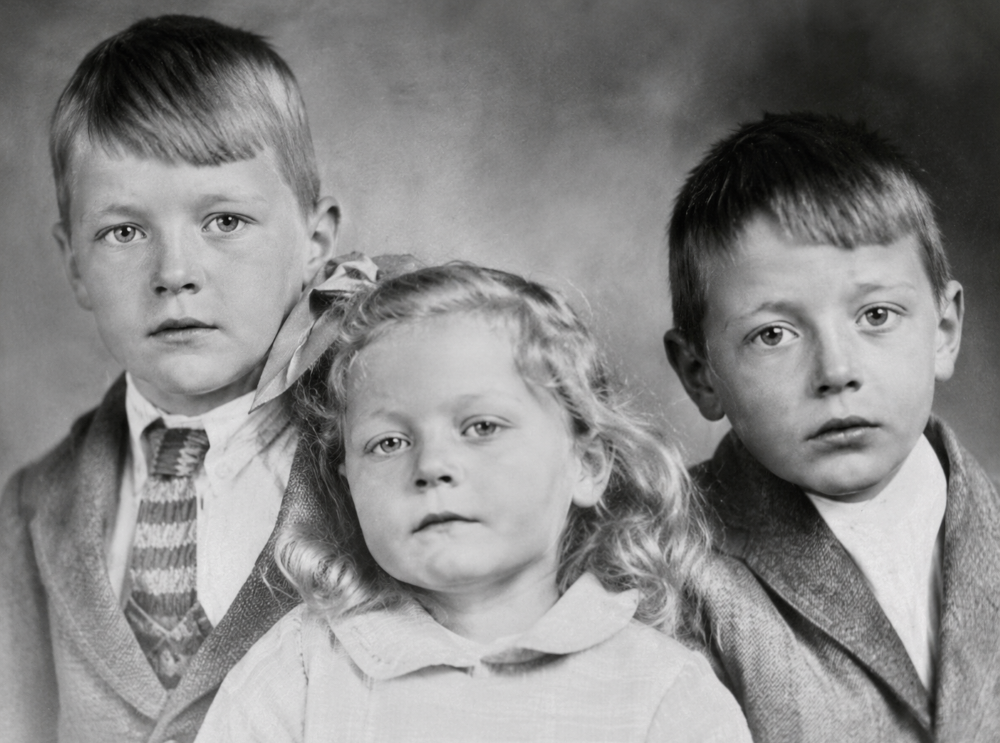
Sr. Margaret Cessna's mother and her two brothers are pictured in this childhood photograph. Cessna's Uncle Matt, who died before she was born, is on the right. (Courtesy of Margaret Cessna).
by Sr. Margaret Cessna
Horace was a Latin lyric poet who lived more than two millennia ago. In the epilogue to his third book of Odes he wrote,
I have erected a monument more lasting than bronze
And taller than the regal peak of pyramids.
I shall never completely die.
I read that quote in the newspaper the other day. That's what he wrote: "I shall never completely die." Although Horace was referring to his poetry, cannot each of us hope to say the same about our life and the lives of the ones we love? Even about the ones we know about but never really got the chance to know? Can a life be a monument more lasting than bronze? Only if remembered? Who will remember? Which life, besides Horace's, will never completely die?
Did you ever walk down a crowded street looking at hundreds of people, hundreds of faces that you will never see again? Did you ever stop at a traffic light and catch a glimpse of the driver in the next car, in all probability, never to be seen again? Do you ever think about these once-in-a-lifetime encounters? I do. We will never run out of people that we do not know.
So if there are literally billions of people that we will never know, is it too much to ask that we actively remember the ones that are directly connected to us, even if we never met them in person?
I used to have an Uncle Matt. Well, technically I didn't. He died before I was born. But if he had lived longer or if I had been born earlier, I would have really had an Uncle Matt.
I was thinking the other day that there is no one left to remember him. No one to remember my Uncle Matt. All who knew him are dead. I know a little about him, but I did not know him. So I wonder if my thinking about him and the fact that I know his name and have his photo means that he is still remembered. And how do I pass that on and on and on? For some reasons that I do not understand, I feel that it is my responsibility to do so.
Uncle Matt was 21 when he had a seizure in church on Nov. 15, 1933, and he died soon after. My grandmother never really got over it.
My mother told me a little about her oldest brother. He was, mostly, ordinary. But he was greatly loved, and I have this strange need to make sure that this uncle that I never knew personally is remembered. By someone.
Here's what I know. He was born of an Irish mother and an English father in Durham County, England. He sailed from Southampton with his family when he was 8 years old. I have a copy of the ship's manifest. Matthew's occupation is listed as scholar because he was in the third grade when they left their home. They arrived in New York on the Aquitania in October 1920.
"Not in steerage," my mother would say. That was an important fact that we should never forget. We should never forget that they did not come as paupers.
Uncle Matt's passport photo is framed and on my photo shelf.
Advertisement
My grandfather, grandmother, their two sons and daughter settled in a small coal-mining town in Pennsylvania. They were churchgoing people. Roman Catholic. And then Matt was here and gone. One day. In church. Here one moment and gone the next. My grandfather stopped going to church the day his son died. The day Matt died in church.
They never talked much about him — the ones who knew and loved him. Perhaps their grief was still too present. Still too raw to touch. I wish now that I had asked more about him.
Before my youngest brother's first child was born, our mother asked him if he would consider the name Matthew if the baby were a boy.
My youngest brother called her from the hospital the day of the birth.
"It's a boy," he said. "We named him Matthew. We named him for your brother."
My mother wept.
In the final analysis, this is not only about Uncle Matt. This is about the brevity of our lives. This is about what small worlds most of us live in. Here one day. Gone the next. So what do we do between? Between here and gone? We may as well be happy and generous. Deal with setbacks and heartbreak. What else is there?
Once gone, what do we leave behind? Where is our mark? Who will remember and why? How important is it to be remembered? Remembered longer than the lives of those who knew us personally? The real answers to these questions may rest somewhere beyond words. In the meantime, this is for you, Uncle Matt. I remember you and I will pass you on to the next generation. I hope they will do the same so that you shall never completely die. My duty done, I can one day rest in peace. And finally, leave all the remembering to others.