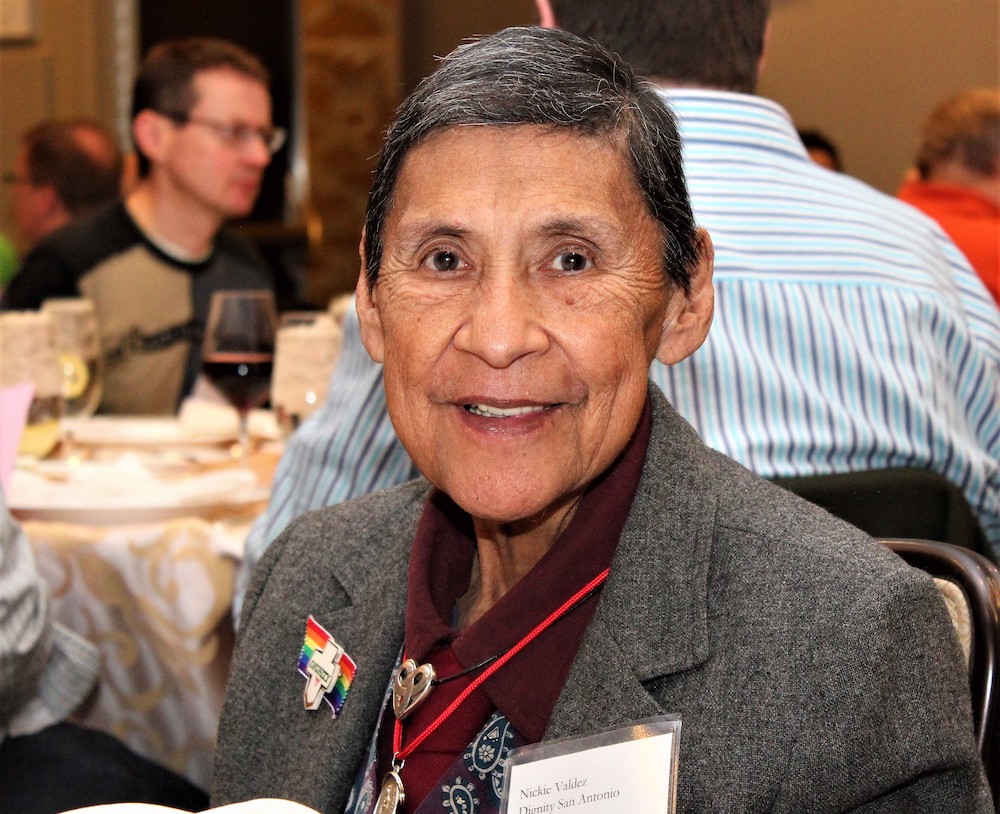
Nickie Valdez at a DignityUSA conference in April 2014 (Mary Kaye Radtke)
About 15 years ago, I gathered a community of lesbian Catholics to talk and write about their faith journeys. Their stories became the book Living True: Lesbian Women Share Stories of Faith, which I co-edited with Ann Peper Perkins. After several years, the publisher and I wanted to expand the book to include more stories told by women of color.
One person who immediately came to mind was Nickie Valdez. I had heard her speak at a conference. She was a matriarch, a strong and wise advocate for her beloved LGBT community for more than 60 years. I wanted to interview her to hear what she would have to say about our times.
Sadly, I discovered she had died on Christmas Day 2020.
Still, I still searched for her. And discovered her voice was everywhere.
This small woman, born in 1940 to a teenage mother and a father who served in the Navy, was a lifelong advocate for the gay community in San Antonio, Texas. She was always reaching out, calling her community together, extending hospitality. This was Nickie.
Her life stood in dramatic contrast to her personal experience. She had been abandoned by her mother, raised by her paternal grandmother, and later disowned by her father. After joining a convent, she was asked to leave because her parents were not married. Throughout her childhood and teenage years, she felt like she did not belong or fit in.
I found myself in awe of her, wondering how she developed such a strong inner core, deep spirituality and belief in herself.
These traits showed up early in her life. Among her first jobs was tending bar. She had a real talent for it and was good at listening to her customers. What she heard was that her regulars were looking for community and searching for spirituality. Always the practical one, Nickie organized meetings in homes where people could pray together, read Scripture, discuss it and apply it to their lives. Shortly after, Nickie discovered Dignity and started the San Antonio chapter in 1976.
I admire her abundant energy and spunky personality. She had a passion for justice. She knew in her bones what intersectionality was even before we had a word for it. She brought her drive for inclusiveness to the National Organization for Women, Pax Christi, Esperanza Peace and Justice Center, the San Antonio Equal Rights Political Caucus and the United Way. In all these groups, she insisted that lesbians have a seat at the table as equal partners — and that racial equality be included.
Another quality that inspires me is Nickie's deep spirituality. She had a unique ability to fuse Scripture with her own life experience — following both the Word of God and the word of her heart.
Advertisement
Nickie was known for nurturing friendships. She fostered connections among the people and groups she brought together. Her most cherished relationship was with her partner and wife, Deborah Myers. They met in 1985 at a Dignity Mass. They bonded over sharing how they had both been disowned by their families.
Despite concerns about their 20-year age gap, they decided to give their relationship a try. Thirty-five years later, they were still together. They married in 2015 and remained together until Nickie's death. They opened their home to other lesbian women who needed a place to stay. They mentored couples who looked to them as a model — wanting the same loving relationship Nickie and Deb had.
When I talked with Deb on the phone, she described Nickie as having the courage to be herself and to know she was "a child of the universe." Nickie herself described her journey as "a deep longing to be spiritual and stay connected to my faith."
Nickie's attitude toward the church was clear: "You baptized me. I am here to stay. You can't disown me." She was strong in her faith and defiant about being "disowned" again. Through it all, she was convinced that she belonged. And she wanted to extend hospitality so others could feel they belonged, too.
Nickie Valdez, a child abandoned by her parents, became a woman who helped others belong. She encouraged others to love who they chose. She overcame rejection and extended a sense of belonging to anyone in need of her deep love, open heart and welcoming arms.
Nickie was a woman of simple desires. She only wanted to be able to "hold hands in public." She did not make demands but was resolute in her stand for justice. After her death, the San Antonio Express-News described her as "a pioneer and hero in the gay community and a tireless advocate for justice and social equality."
As I searched for Nickie's spirit, I came to know her as someone who brought others together to discuss "spirituality in the context of sexuality." As her wife Deb said, "For Nickie, faith and spirituality were stronger than doctrine" and "God is greater than anything we can imagine."
On the fifth anniversary of her death, I want to honor her memory and hold her up as an example of hospitality and love in these times of division. Two tributes left in her funeral home message site explain her life quite well: "She never saw others as enemies, only people with different viewpoints" and "She fought battles with compassion and inspired us all to be our better angels."
Nickie's life invites us to extend hospitality, love, compassion and kindness to others, especially those who are pushed to the margins in our country and in our world.