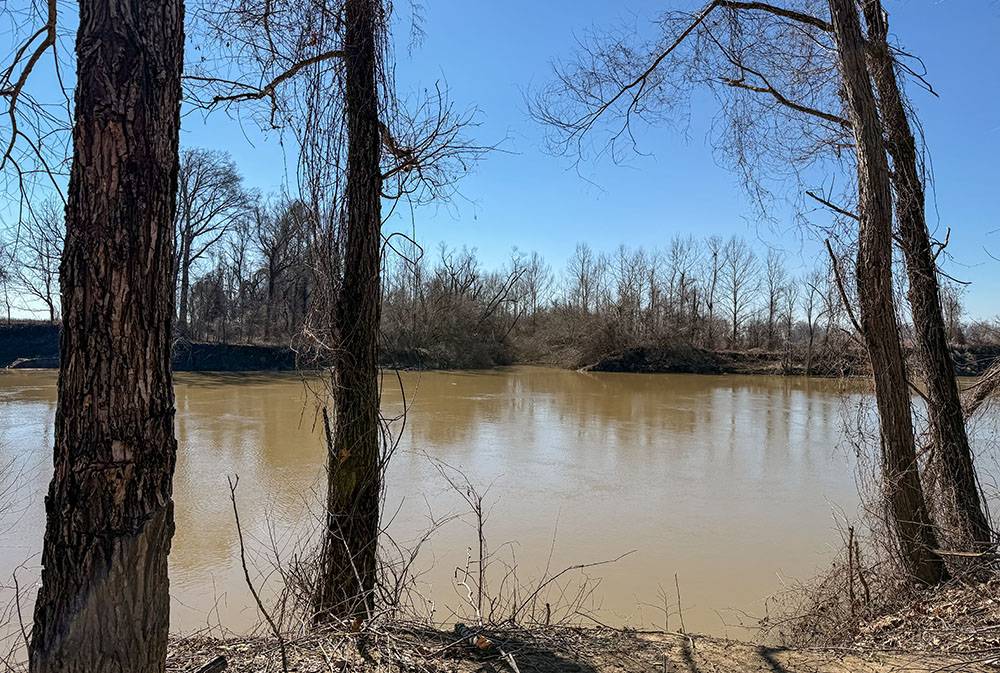
The Tallahatchie River flows near Glendora, Mississippi, where the body of 14-year-old Emmett Till was recovered in 1955 after he was kidnapped and murdered. The site is seen Feb. 7, 2026. (Laura Nettles)

by Sr. Laura Nettles
The Tallahatchie River moved slow and heavy near Glendora, Mississippi, as I stood on its bank with two of my Franciscan sisters. In 1955, the mutilated body of Emmett Till was pulled from this site. Nearby, a historical marker listed the sobering facts: a 14-year-old from Chicago, accused of whistling at a white woman, kidnapped, tortured and murdered by men who were never held accountable. The silence that morning seemed to match the weight of the water.
My sisters and I had not come as tourists, but as pilgrims, seeking to understand the world that shaped our sister, Thea Bowman. We knew that to honor her holiness meant finally confronting the painful truths she had always compelled us to see.
To make a pilgrimage is to surrender to a place until it changes you. Sister Thea understood this type of transformation. She knew that the work of racial justice could not be done from a distance. Repeatedly, she called her Franciscan sisters, white Catholics and the wider church to encounter the embodied reality of Black Catholic experience. To let their stories and experiences land on us not as information, but as invitation. To stop protecting our comfort and walk toward the hard truths. And she asked us to come close enough to let those truths matter.
So, we went to Mississippi and made Sister Thea's path our own pilgrimage.
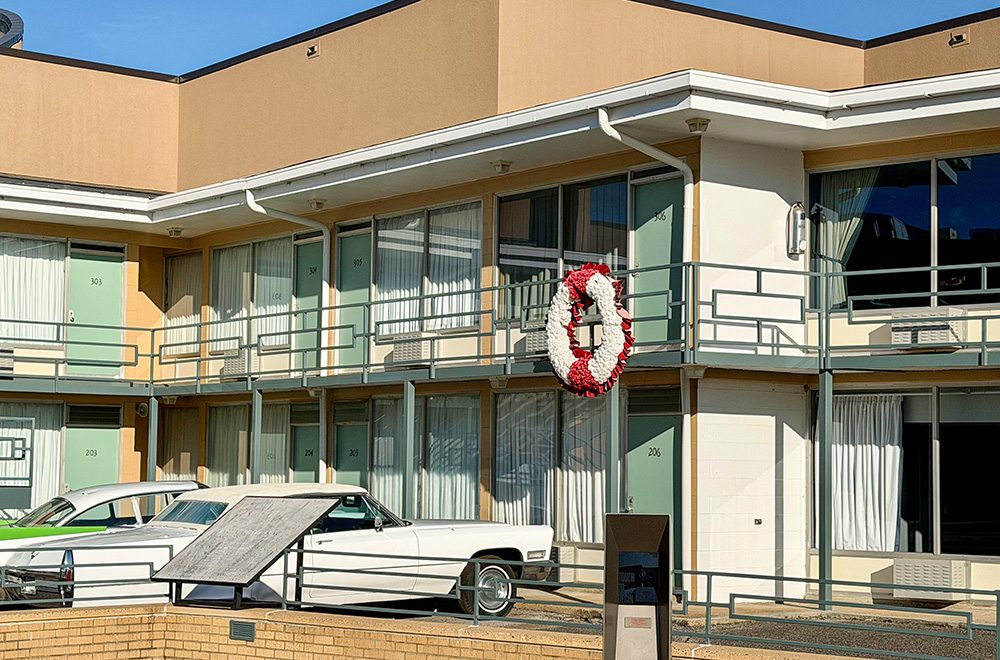
The Lorraine Motel, where the Rev. Martin Luther King Jr. was assassinated in 1968, is seen Feb. 7, 2026, in Memphis, Tennessee. (Laura Nettles)
From Glendora, we traced the march toward justice through Mississippi to Memphis, Tennessee, through towns where justice had cost everything. In Memphis, we stood beneath the balcony where Martin Luther King Jr. was assassinated. In Canton, Mississippi, Sister Thea's hometown, friends spoke candidly of racism and quiet endurance. In Jackson, Mississippi, we paused at the corner where Medgar Evers was murdered. At the Mississippi Civil Rights Museum, photographs and testimonies bore witness to people who marched, organized, prayed and persisted.
At each stop, we prayed. We lamented. We lingered longer than was comfortable. Slowly, it became harder to speak of racism as a sin confined to another era or located safely "out there." The sites drew us in and asked what remains unexamined in our own community and in our church.
Two days later, we processed into the Cathedral of St. Peter the Apostle in Jackson for the closing of the diocesan phase of Sister Thea's cause for canonization. The liturgy and closing ceremony were beautiful, a moment of hope as the church formally advances the cause of a woman so many already call a saint.
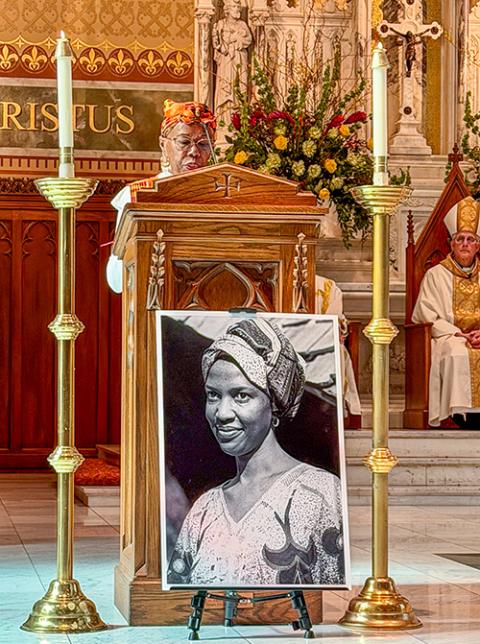
Tanya Britton reads during the liturgy marking the close of the diocesan phase of Sr. Thea Bowman's cause for canonization at the Cathedral of St. Peter the Apostle in Jackson, Mississippi. (Laura Nettles)
Still, even as we celebrated, I couldn't shake the image of the river and the sites we had visited. Sister Thea would be the first to remind us that sanctity is not found in a church alone. It is tested where suffering is real and trust is costly. Both are necessary if canonization is to mean more than admiration.
There is a particular complexity in three white sisters traveling to honor a Black woman from our predominantly white community. Sister Thea entered the Franciscan Sisters of Perpetual Adoration in 1953 as the first African American woman to join our congregation. She navigated a religious life that was not always prepared to receive the fullness of her identity. But she loved us faithfully. She challenged us unflinchingly. She remained.
As we gathered in the cathedral, I found myself wondering what Sister Thea would make of this moment, of her sisters coming to honor her, having only just begun to understand her message. Is it enough to celebrate her gifts while the systems she fought against remain? The temptation to honor a prophet while ignoring her message is dangerous.
As Sister Thea's cause moves forward, so does her invitation. She calls us to a pilgrimage beyond mere devotion. A journey through truth that requires us to show up to the sites of trauma, to the uncomfortable conversations, and to the places where our own complicity is exposed. Her cause is our invitation to conversion.
If we would proclaim her a saint, we must also walk where she walked.
Sr. Thea Bowman, pray for us!
Advertisement