
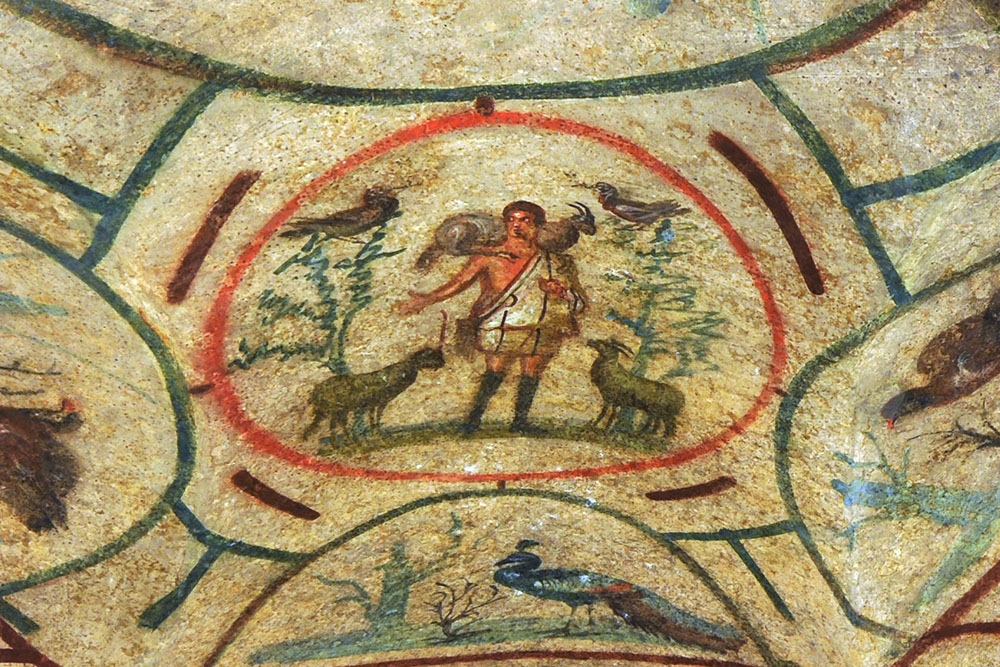
A third-century fresco of the Good Shepherd is seen on a ceiling in the Catacomb of Priscilla in Rome. (Newscom/ABACA/Vandeville Eric)

by Sr. Juliet Mousseau
Contributor
Editor's note: Welcome to Theologians' Corner, where each week a different woman theologian from around the world offers a fresh reflection on the Sunday readings.

Fourth Sunday of Easter
April 26, 2026
On my desk sits an image of Christ as the Good Shepherd from the Catacomb of Priscilla in Rome. I'm sure it's familiar to many people — a boy in the center carries a lamb on his shoulders, and two other sheep flank him, each looking up at him, with two trees in the background.
The image accompanied me and my sisters as we prepared for our final profession as Religious of the Sacred Heart, along with the verse from John 10:14, "I know my sheep and mine know me," the verse for today's Gospel acclamation. The image of Christ as the Good Shepherd brings up images of idyllic pastures and running water, the peacefulness of being in a beautiful field surrounded by God's creation, knowing the safety and security of being deeply loved and cared for.
When Pope Francis said that a shepherd should "smell of his sheep," that image became a bit more real to me. Growing up in Montana, we would pass fields of sheep on the way to school every day. In the field, there was a little hut or camper where the lone shepherd lived, among his sheep. It seemed a solitary life — and even somewhat attractive for this introvert.
The ancient world was significantly more familiar with shepherding than I became as I whizzed by in a car. Montana is the eighth largest producer of sheep in the U.S., but that didn't touch my daily life other than as an image flying by my window. In the ancient world, however, sheep were a necessity for basic human needs, particularly clothing, shelter and food.
Advertisement
Sheep were one of the first animals domesticated by human beings, perhaps as long ago as 11,000 B.C. Then, they were bred for particular genetic characteristics (including wooliness, growth rate and even color) as early as 6,000 B.C. Sheep provided wool, milk, meat and pelts, and they were vulnerable to predators as they had little means to protect themselves. In fact, long before Jesus walked the earth, the image of a shepherd was used as a metaphor for kingship or leadership of the people.
It is unsurprising, then, that Jesus chose the shepherd as an image of his care for his people. Those who heard the image would know how important the shepherd is not only for the safety of the sheep but also for the well-being of the entire community. They would also know that being a shepherd involves sacrifice and risk-taking.
Remember the story of David, that as the youngest in the family, he was on shepherd duty. He was far away from the community and had to be called back to fight Goliath. The shepherd had to be disconnected from his family and his community in order to protect the vulnerable animals on whom the community then depended. The shepherd's service was essential to the people's survival.
The Jewish community to whom Jesus spoke in today's Gospel reading (John 10:1-10) were familiar both with the image of a shepherd and with today's responsorial psalm (Psalm 23), which uses the image of the shepherd to refer to God. Just as a shepherd takes good care of his sheep, so also I can rely on God for everything I need.
Jesus is indeed our shepherd, and by becoming human he experiences the very things that he assures us he will protect us from.
The peaceful image of sheep in a field with running water nearby takes shape — "In verdant pastures he gives me repose; beside restful waters he leads me; he refreshes my soul." Everything that causes me worry as a human being is considered: hunger and thirst, discernment between paths that open before me, the darkness of sorrow and grief, dangers that threaten my life. All that I need is here, and I am safe and sound in God's arms.
Yet God offers us even more — the gift of his very own Son, to walk this earth and experience with us the sorrows, threats and dangers that we experience. Just as a shepherd smells of his sheep, so also God takes on human form, our very life, to show how much he loves us. Us. All of us, both in our variety of persons and in the entirety of our human experiences.
Jesus is indeed our shepherd, and by becoming human he experiences the very things that he assures us he will protect us from. He knows what it means to be hungry and thirsty because he felt it. He understands the exhaustion of a hard day's work because he participated in it with his earthly father and with his followers. He knows fear of physical harm because he was pursued by his enemies. He experiences the anguish of friends who fail him in his moment of greatest suffering.
Whatever difficulty we experience, Jesus accompanies us because he chose to suffer out of love for us. In this, let us find the life that Jesus promises us for all eternity.