(Dreamstime/Genotar)

by Sr. Margaret Gonsalves
Contributor
Every time I recite the Angelus, I find myself pausing at "And the Word became flesh and dwelt among us." This year as I was making my thanksgiving recollection on the eve of the Jubilee year, I decided to reflect deeper on how the word became flesh for me and how my flesh became that word.
As we look around, there is sadness in the world. The dark hours of brutality and fanaticism are terrifying us to be alive, losing hope and searching for light in the midst of despair. Iris Murdoch once said, "Tyrants always fear art because tyrants want to mystify while art tends to clarify." In Matthew Fox's book Original Blessing, the meaning of "word" is dabhar, meaning the creative energy of God, which is dynamic, inventive and spirited.
Amid all this turmoil and confusion, Jesus as Word of God becomes the artist of kenosis — the greatest fullness of God's inner life and inestimable superabundance of compassionate love.
Mary's visit to her cousin Elizabeth (Luke 1:39-45) is a powerful and concrete step taken toward evangelization. Mary does not use an abundance of words but she simply walks into Elizabeth's house with the Word conceived in her womb. With the vibrations of the Word in Mary's womb, the unborn in Elizabeth's womb leaps for joy.
In English grammar, every word is a part of speech. Every word denotes what part of speech it belongs to and can be defined as words that perform different roles in a sentence. So, Jesus as the Word of God plays different roles in our spiritual life. Words carry strong vibrations to inspire, heal and transform the human heart, including plants, animals and all of cosmic creation.
Jesus is both noun and pronoun.
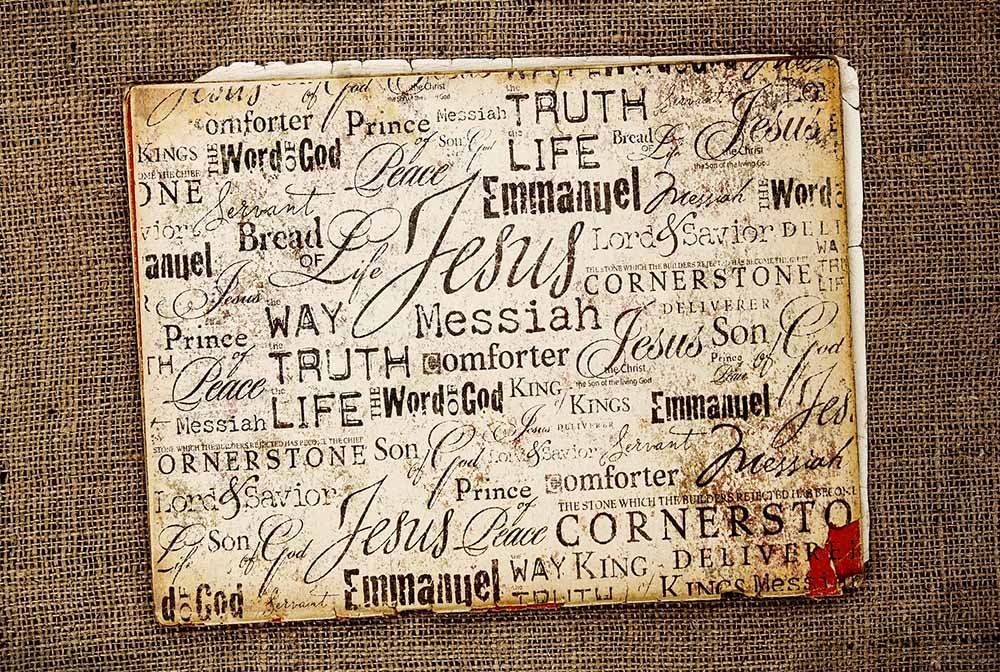
Jesus' messianic title "Emmanuel" is a proper noun. Though theologically it is understood that God's being transcends human notions of gender, Jesus' default pronoun is he.
In her book She Who Is, St. Joseph Sr. Elizabeth Johnson mentions Jesus as "Sophia" — a Greek word for wisdom who birthed creation into existence. St. Paul reaffirms it saying, "Christ the power of God and the wisdom of God" (1 Corinthians 1:24). The well-established Jewish thought in the Old Testament of this "Sophia" or wisdom was there when the world began.
Advertisement
The Gospel of John 1:1-3 links Wisdom (as being she) and the Word of God in the opening words. From my Indian roots, I tend to believe that Jesus Ardhanarishwara denotes the union of one divine — masculine and feminine. This drew my attention to the inclusivity.
Jesus is both verb and adverb.
Jesus as "verb" is always active and on the move. "Words are events, they do things, change things," wrote Ursula Le Guin. In the beginning there was Word incarnate over the deep and a swirling creative energy, with breath, skin and emotions, which took flesh and dwelt among us. The Word's "Isness," is what makes us Alpha and Omega, which in Indian scripture is Aham Brahmasmi — I am Brahman or I am Divine. This asks us to move from static dogmas to creative ways of living our faith in one God.
Jesus is both adjective and preposition.
Jesus is a mighty healer, redeemer, anawim of the poor. The risen Christ pervades in the entire universe. As the prayer goes: "Christ before us, Christ behind us, Christ under our feet, Christ within us, Christ over us, all around us is Christ." Ultimately Jesus is the cosmic Godhead.
Jesus is both conjunction and interjection.
In Jesus there is no duality, no either/or, but "both-and" — sacred and secular, body and spirit, nature and human being, action and contemplation, God and Goddess, masculine and feminine, are all integral parts of a total reality. Jesus is a connector, not a divider.
This grammar is simple enough for everyone to understand and shallow enough to walk through it and deep enough for the mystics to dive in. Each of us is a "word" swirling over the deep with creative energy — creating and destroying.
The verb became flesh. "Words belong to each other," said Virginia Woolf, affirming our being born into the image of likeness of this Word-Jesus.
To broaden and deepen and celebrate the beautifully hidden meanings of the Word is to broaden and deepen one's life with conversion of heart.
This Word became flesh is a dictionary and thesaurus for me and for those who want to walk the talk, providing us with solid infrastructures to rebuild our lives on a more authentic and sincere basis when the dreariness and turmoil of being hits us badly.
There are deep and difficult questions weighing us down in life, but the Word provides us with playfulness and delight, when we read it as a story.
God is constantly on the move and is actively engaged (Psalm 18 and 28). In God there is no stagnation. To broaden and deepen and celebrate the beautifully hidden meanings of the Word is to broaden and deepen one's life with conversion of heart.
The dictionaries on our bookshelves can give us alphabetical meanings of words, but this eternal Word can sing back to us the song of ourself when we forget it. Mere accumulation of words is not enough, we need to process the data of conversion within, without which our encyclopedic knowledge and minuscule wisdom is useless.
Changes in our perceptions will definitely grant us new consciousness. This thesaurus will be a meeting place of people of all faiths, backgrounds and cultures to embrace the oneness of our planetary family.
By embodying this "word," we become God's life-giving presence in the world. "By this everyone will know that you are my disciples" (John 13:35). For today's evangelization, what we simply need is being a Christ-bearer to others. Mary's visitation stands as a powerful platform, where the Word can speak heart to heart with its hearers. Each one of us as a "word" of God and as God-bearer is commissioned to spread the exultant joy of the Gospel.
As pilgrims we journey into this jubilee year with one mind — Word, peace, Emmanuel.