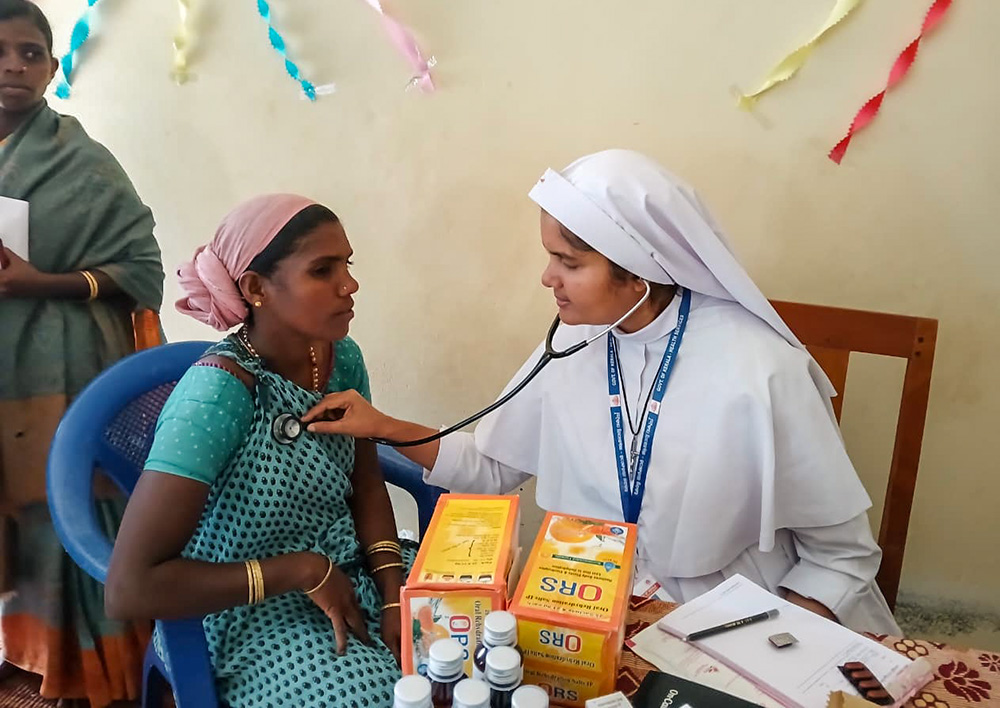
Sr. Jean Rose, a member of the Sisters of the Destitute and a medical doctor, treats a tribal woman at the government Community Health Centre in Marayoor, a remote village in the Idukki district of Kerala, southwestern India. (Courtesy of Jean Rose)

by Thomas Scaria
Sr. Jean Rose is the first Catholic nun to be appointed as a medical officer in a government hospital in the southwestern Indian state of Kerala. Catholic nuns with medical degrees usually serve only in the church-owned hospitals or health care institutions.
Rose, a member of the Sisters of the Destitute, serves the Community Health Centre at Marayoor, a remote tribal village in the hilly district of Idukki. The nun holds a master's degree in medicine from church-run St. John's Medical College in Bengaluru, capital of neighboring Karnataka state.
The 52-year-old nun shared with Global Sisters Report about her decision to enter the medical profession. Her previous superior, Sr. Lucy Theresa, a retired nurse from the Calicut Medical College, motivated her to take a state exam and join the government sector.
GSR: You became a medical officer in a government hospital a year ago. How has it been?
Rose: The work is tough, but I enjoy working as a government servant as well as a religious sister. I don't feel tired, as serving tribal communities is a motto of our congregation.
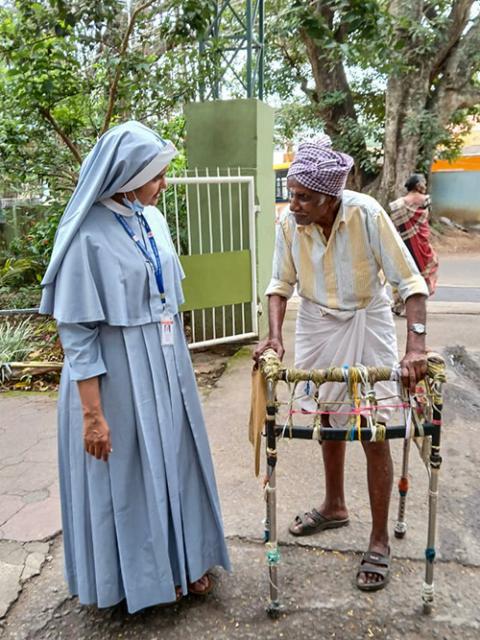
Sr. Jean Rose, a medical doctor, assists an elderly patient during a physiotherapy session at her convent premises in Marayoor village in Kerala, southwestern India. (Courtesy of Jean Rose)
The Community Health Centre is surrounded by some 25 tribal communities, who live in deep forests. On an average, we attend to more than 200 cases daily for outpatients. We also reach out to those in bed at their own homes. We don't have inpatient facilities at this center, so I go to their homes in thick forests once or twice a week.
Why did you choose to work in a government center instead of a church institution?
I opted to serve in a government center because doctors usually keep away from difficult and remote places. The Sister Doctors Forum [of India] has more than 1,000 nun members who work in church-managed health facilities. The main concern is their safety and working in such institutions justifies their religious vocation.
But I have chosen to serve the government sector. When I qualified for a government job, I chose Marayoor because I had worked among tribals here for over a decade as a doctor in our clinic. The experience really helped my role as a government medical officer here.
My former superior, who retired as a nurse from a government medical college, encouraged me to join the government service.
What are your real challenges as a medical officer there?
Marayoor [some 60 miles northeast of Painavu, the district headquarters] has extreme cold climate all throughout the year. Hardly any doctor prefers to come here, and those who come do not stay for long. We cannot blame them as they are from far-off places, and they cannot bring their families here.
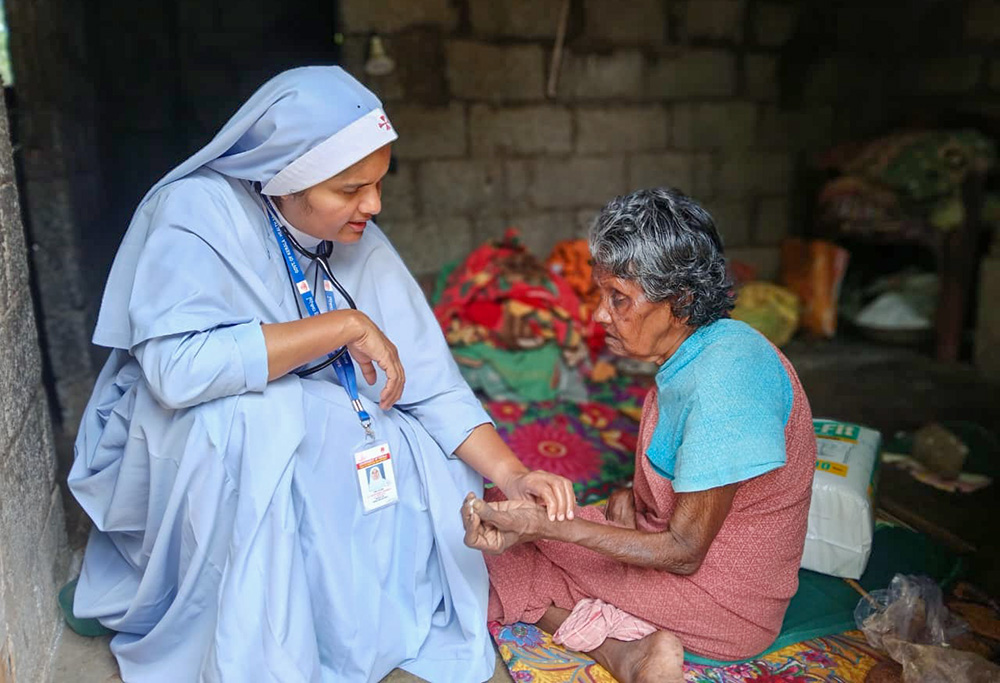
Sr. Jean Rose, a member of the Sisters of the Destitute and a medical doctor, gives palliative care to an elderly tribal woman at her home in the deep forests of Idukki district in Kerala, southwestern India. (Courtesy of Jean Rose)
We are always understaffed and those posted here have double work. All this affects the quality of service. But the government is very supportive.
Another challenge is my own health. I have respiratory problems which keep recurring.
As a religious sister, how do you fit into a government job?
I believe every religious sister should also work in a government institution, because both are expected to serve the public, irrespective of caste and creed. Our congregation's motto is "Compassionate love of Christ urges us" and we choose to work among the destitute and the poorest of the poor. The work here gives me a perfect platform to live my charism.
I don't see this as just a government job, but a ministry to reach God's compassion to the poor. Being part of the government, I channelize several health programs to them, which otherwise was not possible.
Advertisement
What do you do as a medical officer?
Besides medical services, I have to be involved in administrative activities. I have to maintain proper records, attend meetings, conduct surveys and immunization drives, bring palliative care to the sick at their homes, and carry out appropriate referral services.
Due to scarcity of staff and sometimes unexpected absences of colleagues, I have to go extra miles to complete the tasks assigned to me. Often my day starts in the early morning and lasts until late at night with one or the other jobs, most often visiting patients in remote villages.
How do you travel to the villages in thick forests?
We don't have a government vehicle here. All I have is a scooty [two-wheeler] that I use for home visits. Initially, it was a challenge to travel to interior villages as we encountered elephants, bears, boars and even tigers.
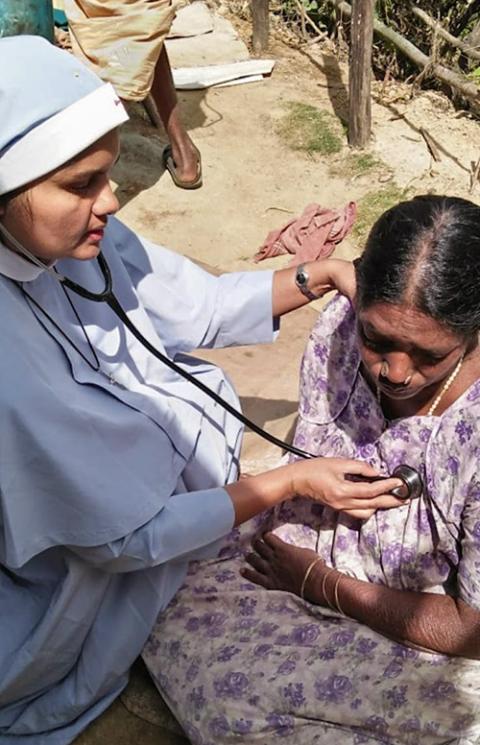
Sr. Jean Rose attends to a sick tribal woman during a community health camp in her village in the Idukki district of Kerala, India. (Courtesy of Jean Rose)
Some villagers or forest officials often accompany us in our home visits. But my real courage comes from God's protection, which I have experienced all through my journey as a sister.
Does your congregation support you?
My congregation is very supportive to my mission as a government servant. We have a convent and a hospital in Marayoor. My workload does not allow me to help in our hospital here, but the community supports me. Our congregation has several doctors engaged in community health services as part of our hospitals and dispensaries.
I am accountable to the government and to our congregation. I enjoy balancing both the roles.
Why did you become a nun? Why this congregation?
As a child, I wanted to help the poor and needy. Our congregation focuses on caring for the poorer sections of society, which suited my aspirations.
My family is from Idukki itself and very supportive of religious life. My parents were from a traditional agrarian family, God-fearing and devout villagers. They have played a very crucial role in my vocation to religious life. I drew a lot of inspiration from them. My parents are no more, and my three sisters and three brothers are happily married and settled.
The satisfaction that I receive every day continues to motivate me to keep going.