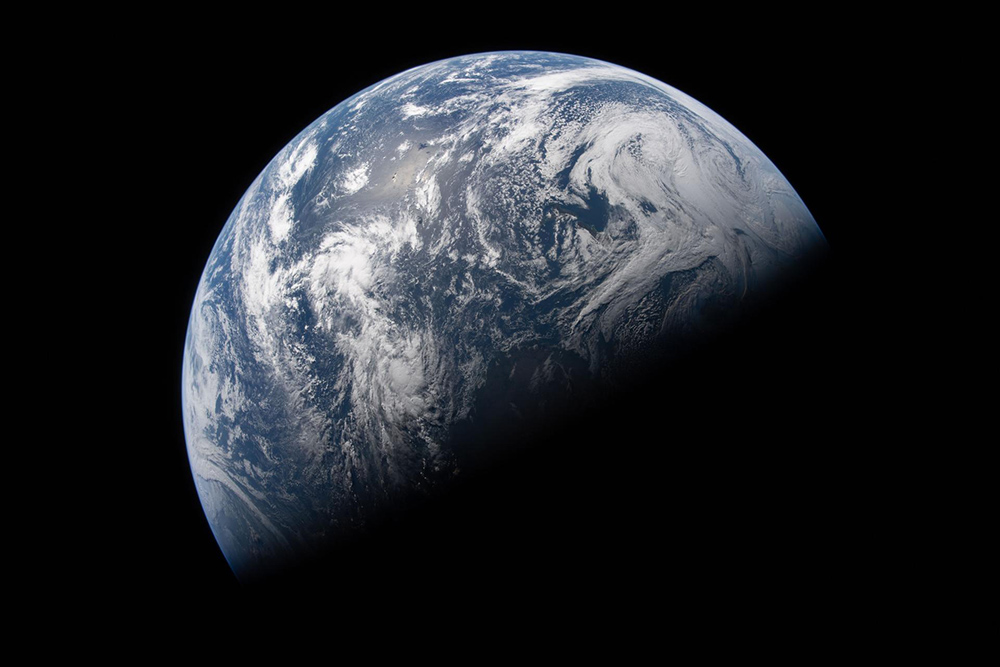
Earth is illuminated against the blackness of space in this photo taken by an Artemis II crew member through an Orion spacecraft window on April 2, 2026, the second day of the mission. (NASA)

by Sr. Hilda Mateo
Editor's note: Welcome to Theologians' Corner, where each week a different woman theologian from around the world offers a fresh reflection on the Sunday readings.

Seventh Sunday of Easter - Ascension
May 17, 2026
The season of Easter is an extended liturgical time that invites us to weave together what it actually implies to accept a new life in Christ. Faith in the Resurrection is not a belief in a reanimated body; I suggest it is a call to live from a unifying and cosmic consciousness.
Traditionally, we have imagined the Ascension as a vertical liftoff event: Jesus goes up, and we stay behind. This vision reinforces a dangerous dualism: the sacred vs. the profane, heaven vs. earth, God vs. humanity. However, from a unifying and cosmic perspective through Christ, the Ascension is not a change of location, but a change of state and perspective.
As the readings for the solemnity and the Seventh Sunday of Easter suggest, Christ does not withdraw to disengage from history. On the contrary, he ascends to fill all things (Ephesians 4:10). The Ascension is the culmination of the mystery of the Incarnation: If at Christmas we celebrate God becoming human, in the Ascension humanity is permanently introduced into the heart of divine reality. All separation is illusory.
It is providential that, while we contemplate this mystery, humanity just experienced the Artemis II mission a few weeks ago. Four astronauts ascended and were able to experience (during Easter Sunday) what psychologists call the "overview effect": By seeing our planet from space, political borders disappear, the atmosphere appears fragile, and the unity of life becomes evident. The Ascension is the "overview effect" of theology. Christ ascends so that we can see reality from his perspective: a perspective where us vs. them does not exist, but rather the entire universe is living and sacred.
We cannot speak of heaven while ignoring that the Earth bleeds. The current tension between Israel, the United States and Iran is the supreme symptom of the dualistic ego. It is the blind belief that my security depends on your annihilation, and that my religious or political truth demands your exclusion.
If the Ascension means that Christ fills all things, then Christ is suffering in the bunkers of Tel Aviv, in the streets of Tehran, and in the ruins of Gaza. An updated spirituality of life forces us to recognize that otherness is an illusion. What we do to the enemy, we do to ourselves.
Advertisement
"Father, may they all be one, as you and I are one" (John 17:21). This is not an expression of wishful thinking; it is a description of the fundamental structure of the reality that the Ascension reveals.
How do we live this today? Not by looking at the sky with nostalgia (Acts 1:11), but by looking at the earth with presence. A spirituality of life in 2026 must be:
- Profoundly material: If the body of Christ has been glorified, all matter is now divine matter. Caring for the environment, seeking social justice, and healing bodies are not secular tasks; they are liturgical acts.
- Resistant to fear: Amid war and financial volatility, the Christian person is called to rest in the unbreakable unity with the Source. The theologian Karl Rahner (1904-84) famously noted: "The Christian of the future will be a mystic, or will not be a Christian at all." We are urged to reintroduce ourselves to the contemplative tradition and live in loving attention through a growing practice of silence.
- Missionary in unity: Our mission is not to convert others to a religion, but to awaken them to the reality that we are already united.
The Ascension reveals something radical: that the distance between the divine and the human is zero. Therefore, our response to the global crisis cannot be a spiritual escape. We are called to be the incarnation of that unity in places of conflict, keeping the belief in the Resurrection alive through our contemplative and loving action.
As the Easter season concludes, we are urged to stop seeking God in the clouds and start recognizing God both in conflicts (war, economic crisis, etc.) and in the achievements of human intelligence (Artemis II). We are invited to a spirituality of life that fears neither death nor scarcity, knowing that the ascent of humanity in Christ and the Holy Spirit already is.
Our task is simply to manifest that life here and now, transforming our separatist and conflict-oriented gaze into a praxis of communion. The kingdom of God is not a place in the sky or the end of a moralistic path; it is the depth with which we walk upon the earth with unifying consciousness.
How could you act today from that unity where the other ceases to be a stranger and becomes part of yourself?