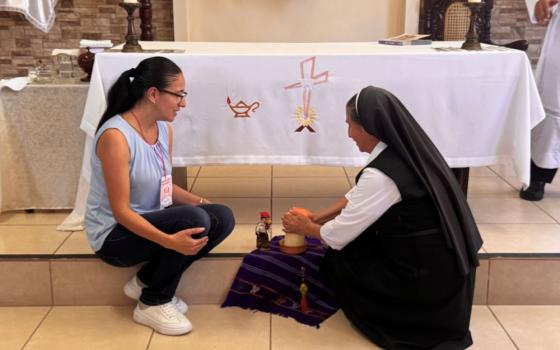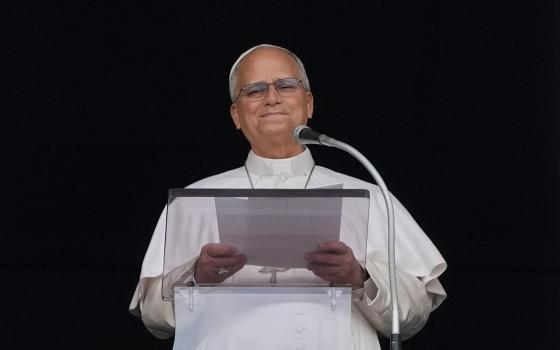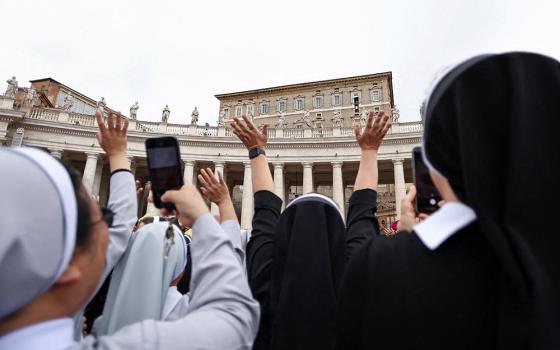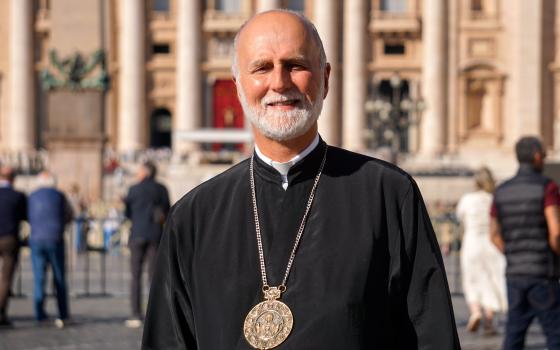

Children and others smile as they attend a prayer service with Pope Leo XIV at the Sanctuary of Our Lady of Muxima in Muxima, Angola, April 19, 2026. (CNS/Lola Gomez)

by Stephanie Ann Puen
Editor's note: Welcome to Theologians' Corner, where each week a different woman theologian from around the world offers a fresh reflection on the Sunday readings.

Sixth Sunday of Easter
May 10, 2026
The readings for today discuss the active role of the Holy Spirit in our lives. The Gospel of John refers to how the Holy Spirit, as the Advocate, is meant to be a source of help and guidance, with the gifts and fruits of the Holy Spirit as the ways in which we describe how we are transformed by the Holy Spirit.
For this reflection, I would especially like to highlight how the readings and the psalms all underscore the joy that comes with the Holy Spirit. We talk about joy as the core of the Easter story of the resurrection and ascension of Jesus. As Christians, we are meant to be an Easter people — a people marked by joy.
Joy is one of the fruits of the Holy Spirit, meant to reflect the character of a person or a community when the Holy Spirit dwells among them. Joy is a perspective or disposition, as well as a virtue that we cultivate in daily life — a virtue that Pope Francis cultivated as well during his papacy and reflected in his apostolic exhortation Evangelii Gaudium, the joy of the Gospel.
Such joy goes beyond mere happiness. As someone whose spirituality was nurtured by the Jesuits and is very much Ignatian, I always remember and remind my own students that the joy discussed here is a deeper sense of gladness, grounded in encountering God. It is more stable than the ups and downs of happiness we might feel in the day to day. It is not a refusal to acknowledge the difficulties, complexities and suffering of our day, but rather joy allows us to wake up to the world in a whole new way, as theologian N.T. Wright says. It is this joy in the kingdom of God that radically reorients us, our past, our present and our future.
Advertisement
To cultivate this feeling is admittedly difficult in our current time — the environmental, social, political and economic commentary of today does not really elicit joy. The tensions and war in the Middle East as people in power scramble for even more power often leaves many of the most vulnerable and marginalized worse off or even dead, killed by war and greed. The technocratic paradigm and throwaway culture continue to encourage people toward consuming more and always going for the next good thing, rather than a sustained commitment to the common good.
Cultivating joy in itself is already hard, and the culture of our time does not offer the space or skill to practice joy or what is needed to deepen joy in our lives. "Technological society has succeeded in multiplying the opportunities for pleasure, but it has great difficulty in generating joy," as Pope Paul VI lamented in Gaudete in Domino.
However, this is one of the many invitations and challenges of our time — to rejoice in the glimmers of good that we see and experience. This joy sustains us in our work and being toward the common good, in response to what opposes God and the good, and even amid the failures and upset we may feel, and when the thousand conditions we hope for our life and for our happiness are not met and seem so far away.
My husband's master's thesis, which was on joy in Francis' papacy and in the Gospels, succinctly described joy in this way: The joy of the Gospel is what we ought to share to the world, that the world may come to hope, and that the world may come to love.
May this Easter be an opportunity for a renewed encounter with God, and a renewed sense of joy in our lives and in the world.