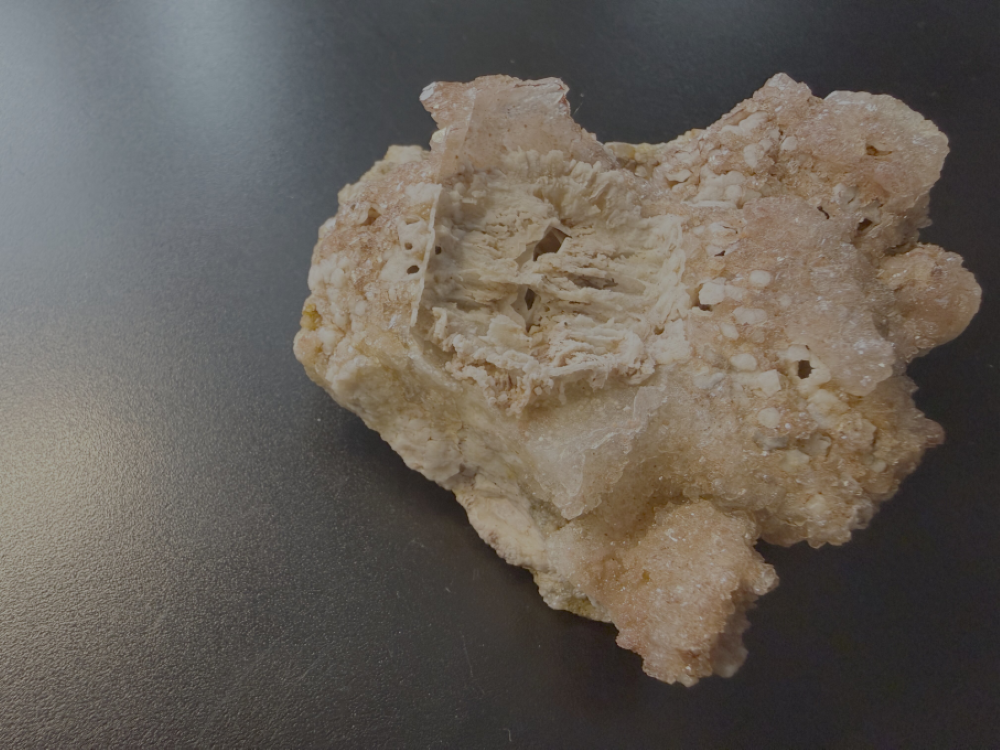
This pink amethyst with barite and hematite formed naturally in the shape of a heart. It reflects the heart with all its complexity, beauty and fragility. (Julie Vieira)

by Sr. Julie Vieira
Contributor
I've always kind of resented Scripture's call to "create in me a clean heart." It's not that I think I or any other human being is perfect. Far from it. But the expectation of having to be pristine is a hard ask. Plus, what it implies is that one's heart is so grimy that it has to be cleaned out and sanitized and scoured.
I just don't have it in me on most days to clean up the dishes in my sink, let alone to clean up my heart. I know I'm not alone in this. For many of us, "creating a clean heart" is not inspirational; it is overwhelming. It feels like one more burden heaped upon us when we are already fighting for dear life. It's like we all woke up one day to find ourselves unwillingly cast in a season of "Survivor," each of us isolated in a hostile geography. There are mental and physical challenges around every twist and turn, and no one can find the immunity idols to save ourselves.
What, in the name of God, is God thinking? What more can I do? How much more do I have to give? What do I have left to sacrifice? There's no room left at the inn.
How do I create a clean heart when my heart is filled up with all the joys and sorrows of my life and the world? I feel this weight on my heart and I'm doing my best to keep pumping out lifesaving blood to as many desperate places as I can. Then, of course, the damned thing has to go and break. A broken heart is nothing to trifle with. It holds nothing, drained bit by bit through ever-widening cracks. Cold. Emptied out. There's nothing there. It's like a sterile, even hostile, environment in which nary a microorganism — let alone me — can live.
God doesn't clean out our hearts; God gathers in all that is within our hearts into God's loving embrace.
Our hearts are either too full with the weight of the world, or too empty because of the weight of the world. Neither are very livable.
If this sounds a bit dramatic, it's because it is. I'm tired, and I don't have many spoons left to get through the day. Every little thing feels big and omnipotent. What used to be a fun break checking my social media feed, for example, has turned into bracing myself for political news of the latest god-awful thing done "in the name of God." I can't clean up those dishes in the sink because my brain can't reconcile the moral complexity of using the dishwasher to take care of myself while simultaneously polluting the environment.
These little things add up. And when you throw in a big-ticket item like grief, suffering, pain or oppression, they can strip our hearts of every ounce of life. Who needs a clean heart when it's already been stripped clean?
This is where the reality show "plot twist" technique might be handy.
Normally, "cleansing” in Scripture does in fact imply that something or someone fell short of the mark. They messed things up. They may even have turned away from God in the process, that is, they may also have sinned. Psalm 51, for example, is not about a lovely spa day to do some deep tissue work to relax and regulate the heart. Rather, it's another version of the same old repentance story: Consciences were misguided, sins were committed, hearts were uncleaned, consequences were had, amends were made, hearts were recleaned. This is not to make light of either sin or repentance, but simply to fast forward down the lengthy road of perdition to get to the aforementioned plot twist.
We know that sin is not good. It's a deliberate failure to love that is contrary to who we are and whose we are. Sin puts the "un" in unclean. Sin corrupts the heart like that pile of dirty dishes overtaking the sink. Those who suffer are not exempt from sin nor its consequences. We are still human. I have no qualms left to give in this regard.
But within this messiness is an Easter egg. No, not the kind of Easter egg that dyed your fingers blue when you were a kid. I mean the pop culture kind of Easter egg referring to a hidden surprise embedded in a storyline to delight those who happen upon it. [An old-school version of this would be the "hidden tracks" on music albums which were unlisted but if you kept playing the album beyond the last song or — God save us — played an album backwards, you'd be treated to a bonus track or feature.]

(Unsplash/Kelly Sikkema)
I accidentally discovered an Easter egg in Scripture that has unlocked a new level of understanding of the call to "create in me a clean heart." It's hidden in the story of the Transfiguration of Jesus. No, you do not have to read Matthew 17:1-9 backwards to get it.
Here's what happened. It was the liturgy for the second Sunday of Lent. I was minding my own business, writing in my notebook during the readings (a useful hack that helps my neurodivergent mind be more present and engaged). I was rereading my notes from Ash Wednesday, which had left me both thoughtful and resentful about the whole "clean heart" issue. As I read my scribbled words "scoured, sterile, bleached." I heard the words "white as light" of the Gospel being proclaimed at that moment.
Bleached. White as light. Transfigured.
For just a moment, everything was still.
There was no sound but the voice from the cloud.
There was no sight but the blindness from the sun.
For just a moment, everything was empty,
carved out so as to receive:
see, hear, feel, sense the sacred
clearly, unmistakably.
In this spaciousness echoed love, love reverberating
across the mountain top,
across the valley,
across space and time.
And in the descent, returned love, love reverberating
within the heart's deepest chambers
— and then! —
through blood and muscle,
through bone and skin,
through utterances of kindness and movements of justice,
through tears and smiles and sighs too big to express.
Flowing and returning.
Transfigured.
If "transfiguration" — dare we say even "resurrection" — means anything, it's that all that is within our hearts is not swept away but rather swept up in God. That is, God doesn't clean out our hearts; God gathers in all that is within our hearts into God's loving embrace.
For all that is within our hearts is the stuff of life. It is the earthiness of our day-to-day lives — the griminess. Blood, sweat and tears. Ordinary and mundane. Joy and fear. Delight and trauma. Yearning and hope. With the utmost love and respect, God embraces every last bit of dust and debris and makes it God's own, heals it, and maybe even redeems it.
Like the heart beating in our body right now — filling and emptying — so, too, is the human heart that holds so much and breaks so many times. And sometimes in the midst of this rhythm, we catch a glimpse of heaven. White as light. We experience for a brief second how the beating of our own hearts is in rhythm with the love of God that reverberates without end.
O God, create in me a clean heart.
Advertisement