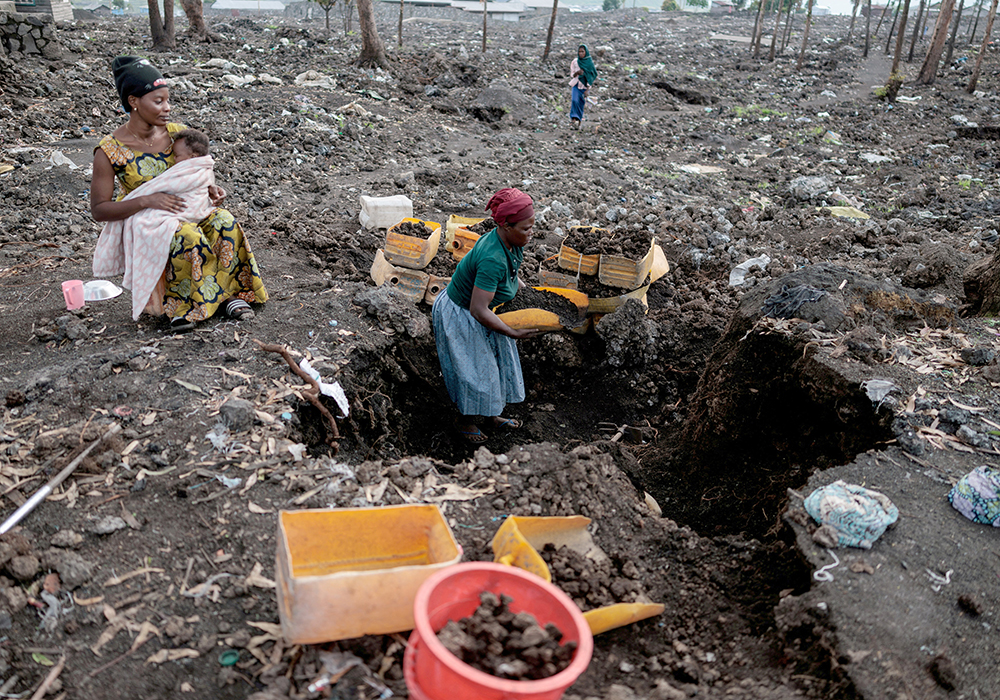
An internally displaced woman, who said she could not return home because it was destroyed during fighting, gathers volcanic gravel to sell at a camp in the Mugunga district, near Goma, in eastern Congo, March 22, 2025. The camp was emptied after M23 rebels ordered many displaced people to leave it and other camps. (OSV photo/Reuters/Zohra Bensemra)

by Doreen Ajiambo
Editor's note: For security and pastoral sensitivity, the identities of sisters interviewed for this story have been withheld at their request.
By day, the streets of Bukavu, a city in eastern Democratic Republic of the Congo, can appear deceptively calm.
Women still balance baskets of fruit on their heads. Motorbikes weave through crowded roads. Church bells still ring over the hills that descend toward Lake Kivu.
But beyond the city center, the sound of war has not gone silent.
Gunfire still crackles in the outskirts. Families continue to flee villages with whatever they can carry. At night, fear settles heavily over homes and convents alike, as residents listen for explosions, drones or footsteps in the dark.
The latest fighting involves the March 23 Movement (M23) rebel group that has seized large parts of eastern Congo, including major urban centers in North and South Kivu. M23 is linked to the Congo River Alliance or Alliance Fleuve Congo (AFC), a political-military coalition.
For Catholic sisters who have chosen to remain in the region as conflict deepens, staying has become both a ministry and an act of witness.
"We remain here by God's grace, even as we live under the control of the AFC/M23 movement," said a superior of a women's religious congregation in Bukavu, who requested anonymity for security reasons. "In the city, there is some calm, but in the outskirts of Bukavu, fighting is still ongoing."
A conflict reshaping daily life
Her words reflect the fragile reality facing eastern Democratic Republic of the Congo, where war continues to redraw daily life.
The conflict, driven by decades-old ethnic tensions, regional rivalries and competition over the region's vast mineral wealth, intensified after M23 rebels renewed offensives in 2025. According to the Council on Foreign Relations, the Congolese government and several international actors have accused neighboring Rwanda of backing the armed group, a claim Kigali denies. The region's rich deposits of cobalt, coltan and gold — minerals essential to global electronics and green energy supply chains — have long fueled competing interests and armed violence.
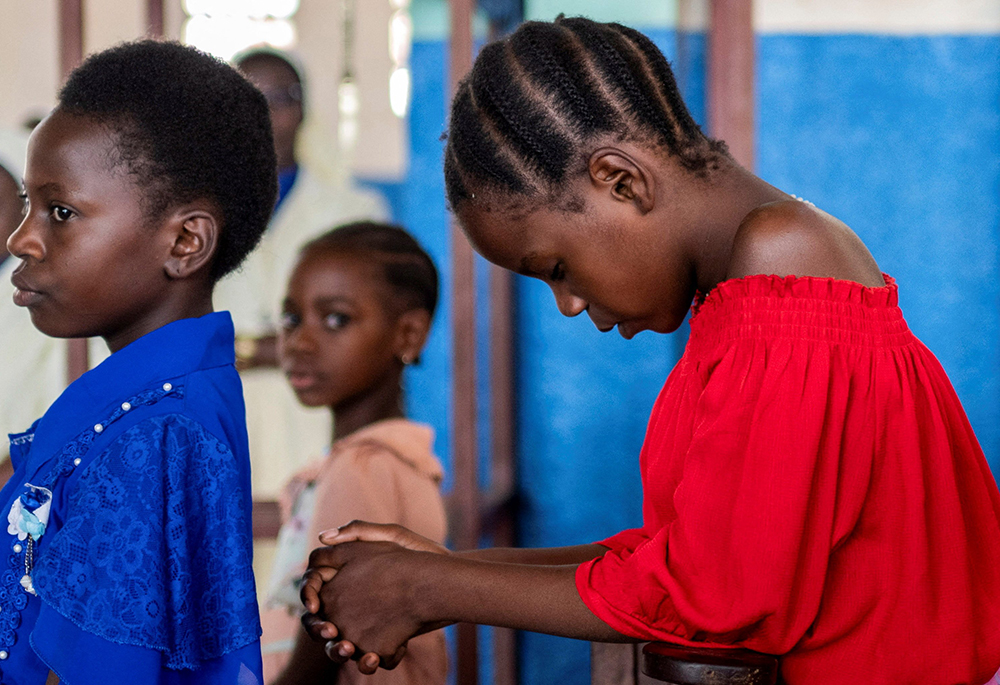
A girl prays during Mass at a Catholic church in Uvira, Congo, Dec. 14, 2025, after members of the Alliance Fleuve Congo AFC-M23 Movement took over the town from the Democratic Republic of the Congo, or FARDC. A climate of fear reigned Dec. 13 in Uvira, a strategic city in eastern Congo, days after it fell to the Rwanda-backed M23 group, as fighting in the region escalated despite a U.S. mediated peace deal. (OSV News/Reuters)
Despite M23's declaration of a unilateral ceasefire on Feb. 4, Vivian van de Perre, a United Nations official, warned in March that hostilities have expanded beyond North and South Kivu toward Tshopo Province and areas near Burundi's border, "raising fears of a broader regional conflict," according to a U.N. report
For ordinary Congolese, however, the war is measured less by political statements than by its relentless human toll.
According to the latest Integrated Food Security Phase Classification analysis, about 26.6 million people in the DRC are facing severe food insecurity, while millions remain displaced, most of them in the eastern provinces.
For sisters, those numbers are the faces they see every day.
"This conflict has touched every life," the Bukavu-based superior said. "You see it in the growing poverty, in unemployment, in the aggression among people. There is more dishonesty, more violence, signs of a society under deep strain."
Markets that once bustled with trade now often close early as residents fear movement after dark. Parents worry whether children can safely walk to school. Transport routes into some villages have become unreliable because of damaged roads, military checkpoints and shifting front lines.
Advertisement
In Goma, another sister said fear has become so pervasive that even speaking can be dangerous.
"Being in this occupied area, if it is ever discovered that I provided any information, my life would be in danger," she said, also requesting anonymity. "Right now, we are the only sisters available in this region."
Her caution mirrors reports of intimidation of journalists, aid workers and community leaders in areas under rebel control.
The conflict has also taken a devastating toll on women and girls. Van de Perre, the interim head of the U.N.'s Congo peacekeeping mission MONUSCO, recently confirmed at least 173 cases of conflict-related sexual violence since late 2025, most involving women and girls, while warning that the actual number is likely far higher.
Families told Global Sisters Report of their repeated displacement, and scenes in Bukavu reflected that reality: belongings bundled into sacks, children carried on their mothers' backs, and households moving yet again toward church compounds and temporary shelters.
Convents as places of refuge
For Catholic sisters, convents have increasingly become places of refuge and quiet resistance.
They accompany displaced mothers. They pray with families who have lost loved ones. They help those struggling to find food, medicine and school fees.
"What people are asking for is simple but urgent: peace, someone to listen to them, and support to survive, both financially and materially," the superior said.
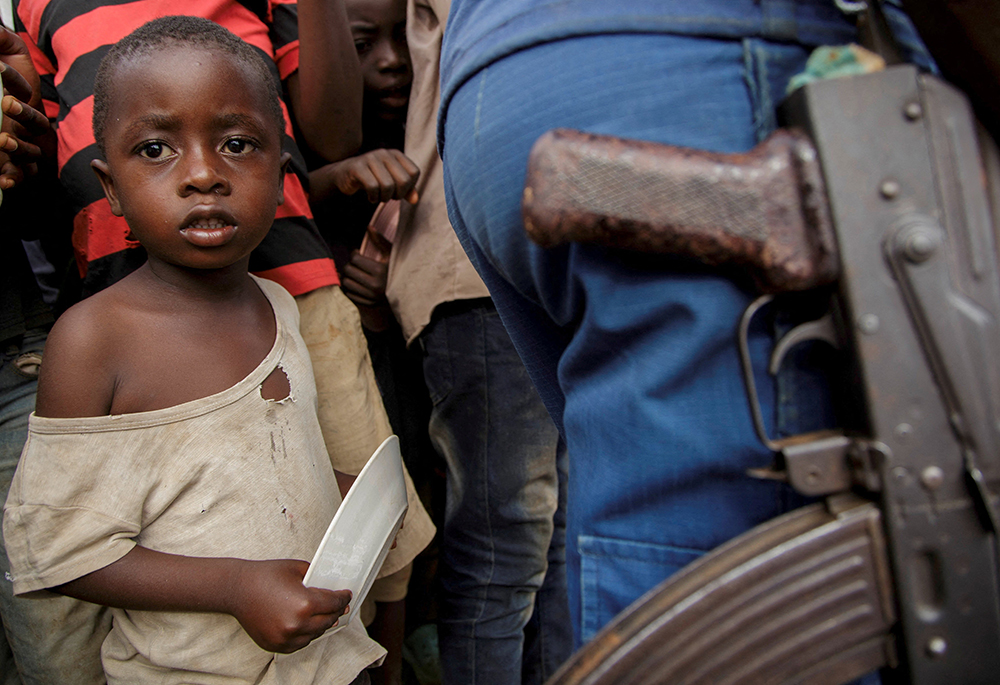
A child stands next to a police officer as displaced families wait for food at Rugombo Stadium in Burundi Feb. 18, 2025, after Congolese fled from renewed clashes between M23 rebels and the armed forces of the Democratic Republic of the Congo (FARDC). (OSV News/Reuters/Evrard Ngendakumana)
The sisters say their ministry has changed with the war.
Where once much of their work focused on education, pastoral accompaniment and community outreach, it now increasingly centers on emergency support and trauma care.
They listen to women who have lost husbands and sons. They pray with mothers separated from their children. They accompany people living with the daily uncertainty of violence. Sometimes, they say, the most important ministry is simply presence.
Where once much of the sisters' work focused on education, pastoral accompaniment and community outreach, it now increasingly centers on emergency support and trauma care.
For residents, daily life has narrowed into routines of uncertainty.
"Every night we sleep listening for sounds outside," said Chantal Bahati, a Bukavu resident. "Sometimes it is gunfire, sometimes people running. We wake up unsure whether the roads will still be safe in the morning."
She said people in her neighborhood now live with a constant readiness to flee.
"Some families keep bags packed near the door," she said. "We no longer sleep deeply."
Churches and religious houses have in some cases become informal shelters, receiving women, children and elderly people displaced by fighting in surrounding villages.
Even with scarce resources, the sisters continue to share what they have.
The superior described poor roads and insecurity as some of the biggest challenges to reaching people in need.
The conflict's roots stretch back nearly three decades, to the aftermath of the 1994 Rwandan genocide and the wars that followed, which destabilized eastern Congo and left millions dead or displaced.
Yet beyond the geopolitics, the sisters describe the crisis in spiritual terms.
'Some families keep bags packed near the door. We no longer sleep deeply.'
—Chantal Bahati, a Bukavu resident
Faith, courage and the choice to stay
"I have come to accept that I cannot change the reality of war. It is real," the Bukavu superior said. "But I can change how I live within it. I choose to walk through it with faith and hope, together with my community."
For her, the war has become a school of spiritual endurance.
"In this difficult time, I am learning to be courageous and patient — to forgive, to hope, to tolerate, to pray, and to discern," she said.
In Kinshasa, where life is relatively calmer, another sister said communities continue to pray for the east.
"The people on the eastern side were the most affected and some are still living in fear," she said. "We pray that everything settles down soon so that they can resume their lives."
For many in eastern Congo, hope itself has become an act of resistance.
Even as political leaders trade accusations and armed groups continue to shift positions, the sisters say their mission remains rooted in staying with the people, accompanying and advocating for peace.
The Bukavu superior said she hopes the wider church will continue to raise its voice.
"I ask the church to speak out for those of us who are marginalized, to advocate for peace and to keep calling on those who fuel this war to stop, with urgency and persistence."
The quiet resilience of the sisters is, in many ways, the story of eastern Congo itself: a people wounded, displaced and afraid, yet still holding fast to the possibility of peace.
"We may not be able to end the war ourselves," she said, "but we can choose how we live through it, with faith, with hope, and with the courage to remain present among our people."
Ameen Auwalii contributed to this report from the Democratic Republic of the Congo.