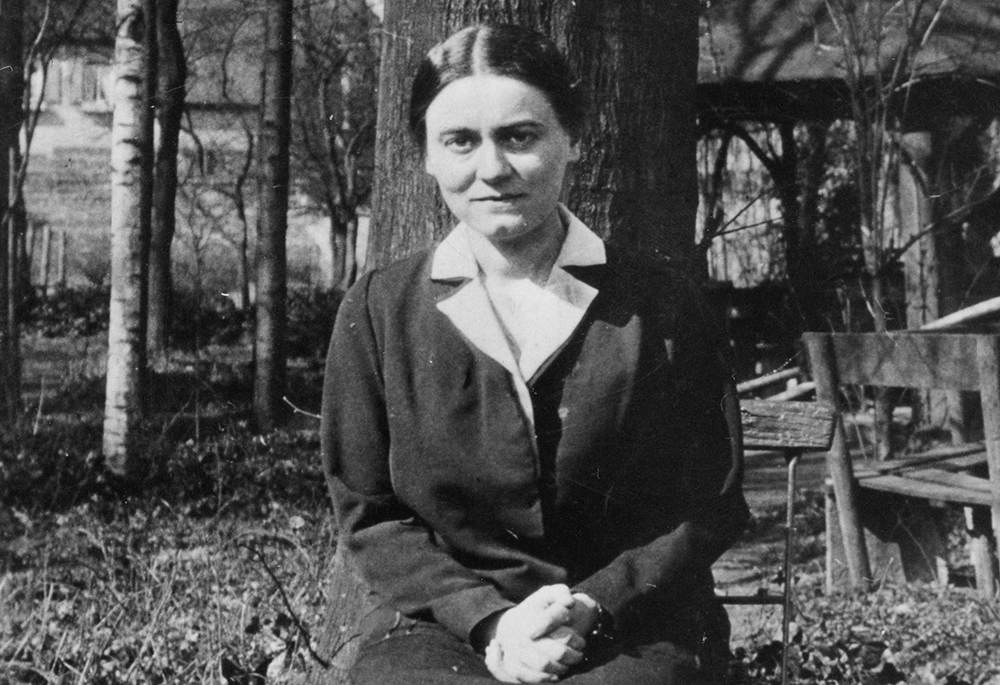
St. Teresa Benedicta of the Cross, also known as Edith Stein, is pictured in an undated photo. St. Teresa converted from Judaism to Catholicism in the course of her work as a philosopher, and later entered the Carmelite order. She died in the Nazi concentration camp at Auschwitz in 1942. (OSV News/CNS Archive)

Today is an appropriate moment to remember and honor Edith Stein.
Jan. 27 marks the United Nations International Day of Commemoration in memory of the victims of the Holocaust — an annual event that, as the world body describes it, "dignifies the victims and survivors of the Holocaust."
One of those victims was Stein (1891-1942). Born and raised Jewish, she converted to Catholicism in 1922, later becoming a Discalced Carmelite nun who was arrested by the Gestapo and perished in Auschwitz in 1942.
Stein, who was already a noted German lay educator, scholar and philosopher before she entered religious life, took the name Teresa Benedicta of the Cross, and was canonized as a saint by Pope John Paul II in 1998.
Stein's life and example are models for anyone of any faith, and I spent some time during the recent winter holidays being introduced to Stein through a small volume published in 2002 by Orbis Books entitled Edith Stein: Essential Writings, part of the publication's ongoing Modern Spiritual Masters series.
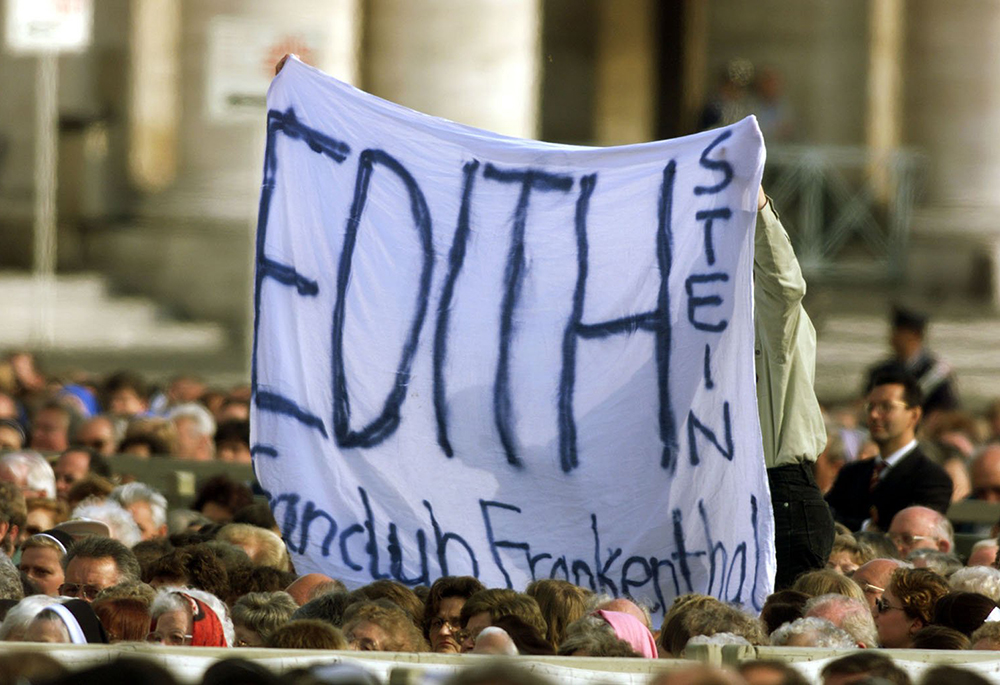
Pilgrims hold up a banner in St. Peter's Square during the canonization of Edith Stein Oct. 11, 1998. (CNS/Reuters)
What struck me most about Stein's thought and spirituality were a sense of awe, openness and empathy. Perhaps because she was a convert and had a belief in ecumenism, Stein was able to look beyond what Carmelite Fr. John Sullivan in his introduction calls "mere rote repetition of standard tenets." Stein, he writes, "never gave into such parochialism. She embodied a spirituality that was always open and connected to her surroundings."
There are several examples of this. Stein wrote admiringly of Edmund Husserl (1859-1938), her mentor and doctoral adviser at the University of Freiburg. Husserl was the Protestant founder of phenomenology, the philosophical movement seeking to study human experience objectively.
"I am not at all worried about my dear Master," she wrote as Husserl lay dying. "It has always been far from me to think that God's mercy allows itself to be circumscribed by the visible church's boundaries. God is truth. All who seek truth seek God, whether this is clear to them or not."
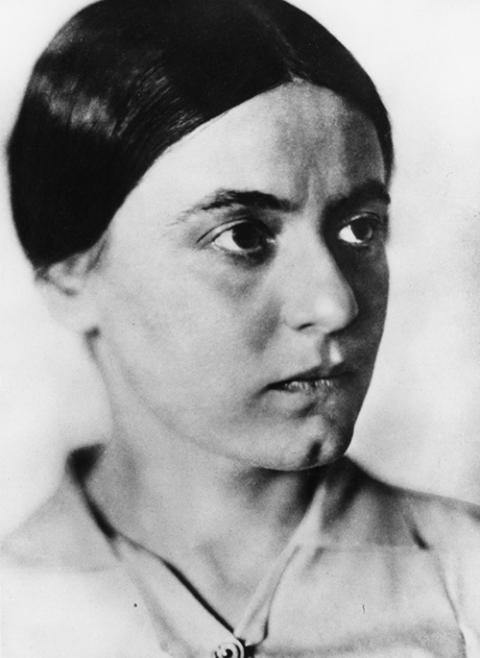
St. Teresa Benedicta of the Cross, also known as St. Edith Stein, is pictured in an undated photo. (CNS files)
As well, Stein revered and prized her Jewish roots. Though her conversion to Catholicism and her embrace of religious life caused her Jewish mother Auguste Stein sadness and even distress, Stein continued "her esteem" for Judaism, Sullivan writes, and told her mother that as a Catholic, "she had come to appreciate as never before the grace-bearing elements that Judaism offered." And in fact, she penned a loving memoir, Sullivan notes, of her Jewish childhood "at precisely the time when anti-Semitic hatred was breaking out in Germany."
The darkness of that era is evident in a number of the selections highlighted by Sullivan. After the notorious November 1938 attack on Jewish synagogues, stores and institutions called Kristallnacht, Stein wrote to the Ursuline Mother Petra Brüning and said: "As the atmosphere around us grows steadily darker, all the more must we open our hearts to the light from above."
That sense of hope continually animated Stein's life.
"If God is in us and if he is love, then it cannot be otherwise but to love one another. Therefore, our love for our brothers and sisters is the measure of our love of God," Stein wrote.
This love, she said, is different from what might be called a more familiar "human love" in which love is extended out only to those because they are family or friends and the rest are strangers who might even "annoy us."
For the Christian, she believed, "there is no 'strange human being.' He is in every instance the 'neighbor' whom we have with us and who is most in need of us. It makes no difference whether he is related or not, whether we 'like' him or not, whether he is 'morally worthy' of help or not."
She continued: "The love of Christ knows no bounds, it never ceases, it never withdraws in the face of hatred or foul play. He came for the sake of sinners and not for the righteous. If the love of Christ lives in us, then we do as he did and seek after the lost sheep."
In that regard, those who have found and felt Christ's love — "blessed souls" Stein called them — and who have "entered into the unity of life in God, everything is one: rest and activity, looking and acting, silence and speaking, listening and communicating, surrender in loving acceptance and an outpouring of love in grateful songs of praise."
Advertisement
To me that suggests Stein is describing women who, like her, embraced religious life. Yet Stein also wrote movingly of the laity — those who "live with Holy Church and its liturgy, i.e., as authentic Catholics," and as such "can never be lonely; they find themselves embedded in the great human community everywhere all are united as brothers and sisters in the depths of their hearts."
That sense of community is enriching and is expansive — looking outward. Stein wrote that those who have surrendered to Christ are not "blind and deaf to the needs of others — on the contrary. We now seek for God's image in each human being and want, above all, to help each human being win his freedom."
One interesting note about Stein's thought and life is that as a laywoman, scholar and teacher and then as a woman religious, Stein championed the cause of women's rights.
While not taking a definitive position on the issue of women's ordination in the Catholic Church, her musings reflect an open mind and inquiring spirit.
Stein noted that in "common usage, we say that priests and religious must be especially called, which means that a particular call must be sent to them by God. Is there any difference between the call sent to man and that to woman?" She said that wherever one landed on that issue — and which was "until now unheard of" — the idea of women's ordination could not be "forbidden by dogma."
Though heralded as a thinker, Stein must also be remembered for her pastoral kindness and love toward others.

Barbed wire near the Birkenau section of the Auschwitz-Birkenau concentration-death camp in Poland (NCR photo/Chris Herlinger)
Stein's conversion to Catholicism did not spare her an untimely fate. She was arrested, as was her sister, Rosa, another Catholic convert, in retaliation for Dutch bishops condemning the deportation of Jews by German authorities. "Come, we are going for our people," Stein reportedly told her sister.
After her arrest and before her deportation to Auschwitz, Stein passed through the Dutch transit camp Westerbork — she had fled Germany for what was then unoccupied Holland in 1938.
In his biographical note, Sullivan quotes a survivor of Westerbork who said that Stein's kindness and care of children there stood out. The survivor, Julian Marcan, said that it was Stein's "complete calm and self-possession that marked her out from the rest of the prisoners."
He recalled that many of the mothers confined in the camp "were on the brink of insanity and had sat moaning for days, without giving any thought to their children. Edith Stein immediately set about taking care of these little ones. She washed them, combed their hair, and tried to make sure they were fed and cared for."
That model should move us all, as professor James Paharik, the director of the National Catholic Center for Holocaust Education at Seton Hill University, recently told me.
"Edith Stein was a remarkable and, indeed, heroic person," he said. "To begin, we admire her willingness to study, embrace and practice the Catholic faith through her membership in the Carmelite community. At the same time, she gave up her life because she was unwilling to repudiate her Jewish identity and the faith of her ancestors."
Paharik added: "She was a living example of the deep and life-enriching bond that is possible between Catholics and Jews."
Those bonds mean a lot today because, as the United Nations says, "we witness daily assaults on our fellow global citizens," eight decades after the Holocaust.
"Antisemitism and hatred surge," the U.N. notes. "Denial and distortion of the Holocaust persist. Remembrance of the Holocaust defies denial and distortion, rejects falsehoods, confronts hatred, and insists on the humanity of the victims."
But as we reflect on the Holocaust and its continued shadow over our world, we should do as Stein might have — constantly aware of the denial of human rights everywhere.
"The defense of universal rights is essential for sustainable peace and lies at the heart of the United Nations," the world body says. "In remembering the victims of the Holocaust, we affirm our shared humanity and pledge to defend the dignity and human rights of all."
One of those who helps us remember is Edith Stein. Saint, scholar, bridge between two religious traditions, and an inspiration.