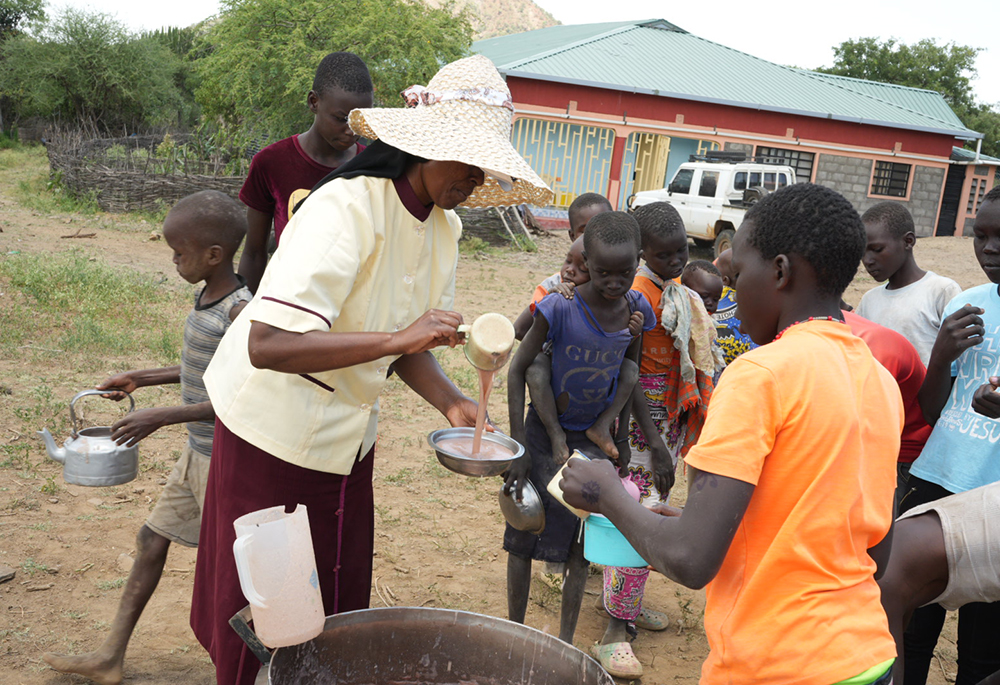
Sr. Jannifer Hiuhu serves porridge to children outside the Incarnate Word Sisters’ convent in northern Kenya. For many students at the congregation’s primary school, the sisters’ "Porridge for Breakfast" program provides their only meal of the day, as nomadic families search for pasture amid a prolonged drought. (GSR photo/Wycliff Peter Oundo)

by Doreen Ajiambo
Before the sun fully rises over this northern Kenyan region, the ground is already dry, cracked and unforgiving. Amina Guyo, 40, steps outside her mud-walled home and scans the horizon, searching for any sign of relief. There is none. The earth beneath her feet has hardened into fissured clay, split open by months of relentless drought.
She lifts two yellow jerrycans onto the back of a donkey and begins the long walk toward the nearest water point, nearly 14 kilometers (8.68 miles) away. It is a journey she makes several times a week, sometimes every day in the worst dry spells. By the time she returns, the sun will be high, the heat oppressive, and the water she carries must last her family until she can make the trek again.
"This land used to feed us," said Guyo, a mother of four and a member of the region's pastoralist community. "Now it barely allows us to survive."
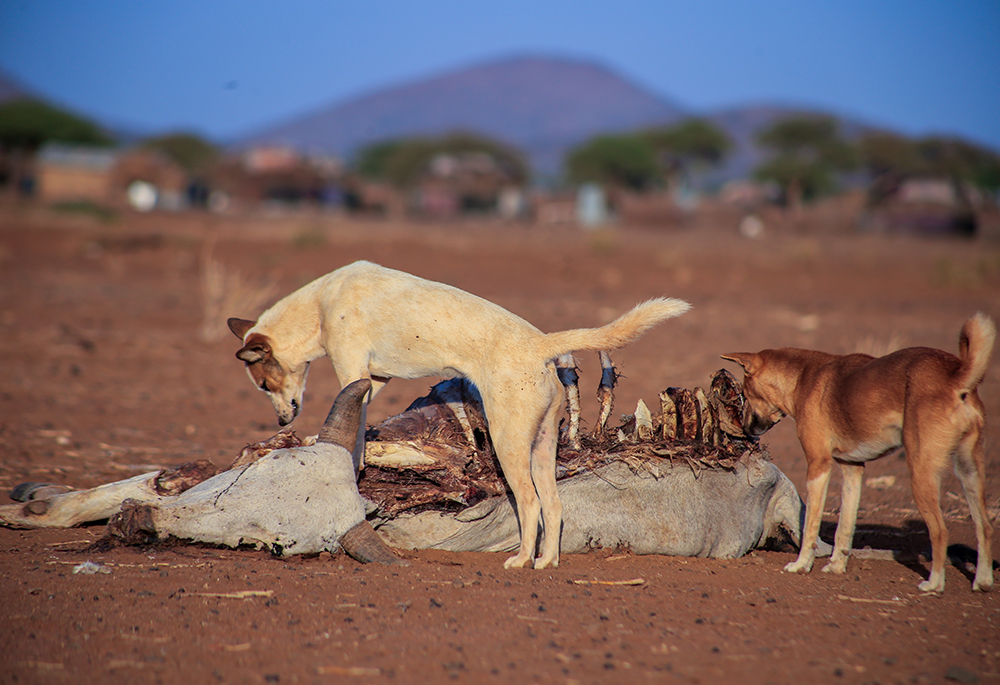
Stray dogs feed on the carcass of a cow in northern Kenya. (Pius Artbeat)
For generations, her family depended on seasonal rains and grazing lands to sustain their livestock. Today, those rhythms have collapsed. Droughts last longer. Rainfall arrives too late or not at all. The land that once supported entire communities has become increasingly hostile to life.
As families like Guyo's struggle to survive, their daily reality now intersects with global climate diplomacy, even as world leaders met last November at COP30 in Belém, Brazil, to debate how to respond to the crisis reshaping lives across Africa.
In Marsabit and neighboring counties, Catholic sisters and parish workers are often among the first responders, organizing food distributions, supporting water projects, offering trauma counseling and advocating for climate justice far beyond their parishes.
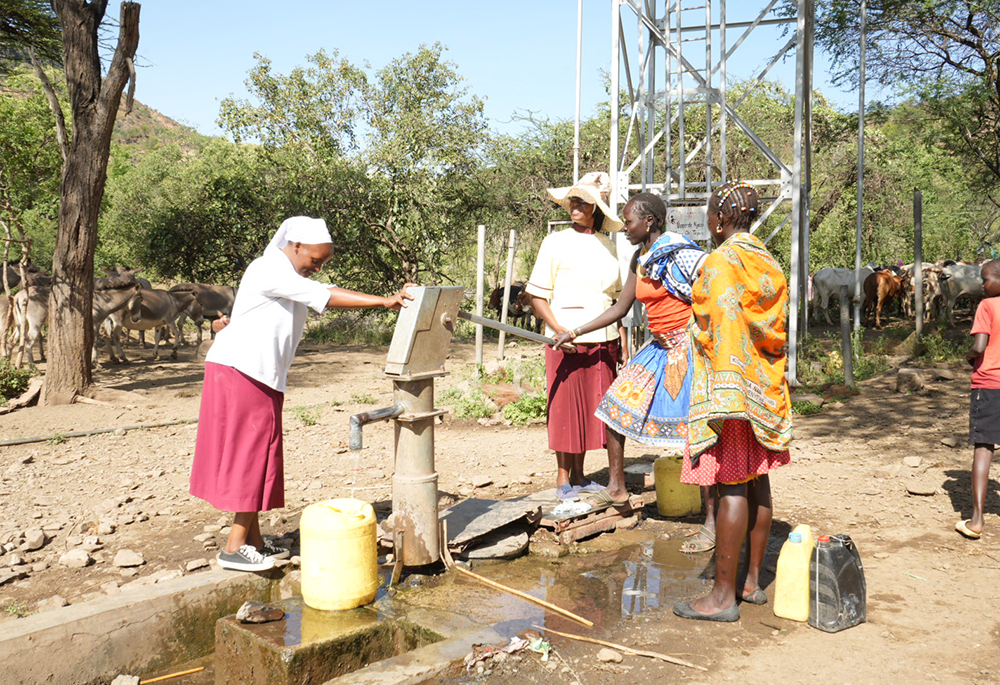
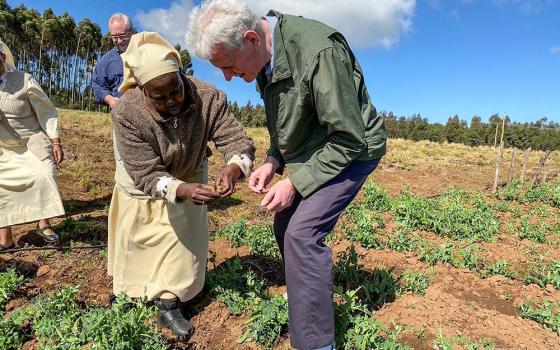
Srs. Aquilina Munyao and Jannifer Hiuhu inspect a borehole the church drilled for Rotu village in northern Kenya. The community protects and maintains the borehole, the only water source for families and their flocks. (GSR photo/Wycliff Peter Oundo)
Across northern Kenya, sisters say they are seeing levels of hunger and displacement that go far beyond what local communities can manage alone.
"We are seeing women walk farther for water, children drop out of school and families losing the last of their livestock," said Sr. Jannifer Hiuhu of the Incarnate Word Sisters, who works in drought-affected pastoral regions of northern Kenya.
Hiuhu and other sisters regularly travel long distances to deliver food rations, organize community feeding programs and support families displaced by drought and conflict. In some villages, sisters provide daily porridge for children and emergency food for households that have lost their animals, often the only source of income and nutrition.
Hiuhu said the loss of livestock strips families of their entire way of life at once, leaving them without food, income or a sense of security. As sisters, she said, their mission is to remain present with families in crisis, reminding them they are not alone as they struggle to survive.
She said the scale of need has grown as droughts become longer and more severe, stretching already limited church resources.
"We are responding to emergencies almost every week now," she said. "What we are seeing is not just a humanitarian problem. It is a climate problem."
Promises and limits
As Guyo walked for water, global leaders, scientists and advocates gathered thousands of kilometers away in Belém, Brazil, for the 30th United Nations Climate Change Conference, known as COP30. The summit, held Nov. 10-21, 2025, was billed as a turning point in the global response to climate change.
Held in the Brazilian Amazon, a region often described as the "lungs of the planet," COP30 carried enormous symbolic weight. Religious sisters, bishops, priests and Catholic lay leaders joined the talks, framing climate action as both a moral and spiritual responsibility.
"The people we serve are already in survival mode," said Sr. Immaculate Tusingwire, a member of the Medical Mission Sisters from Uganda who attended the summit. "For them, climate change is not theory. It is hunger, displacement and sickness."
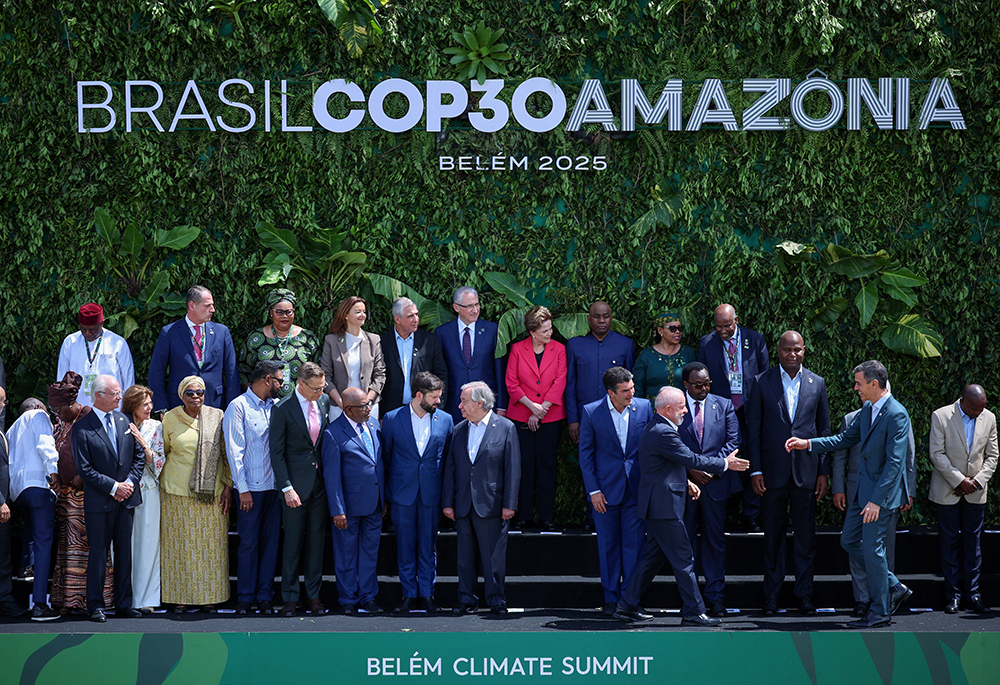
Brazil's President Luiz Inacio Lula da Silva greets Spain's Prime Minister Pedro Sanchez Nov. 7, 2025, as they and other delegates attending the Belem Climate Summit gather for a family photo in Belem, Brazil, ahead of the United Nations Climate Change Conference, or COP30, taking place Nov. 10-21. (OSV News/Reuters/Adriano Machado)
Expectations were high that governments would commit to bold action, particularly to phase out fossil fuels, the primary driver of global warming. But as negotiations unfolded, those hopes dimmed.
The final outcome, known as the Belém Package, included commitments to triple adaptation finance by 2035 and to establish a just transition mechanism intended to support workers and communities affected by the shift away from fossil fuels. However, the agreement stopped short of committing to a global phase out of fossil fuels, a demand long championed by scientists, climate vulnerable nations and faith leaders.
"My biggest expectation was that we would finally see a clear and binding commitment to move away from fossil fuels," Tusingwire said. "That did not happen. And without that, everything else feels like delay."
The Catholic delegation at COP30 was the largest it has ever been at a climate summit, reflecting a growing role for religious congregations in global climate advocacy.
"Climate change is not just an environmental issue," said Gina Castillo, senior climate policy adviser at Catholic Relief Services. "It is a moral crisis. When people lose their land, their homes, their means of survival, it becomes a question of human dignity and justice."
Castillo said faith communities bring a perspective rooted in long-term presence.
"We walk with communities before, during and after disasters," she said. "That gives us a responsibility to speak at global tables on their behalf."
For sisters like Hiuhu, that advocacy is shaped by what they see daily, families arriving at mission centers hungry, children fainting in school and women walking for hours to find water.
"We cannot pray for rain and ignore the policies that are making this worse," Hiuhu said. "Faith calls us to speak when systems fail the poor."
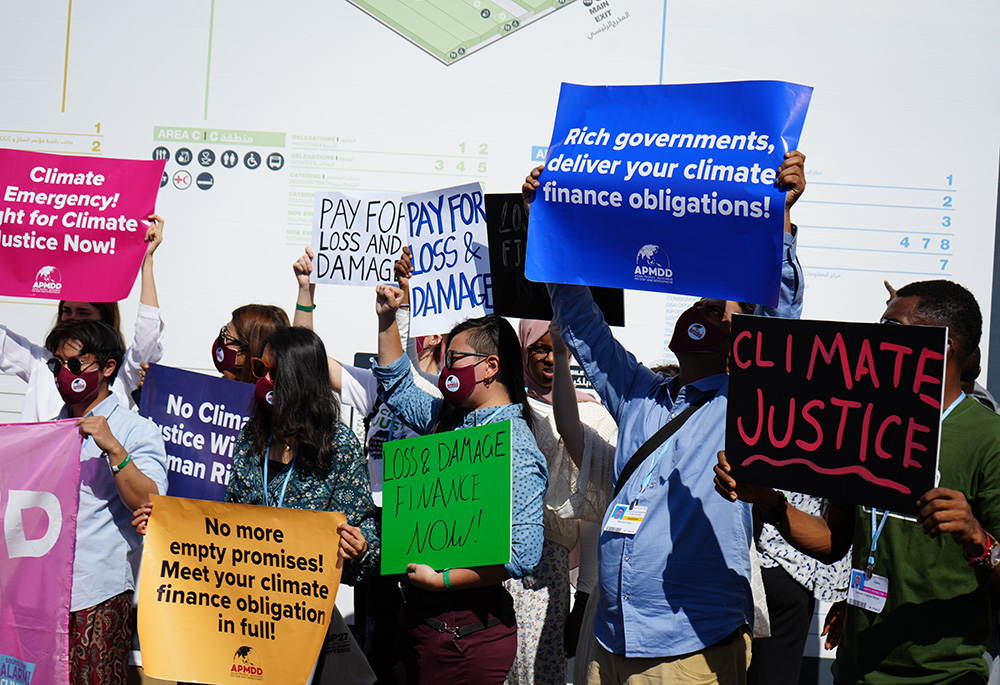
Climate justice activists hold placards demanding that wealthy nations meet their climate finance commitments during the 2022 COP27 climate conference in Sharm el-Sheikh, Egypt, calling for accountability and support for countries bearing the brunt of climate change. (GSR photo/Doreen Ajiambo)
Africa's unequal burden
Africa produces about 2 to 3% of global greenhouse gas emissions, yet faces some of the most severe climate impacts. Limited infrastructure, widespread poverty and dependence on rain-fed agriculture make adaptation difficult without sustained international support.
In East Africa, prolonged droughts have devastated crops and livestock. In southern Africa, powerful cyclones have flattened homes and displaced entire communities. In West Africa, unpredictable rainfall threatens food security for millions.
"Climate change is not an abstract concept for us," said Joyce Mulenga, a community organizer from southern Zambia. "It is hunger. It is losing your home. It is watching your children suffer and not knowing how to help them."
Advertisement
Mulenga's community was hit hard by Cyclone Freddy, one of the longest lasting tropical storms on record. Floodwaters destroyed homes and farmland, leaving families with nothing but the clothes they wore. Churches and faith groups became emergency shelters and food distribution centers.
"We are still trying to rebuild," she said. "But every year there is another disaster. We are exhausted."
For faith leaders, the decision to delay major increases in adaptation financing until 2035 was particularly troubling.
"People cannot wait another decade," said Antonio Yayrator Korkuvi, policy officer and head of delegation for the International Federation of Catholic Parochial Youth Movements. "Every year of delay means more hunger, more displacement, more suffering."
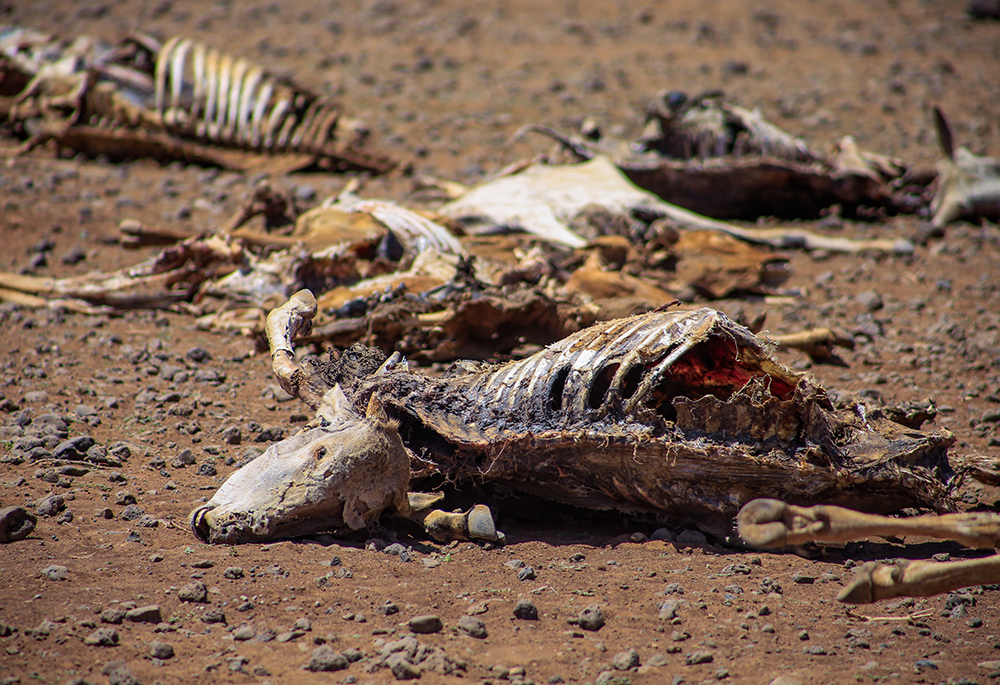
The skeletal remains of livestock lie scattered across the parched ground in Marsabit County, northern Kenya. (Pius Artbeat)
Back in Marsabit, sisters and parish workers help families cope with drought through food aid, water access projects and support for displaced pastoralists. But they say humanitarian responses cannot replace systemic change.
"We are constantly responding to emergencies," Hiuhu said. "But without serious global action, we will remain in crisis mode forever."
As the sun sets over Marsabit, Guyo pours the last of the water into a small pot to prepare a simple meal. There is no electricity, no refrigeration, no guarantee of food tomorrow.
She has heard of climate conferences and global pledges on the radio, but those promises feel distant from her daily struggle.
"We hear people talking about climate change," she said. "But we are the ones living it."
Outside her home, the air cools slightly as night falls. Her children sleep beside her, their futures uncertain. Nearby, sisters and church workers prepare for another day of visiting households in crisis.
"We don't know where this life is taking us," Guyo said. "We go to sleep hungry and wake up not knowing how we will survive. We are asking people of goodwill to help us before it is too late."