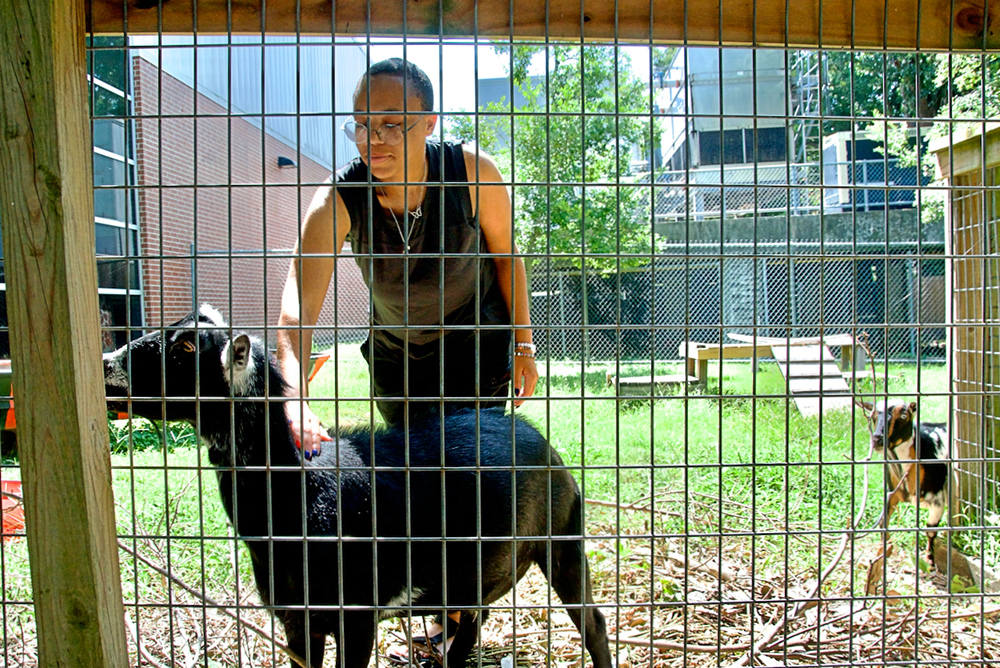
Teacher Ciara Littlejohn pets one of the goats in her garden classroom at Langston Hughes Academy in New Orleans, Louisiana. Littlejohn is a Sisters of Notre Dame de Namur Mission Volunteer and this summer took part in the congregation’s first Laudato Seeds of Change immersion program. (GSR photo/Dan Stockman)

It is the hottest part of the day, and the oppressive Louisiana sun is turning the humid air into something resembling hot, steamy gumbo. But Ciara Littlejohn is smiling broadly, because she is in her element.
She ducks under vines and trellises and pushes through huge banana tree leaves, pointing out all the different crops of the school garden she runs.
"In the summer we get a lot of melons and cover crops," Littlejohn said. "Also, figs, muscadines, tomatoes, a lot of marigolds. Oh, and bush beans."
The garden behind Langston Hughes Academy, a pre-K-8 public charter school in New Orleans' Fairgrounds neighborhood, produces about 500 pounds of food a year, most of which is given away to students' families and staff. More importantly, it produces students with a connection to naturally grown, healthy food and the environment it comes from.
The garden is part of the Edible Schoolyard New Orleans program, which also operates at three other charter schools run by the same company, FirstLine Schools. And Littlejohn is part of the Sisters of Notre Dame de Namur's Mission Volunteers program, which is funded by AmeriCorps and places volunteers across the country to live with and serve marginalized and vulnerable communities.
The Mission Volunteers began with two volunteers in 1992, and at its peak had up to 400 young adults serving in the United States.
And then DOGE — the Trump administration's Department of Government Efficiency — slashed the funding for AmeriCorps, and the Mission Volunteers program went from 300 participants to 34.
"It was heartbreaking and painful and agonizing," said Notre Dame de Namur Sr. Marie Prefontaine, a Mission Volunteers board member. "But it gave us the opportunity to step back and say, 'Who are we? Want what do we want to do, moving into the future?' "
One thing the sisters wanted to do was shrink the program to a more manageable size, and to make it not just a benefit to the communities the volunteers served, but also to develop those volunteers into leaders who have a sense of service for the rest of their lives.
"We're much more able to provide leadership experience for them," Prefontaine said. "It gives us the opportunity to be much more intentional."
Advertisement
With AmeriCorps funding reinstated, this year the program has 74 volunteers at 37 sites in 10 states. One of them is Littlejohn.
"I was looking for a teaching position, maybe art or something outdoors," Littlejohn said. "Then I saw an opening for a garden teacher. I love the people and I love working with the students."
So she moved from North Carolina to New Orleans and took over the garden at Langston Hughes Academy, where, in addition to the plants, there are chickens and goats.
And then in June, the Sisters of Notre Dame de Namur offered another opportunity: They were launching a week-long immersion program in the sisters' ecological efforts in Ipswich, Massachusetts, called Laudato Seeds of Change. Littlejohn joined six other women and two program coordinators at the sisters' campus on the edge of the Great Marsh, made up of more than 25,000 acres of barrier beach, dunes and water bodies, including more than 10,000 acres of salt marsh, learning to deepen the way they live, pray and care for the Earth.
"I learned a lot about that environment, the swamps and marshes," Littlejohn said. "We learned about the ecosystem within them and how they protect us from hurricanes."
She also got to see the sisters' projects in action.
"They have these big lawns, and they're digging them up and planting pollinator gardens," Littlejohn said. "They have a food forest and an herb garden."
And while Littlejohn and the other women did a lot of gardening, that wasn't the point of the program.
"It was to contemplate creation, to notice the connections within the community of creation, and notice the connection of us within the community of creation, not as superior beings above creation," Sr. Mary Alice McCabe said. "That is what seems to have touched them the most."
Just as the school in New Orleans has a garden as an outdoor classroom, the sisters' campus in Ipswich has the Cuvilly Arts & Earth Center, seven acres that are home to education spaces, regenerative vegetation, permaculture, alpacas, pigs, goats, sheep and other animals.
McCabe said the mornings were spent working in the barn, clearing the area for the food forest or in the medicinal herb garden, but there was plenty of time for reflection.
"It's not about finishing a project here," she said, "it's about learning. They learned about healing natural ecosystems."
Littlejohn said working with the sisters, especially Cuvilly founder and executive director Sr. Pat Rolinger, was amazing.
"They're wonderful, and I met so many in Massachusetts," Littlejohn said. "Picking Sr. Pat's brain is so interesting."
Back in New Orleans, Littlejohn is gearing up for the school year and the students who will be cycling through her garden classroom.
"I'm taking the learning and growing I did from there to growing here."