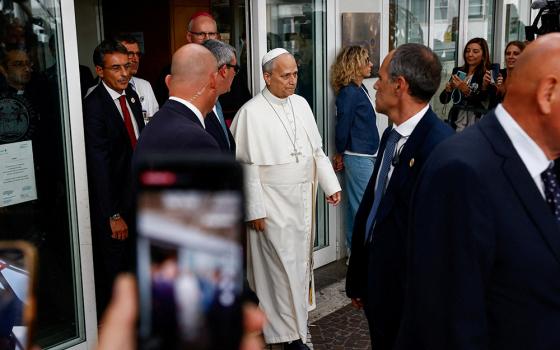
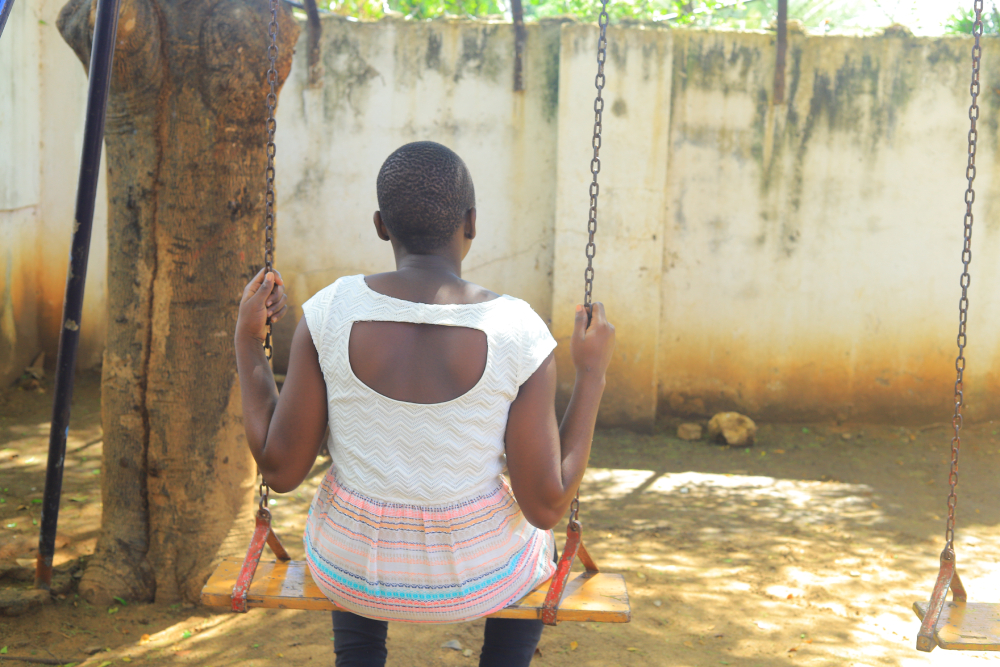
A girl sits alone on a swing at Mahali Pa Usalama, a safe haven run by Catholic sisters for survivors of sexual exploitation. (GSR photo/Doreen Ajiambo)

Global Sisters Report launched one of its most impactful series in 2025 with "Out of the Shadows: Confronting Violence Against Women." Our staff also reported live in Rome at the funeral of Pope Francis and the conclave that elected Pope Leo XIV.
Here are 10 noteworthy series or stories that we hope you will take time to read again, or share with others. In return, we will continue to be a source of inspiration, peace and hope by telling the stories of women religious worldwide.
Out of the Shadows: Confronting Violence Against Women
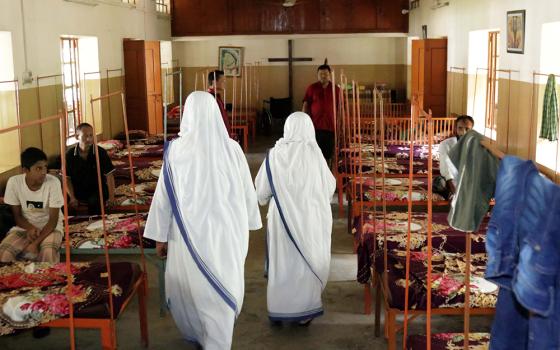
Started in March during Women's History Month, "Out of the Shadows" looks at the ways Catholic sisters are responding to gender-based violence. Sisters worldwide confront this issue, ministering to victims of human trafficking, child marriage, sexual and spiritual abuse, and more.
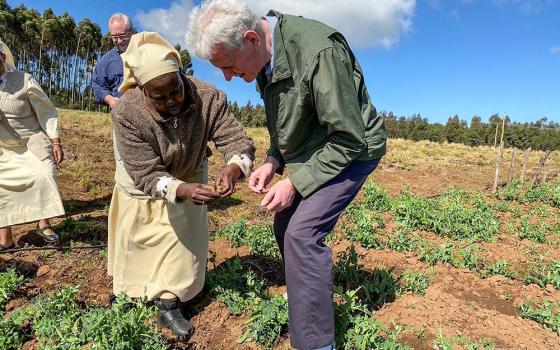
Africa and Middle East correspondent Doreen Ajiambo reported from Kenya on Catholic sisters who offer support to elder men and women who have been driven from their homes — if not killed — following accusations of witchcraft from those eager to take their land.
"What might appear on the surface as cultural belief is, in many cases, a form of gender-based violence targeting vulnerable women under the guise of tradition," Ajiambo wrote.
Few know Pope Leo XIV like these Augustinian sisters from Peru's Catholic community
Latin American regional correspondent Rhina Guidos reported for GSR from Rome during the conclave, using her sources in South America to give context to Pope Leo XIV's life in Peru when he was Cardinal Robert Prevost.
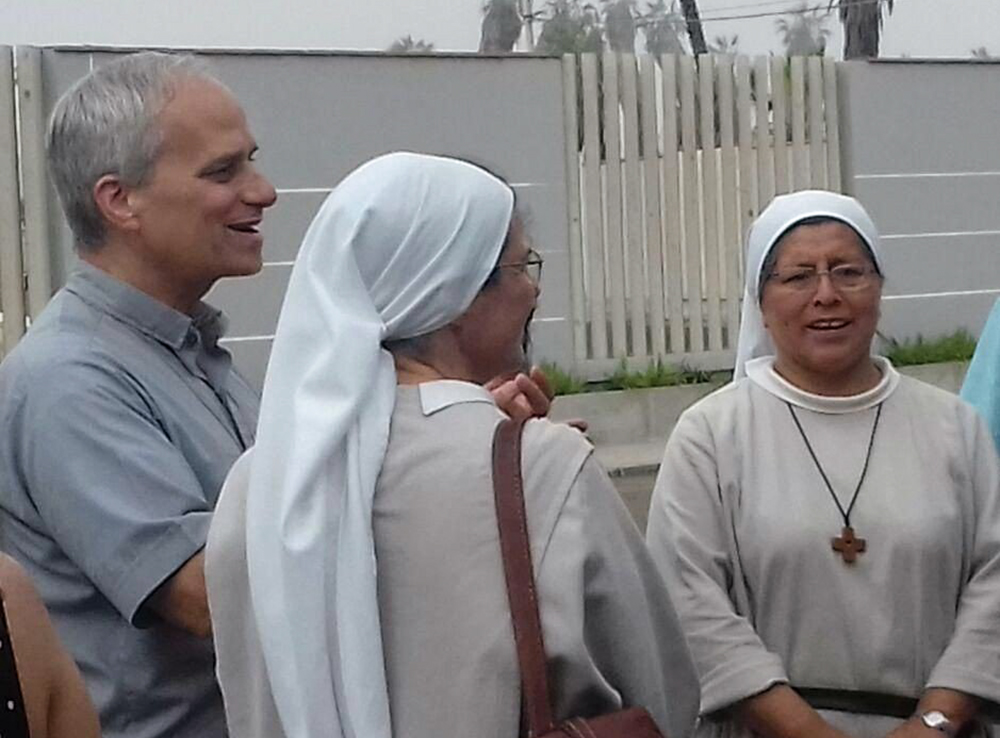
The future Pope Leo XIV visits with Augustinian sisters in Peru in this undated photo. As an Augustinian priest, then-Father Robert F. Prevost spent many years as a missionary in Peru and also served as bishop of that country's Chiclayo Diocese. (OSV News/Courtesy of Augustinian Sr. Carmen Toledano)
"For decades, Augustinian sisters in Peru like [Sr. Carmen] Toledano had a front-row seat to a pope in the making," Guidos wrote. "They traveled with him and saw his work up close in places like Chuquibambilla, one of the most poverty-stricken parts of Peru. They saw the way Prevost moved into action to secure oxygen tanks for the poor who contracted COVID-19 and took the consecrated host to a park in Chiclayo, where he was bishop, to provide spiritual comfort during the pandemic on the feast of Corpus Christi."
After all, being Augustinian is a core part of Leo's identity.
"The pope has a Latin American nationality and he has worked in Latin America, shared the hard realities with people, broken bread with them," but it would be a stretch, as many have done, to call him the second Latin American pope after Francis, said theologian Consuelo Vélez of Colombia. "He's an Augustinian who has experienced Peru as a missionary and that is a rich experience. But would I say he's a Latin American? No."
In act of reparation, Franciscan sisters return land to Chippewa Indians in Wisconsin
The Franciscan Sisters of Perpetual Adoration sold their spirituality center to the Lac du Flambeau Band of Lake Superior Chippewa Indians, making the congregation the first Catholic institution to return land to a Tribal Nation in the name of reparations for colonialism and residential boarding schools, according to officials involved in the sale.
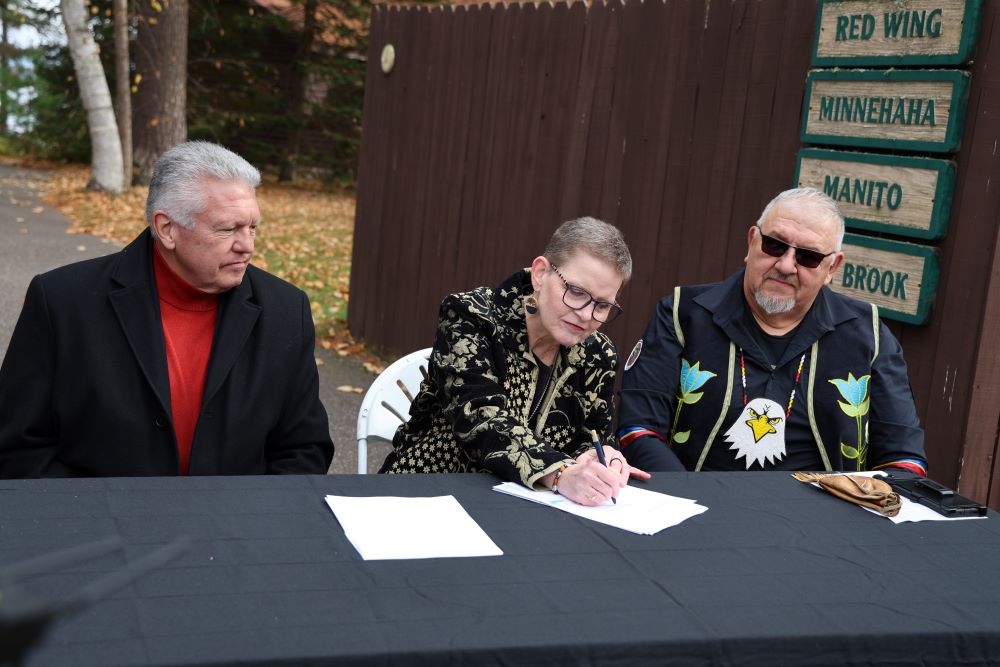
Lac du Flambeau Business Development Corporation CEO Larry Turner (left) and Lac du Flambeau Band of Lake Superior Chippewa Indians President John Johnson Sr. (right) look on as Sr. Sue Ernster signs title documents for property the Franciscan Sisters of Perpetual Adoration had owned Oct. 31. The nearly 2-acre parcel is about 15 minutes east of the Lac de Flambeau Reservation. (Courtesy of the Franciscan Sisters of Perpetual Adoration)
This story, reported by national correspondent Dan Stockman, was our most widely shared story on social media this year. On Instagram alone, it reached over 500,000 people with over 780,000 views.
"There's some pretty strong emotions of letting go, because people have had really good memories and experiences here," Franciscan president Sr. Sue Ernster told Stockman. "But it's not only the letting go — there's also the rejoicing of how we can break the system that created the trauma and the division between us and the original caretakers of the land."
Changing spaces: Sisters convert convents into senior housing
Converting convents to senior housing of one form or another is not new for congregations in the United States, but it is a trend that is growing as sisters reckon with capital assets they no longer need.
Already in the top 10 most read stories for GSR in 2025 after being posted Dec. 8, this report by Stockman illustrates the kind of stories that GSR is well-positioned to tell.

Sisters of St. Joseph of Orange pose for a group portrait in front of the order's motherhouse in Orange, California, in 1975. The motherhouse was built in 1959 to house about 60 sisters; in June 2025, the newly renovated building opened as Villa St. Joseph, a senior housing complex run by Mercy Housing. (Courtesy of the Sisters of St. Joseph of Orange)
"Part of the difficulty in these decisions, sisters in several congregations said, is not just the emotions that come with letting go of buildings — it's what that letting go represents. Admitting you no longer need a motherhouse is admitting that completion — even if it is still decades away — is now on the horizon," Stockman wrote.
In a divided Holy Land, Comboni Missionary Sisters act as a bridge
International correspondent Chris Herlinger visited the West Bank as a member of a delegation of journalists and scholars sponsored by the Jerusalem-based Sabeel Ecumenical Liberation Theology Center.
Herlinger visited the Comboni Missionary Sisters, a congregation based in the West Bank. Before the Oct. 7, 2023, attacks on Israel, the sisters engaged in efforts to nurture dialogue between Jewish and Palestinian Christian women, such as hosting interfaith and intercultural exchanges at the Comboni residence.
"But with the Gaza tragedy, everything stopped, the sisters said," Herlinger wrote. "They added that they are more than willing to shepherd such dialogue in the future. But for the moment, even with the shaky Gaza ceasefire, they say, continuing security concerns and wariness on both sides make that difficult."
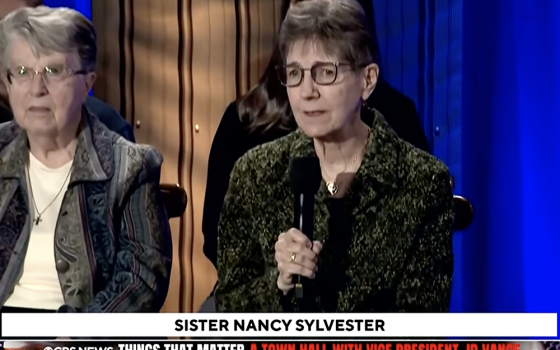
UNANIMA, prominent sister-led coalition at United Nations, to end its ministry
UNANIMA, a coalition of sister congregations at the United Nations that championed causes such as homelessness, anti-trafficking and women's health, will close by the end of the year.
The decision to conclude the coalition's work was painful but felt necessary due to difficulties in finding a new director, and the financial challenges some of the coalition's smaller congregational members are facing, Sr. Jean Quinn, the group's current director, told Herlinger.
"There's a lot of grieving and lamentation, I would say, in terms of coming to terms with endings and what's coming in the future," Quinn said, adding that she is still "in that grieving space myself."
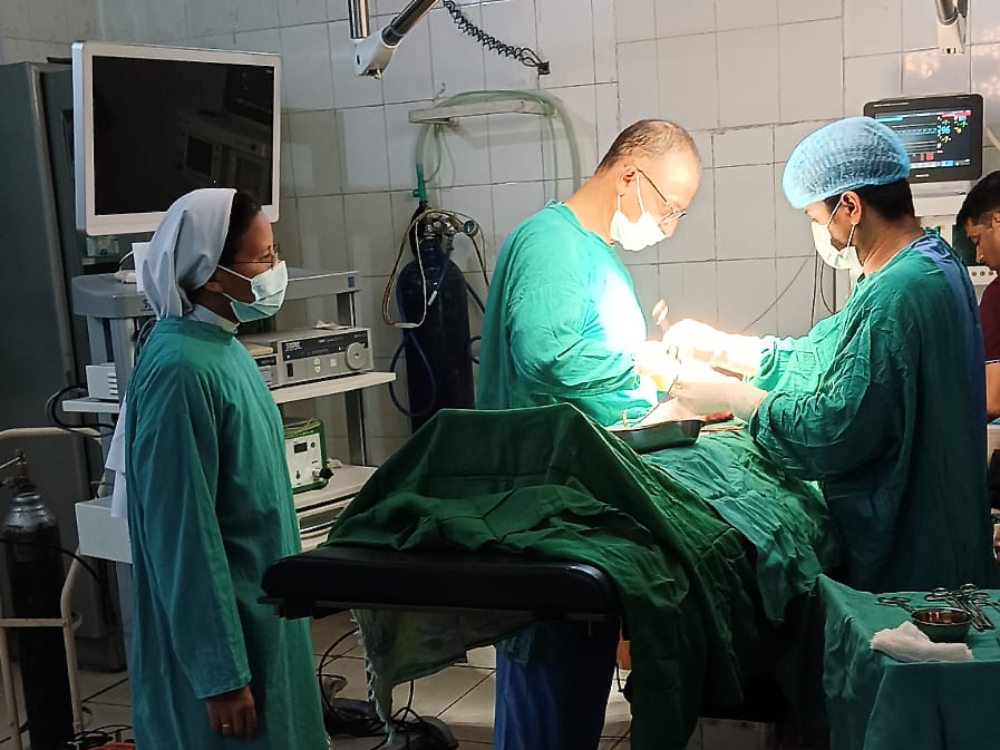
Sr. Lilly Thomas of the Sisters of Charity of Jesus and Mary assists in a surgery at St. Joseph Community Hospital in the Jammu-Srinagar Diocese, India. (Umar Manzoor Shah)
On India-Pakistan border, nuns endure hardships and conflict to care for all
As an international publication, GSR relies on partnerships with two other publications, Matters India and new this year, UCA News, to help us share news of sisters across the globe.
A writer introduced to us by UCA News, Umar Manzoor Shah, wrote this story about sisters who work as nurses at a Catholic hospital on the border of India and Pakistan, a conflict-afflicted region where religion-based social divisions also exist. The modest two-story building, operated by the Jammu-Srinagar Diocese, India, is the region's only charitable health care facility for the poor.
Catholic sisters reveal the greatest gifts of their vocation
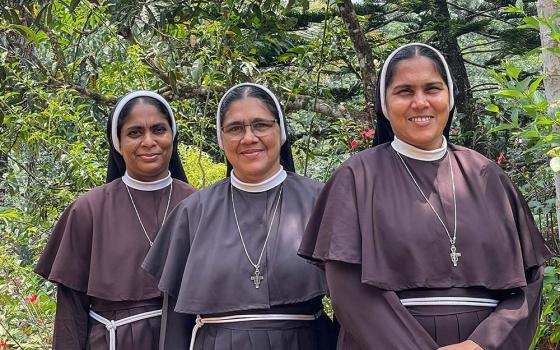
The Life, now in its ninth year, is a testament to the hard work and dedication of columns editor Benedictine Sr. Helga Leija, who works with a group of 20 sisters from across the globe to respond to questions about the unique, challenging and very specific lives of women religious.
The answer to this question — "What has been the greatest gift of your vocation?" — resonated with our audience.
"To live this vocation is to live in friendship — with God, with others, and with creation," one sister wrote. "That friendship, ever deepening, remains the greatest gift of my vocation."
Q&A with Sr. Josefina Cattaneo, the Argentine nun evangelizing as a TikTok superstar
Originally published in Spanish at GSR en espanol, Guidos interviewed Sr. Josefina Cattaneo, a 29-year-old Mercedarian of the Child Jesus who uses TikTok to share with her followers about religious life.

(GSR graphic)
"God can be found everywhere," Cattaneo said. "I believe that if Jesus were around, he would use social networks ... because in his time he looked at all the different ways to reach people, he did it in all kinds of ways and has always been very creative."
The doctor in a nun's habit: A small town's beloved 'Sister Doctor'
This column, one of the most read stories on our site for 2025, shows why letting sisters in their own voices tell about their ministry is so important to GSR. Sr. Molly Fernandes tells the story of Sr. Valentine Cota, "a nurse, woman religious and healer of hearts."
Both members of the Congregation of the Sisters of the Holy Family in Sancoale-Goa, India, Fernandes wrote about her mentor "guiding me with the same nurturing spirit she offered her patients."
"She has been a living parable of grace, sowing seeds of healing in bodies and souls, nurturing hope and empowering people to accept and face reality," Fernandes wrote.
Advertisement
Bonus story: Nearly 30 years after he raped and murdered a nun, an Ohio man asked for forgiveness
Don't miss this powerful story by Stockman about the Ursuline sisters in Ohio transforming healing into a commitment to end the death penalty.
Sr. Joanne Marie Mascha was raped and murdered 30 years ago in the woods behind the congregation's motherhouse. The perpetrator, Daniel Pitcher, is serving a life sentence in an Ohio prison. He wrote to the congregation in September 2024 asking for forgiveness.
Reliving the experience was hard, but the sisters had already started the process of forgiveness 15 years ago, when the sisters said they did not want Pitcher to get the death penalty.