(GSR graphic/Olivia Bardo)

by David Agren
Residents rush to greet Sr. Ana María Carvajal as she walks the dusty streets of the Port-au-Prince camp in Curicó, Chile, where migrants from Haiti christened their community after the capital of their Caribbean country of origin.
The migrant camp, set alongside a river on an agricultural plot, features streets named for Chilean Haitian heroes, handsome homes built from chipboard with corrugated roofs and a community center — along with shops, restaurants and even buildings painted in the blue and red colors of the Haitian flag.
Carvajal, a Handmaid of the Sacred Heart of Jesus, strikes up an easy dialogue with the residents after nearly four years of visiting the camp, helping the Haitians with their immigration paperwork, providing spiritual support and petitioning the local authorities to provide basic services.
But there's tension: The plot's owner has a court decision ordering the camp's removal.
"Deep down, we know they're going to be evicted at some point," Carvajal said, even though the camp, thanks to church support, has been registered in a program for irregular settlements.
There's a potentially bigger problem looming for the camp and its residents, too. President José Antonio Kast, who took office in March, campaigned on expelling irregular migrants from the country, criminalizing illegal migration and building a border wall.
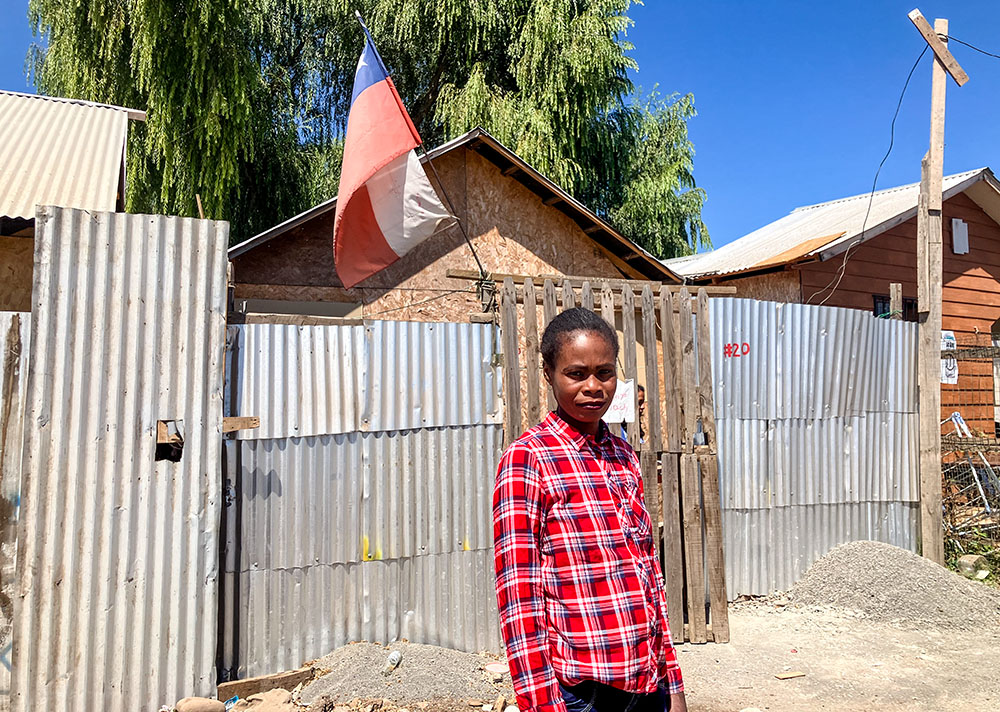
"I don't want to return," said Evena Promesse, a Haitian woman and resident of the camp, standing in front of her home. "I have no family in my country because they all traveled elsewhere." (GSR photo/David Agren)
Most residents of the camp in Curicó, an agricultural community some 120 miles south of Santiago, lack legal immigration status in Chile. Many have spent more than a decade away from Haiti, according to Carvajal, having left the country after the devastating 2010 earthquake.
"I don't want to return," said Evena Promesse, a Haitian woman and resident of the camp.
She departed Haiti — like many did — for Brazil and followed her husband to Chile, where he found work picking fruit in the orchards surrounding Curicó.
"I don't have anything" in Haiti, she said. "I have no family in my country because they all traveled elsewhere."
Promesse entered Chile surreptitiously from Bolivia and hasn't been able to regularize her immigration status. She had been hoping for an amnesty that never arrived under then-President Gabriel Boric, whose left-wing administration preceded Kast's.
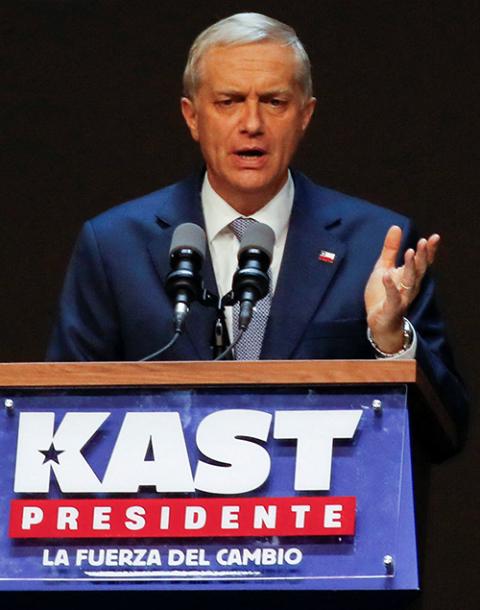
Jose Antonio Kast addresses supporters after winning the presidential runoff election in Santiago Dec. 14, 2025. (OSV News/Reuters/Rodrigo Garrido)
Kast, a conservative Catholic who won the presidency with 58% of the vote, has pledged mass deportations and stricter border controls — moves migrants and church workers fear could soon reach settlements like Curicó's.
Fr. Pablo Walker, chaplain with Jesuit Refugee Service in Chile, said in January that many migrants had called offices with concern: Many expressed worry that the images of Immigration and Customs Enforcement (ICE) raids in the United States — shown on Chilean television and spread on social media — would be replicated in South America.
Chile allows permanent residents to vote in presidential elections. Catholics working with migrants say many of the Venezuelans eligible to vote opted for Kast, saying they agreed with his migration policies and were spooked by his runoff opponent, Jeannette Jara, belonging to Chile's Communist Party.
Even immigrants with permanent residence status expressed dismay with the deterioration of public safety. "It used to be much more orderly," said Luis Rivero, a Venezuelan engineer who has lived in Chile for nearly a decade. "Venezuelans are now not seen as someone who is contributing something, rather someone who came to damage the country, to lower salaries."
Kast took office March 11 and subsequently traveled to the country's northern border with Peru to oversee the construction of a ditch on the frontier to stop illegal entries.
"We want to use these backhoes to build a sovereign Chile. That sovereign Chile has been undermined by illegal immigration, drug trafficking and organized crime," Kast said. "Today, we are closing that window that for years allowed irregular entry into the country."
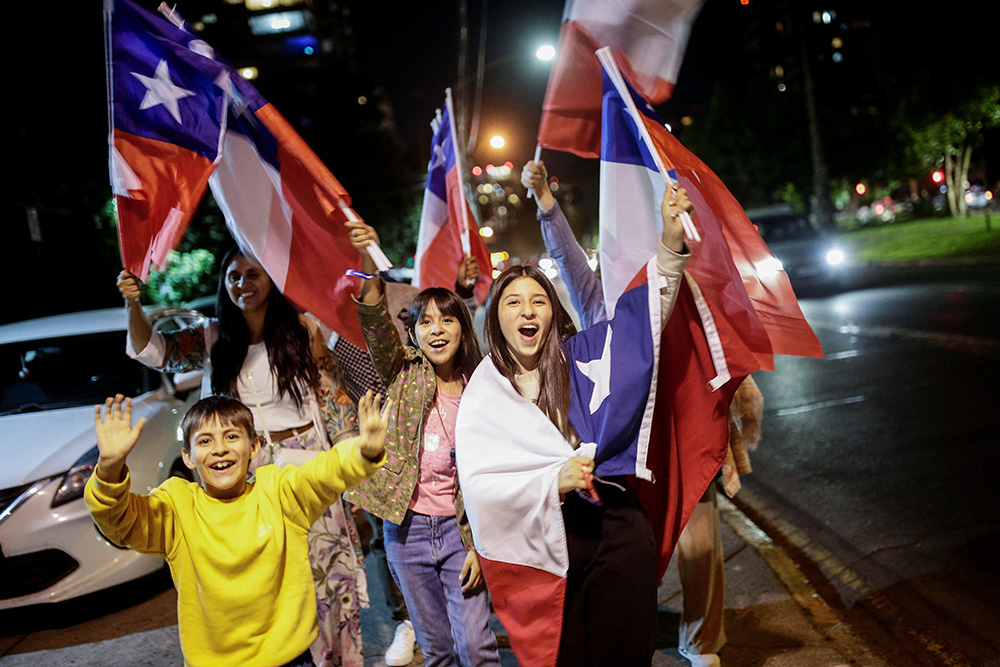
Supporters of José Antonio Kast, a member of the far-right Republican Party of Chile, celebrate after Kast won the presidential runoff election in Santiago Dec. 14, 2025. (OSV News/Reuters/Juan Gonzalez)
With people drawn to the country's prosperous and stable economy, migration has surged over the past two decades. Migrants now make up nearly 10% of Chile's population — including an estimated 330,000 without legal status. Polls show strong public support for tougher enforcement, with up to 81% backing deportations and penalties for illegal entry according to research firm Cadem.
Catholics working with migrants and political analysts cite three main factors for Chile's rising anti-migrant attitudes: rising crime, cultural clashes and perceptions that newcomers have strained social services.
Crime in Chile has climbed in recent years as the homicide rate doubled to six for every 100,000 inhabitants. High-impact crimes such as extortion, kidnapping and the dismembering of corpses shocked the country — acts blamed on the arrival of Venezuelan gang Tren de Aragua.
Still, the country's burgeoning anti-migrant attitude "wasn't just economic fear or fear of crime, but also the perception that they were coming to change the Chilean way of life," said Patricio Navia, political science professor at the Universidad Diego Portales. Haitians, for example, don't speak Spanish; Venezuelans tend to prefer loud music; and migrants often take their children to beg in the streets.
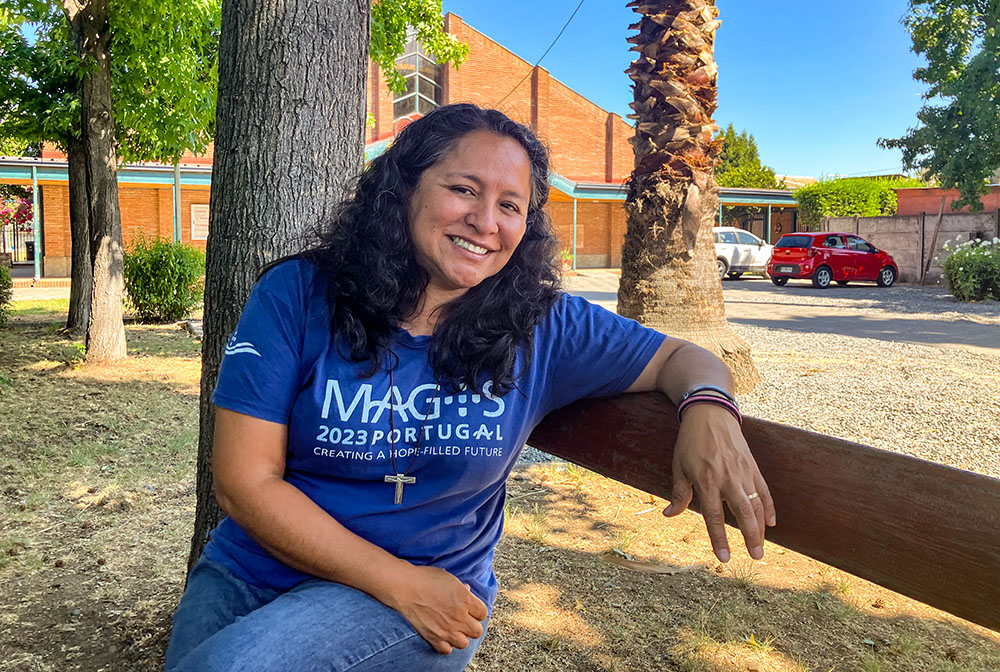
Sr. Ana María Carvajal, a Handmaid of the Sacred Heart of Jesus, accompanies Haitian migrants in the Port-au-Prince migrant camp in Curicó, Chile. (GSR photo/David Agren)
Carvajal described the country as "angry" in recent years and quick to blame immigrants for straining social services such as health and education. But she noted that Chile has the lowest birthrate in the hemisphere, meaning schools would close without younger immigrants arriving.
Then there is the matter of rising rates of violent crime. Chile remains relatively placid in comparison to other Latin American countries. But perceptions of disorder have driven support for Kast.
"The press has covered it in such a way that it's like a horror story that entered Chile," she said.
Carvajal grew up in Iquique in the north of Chile near the Bolivian border — a region she described as multicultural, as cross-border migration and commerce were commonplace. She experienced living abroad through her congregation, including missionary work in Equatorial Guinea until the COVID-19 pandemic complicated their stay.
"We bought a stamp to leave Equatorial Guinea for Cameroon during the pandemic and had to pay along the way so that the soldiers in the villages of Cameroon wouldn't ask us for more documentation," she recalled. She arrived in Rome in 2021, where she experienced the tribulations of many migrants — only receiving her identification card after nine months as "lots of bureaucracy."
Advertisement
"It's true that the religious institution protects you a lot, but there are places where they don't; there's no protection," she said. "You end up experiencing the same things in some ways."
She returned to Chile in late 2021 and was assigned to work with migrant populations in Curicó. The three sisters assigned to Curicó built bridges with nongovernmental groups, the national immigration authorities and local government — relationships that allowed them to help migrants with their paperwork for regularizing their status in Chile and renewing identification documents.
But Carvajal noticed they were mostly helping Venezuelans. The local Haitian population — many of whom didn't speak Spanish — were isolated in irregular settlements like Camp Port-au-Prince. She started visiting the camp with the goal of getting to know the residents. She realized that many of the residents couldn't navigate the Spanish-language paperwork, so the sisters developed a Creole-language guide.
There was also tension with rumors swirling of possible evictions and negative news stories being published. But the sisters' presence became a statement in itself, especially after the local bishop spoke out in support of the migrant population.
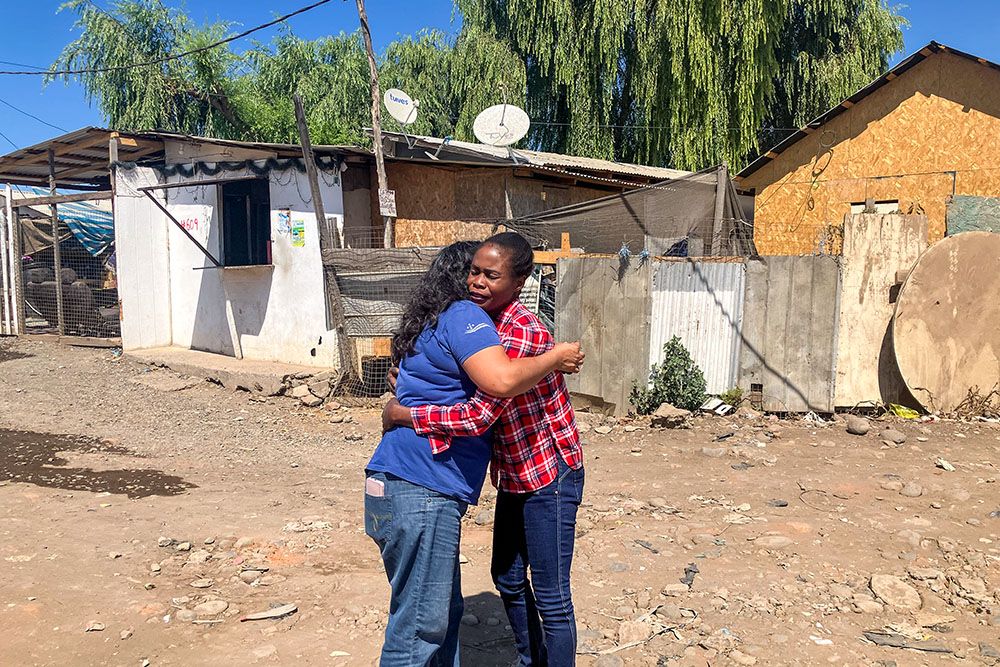
Sr. Ana María Carvajal greets Evena Promesse in the streets of an irregular settlement populated by Haitian immigrants in Curicó, Chile. The settlement's residents face an uncertain future as Chile's new government has promised to expel migrants without legal status. Since arriving in 2022, Promesse has not been able to receive the proper immigration papers. (GSR photo/David Agren)
"We decided to enter the camp by going in twice a week. And it was also like telling the municipality, which was the one that was harassing us all the time: 'The Catholic Church is on the inside,' " she said.
With the bishop being outspoken, she added, "The reading is not about pastoral care of migrants or Sr. Ana Carvajal or the sisters of the congregation. At its core, the message was that the Catholic Church is there."
What comes next remains to be seen. Catholics working with migrants say expulsions are not easy to carry out since Venezuela and Haiti are not able to receive returnees. Neighboring countries like Peru, which has sent soldiers to its border with Chile, also aren't likely to cooperate, they say.
Carvajal said she sees change on the societal level, especially among the young. She recalled Chileans having trepidations of Haitians arriving in the late 2010s due to stereotypes of Blacks. "The image of Black people in their heads was a gang member from American movies," she said.
But the children of Haitian migrants — some born in Chile and automatically citizens — attend local schools and "grow up with other Chilean children," she said.
"There's a change happening. There's a strong change happening in the Chilean population."