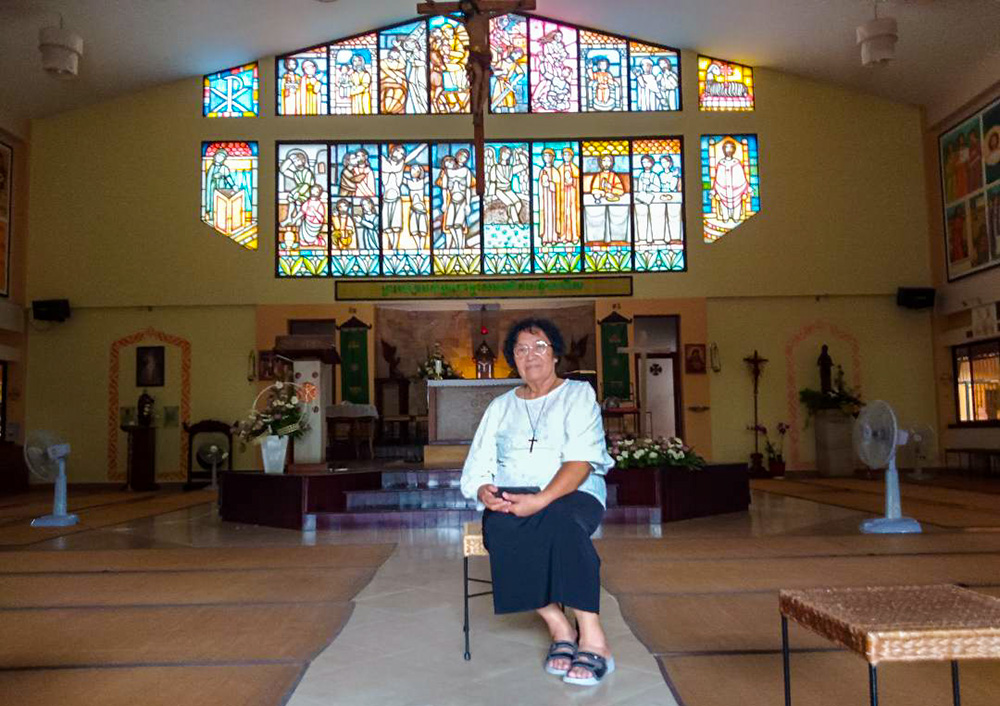
Sr. An Lucie Kim Nga poses for a photo in Child Jesus Catholic Church in Phnom Penh, Cambodia. The Vietnamese-born superior of the Sisters of Providence in Cambodia said she is driven by serving God and reconciliation between Cambodia and Vietnam. "If you have confidence in God, he will show you the way," she said. (Terry Friel)

by Terry Friel
At 79, Sr. An Lucie Kim Nga — known popularly as Sister Lucie — moves with the energy and conviction of someone decades younger.
The Vietnamese-born superior of the Sisters of Providence in Cambodia said she is driven by two commitments: serving God and reconciliation between Cambodia and Vietnam.
"If you have confidence in God, he will show you the way," she said, pouring coffee while chatting in the leafy garden of her convent across the road from Child Jesus Catholic Church in Phnom Penh, Cambodia's capital.
Sister Lucie laughs easily as she scrolls through decades-old photographs on her laptop, recounting memories from before Cambodia plunged into one of the 20th century's darkest chapters — the Khmer Rouge genocide of 1975-79.
"I was young then," she said, pointing to a black-and-white photograph. "I don't look like that anymore. But I feel like that," she adds, switching from English to French, in which she is more comfortable.
Bridging generations
In Cambodia, where the median age is just over 26, Sister Lucie sees a widening gap between generations shaped by very different life experiences.
Rapid economic growth has transformed urban life, with younger Cambodians enjoying technology and modern amenities such as flashy shopping malls. Older Cambodians, however, still carry the trauma of the Khmer Rouge years.
"The gap is there," Sister Lucie said. "I am old enough to remember. I don't want to burden young people, but they should understand what their parents went through — the price they paid."
After years of civil war, the Khmer Rouge seized power in 1975 and ruled Cambodia with brutal force. Religious believers were targeted, and much of the Catholic leadership was executed or died in labor camps.
Before 1975, Cambodia had up to an estimated 100,000 Catholics. Many were killed, forced into labor camps or driven into exile. Missionaries only began returning in the early 1990s.
As many as 2 million people — roughly one-quarter of the population — perished in the genocide.
Quietly doing good
Today, 17 nuns work in Phnom Penh and in the provinces of Battambang and Kampong Chhnang, supporting some of the country's poorest families.
With assistance from church partners such as the U.S.-based Maryknoll organization, the sisters focus on education, basic health care and pastoral outreach, especially through home visits.
In a country without a social security system, many people working in the informal sector cannot afford emergency medical care. The sisters' small clinics often fill that gap.
"They just quietly go around doing good," a woman who works closely with the congregation said, speaking on condition of anonymity. "Because of them, people have food and medicine."
Advertisement
Cambodia's Catholic community is small — about 35,000 people in a nation of nearly 17 million — but closely knit, she adds. "If there is a problem, we have Telegram," she said, referring to the country's most popular messaging app.
Among the nuns' key initiatives is the Light of Mercy Center, established in Phnom Penh in 1997 for children with disabilities.
"We want to bring light to children who are in darkness because of their disabilities," Sister Lucie explains.
The center supports education, family welfare and values formation, while helping parents cope with poverty and social exclusion.
One of the children benefiting is 12-year-old Rithy, who takes a break outside the church after classes at the nearby Growing Special Education School.
"The sisters help my family," he said, munching his rice-egg lunch. "My father was hurt at work and cannot work anymore."
"Because of the sisters, we have food and I can go to school," he adds. "Without them, we would be lost. Sometimes I go into the church and pray."
Journey shaped by exile
Sister Lucie's own journey mirrors Cambodia's turbulent modern history. Like many Catholics, she fled the country when the Khmer Rouge came to power.
After spending more than three decades in France — where she worked with the government assisting immigrants — Sister Lucie returned to Cambodia in 2009.
"One of our missions is to work with the dioceses to compile a list of Cambodian martyrs," she said. "It is a big project."
Her return was also deeply personal. "I decided very young to devote my life to helping people," she said. "And I wanted to help with reconciliation."
Reconciliation has not been easy. Many Catholics in Cambodia are ethnically Vietnamese, making them "double minorities" — both Catholic and Vietnamese — in a predominantly Buddhist society.
Relations between Cambodia and Vietnam have long been strained. Vietnam's invasion ended the Khmer Rouge regime but left lasting resentment. Many ethnic Vietnamese in Cambodia remain stateless, lacking official identification and living on society's margins.
"I have many problems here because I am ethnic Vietnamese, not Khmer," Sister Lucie said frankly. "But this is where God called me."
When the sisters returned after the genocide, they found their old chapel near the Mekong River occupied by families who had turned it into homes.
"We wanted to go back," she recalls. "But people were living there. We could not throw them out. This place is good."
For Sister Lucie, the mission remains clear.
"I want to offer my life for reconciliation — for all people," she said, smiling gently. "I knew it would be difficult. But I wanted to dedicate my life to the people."