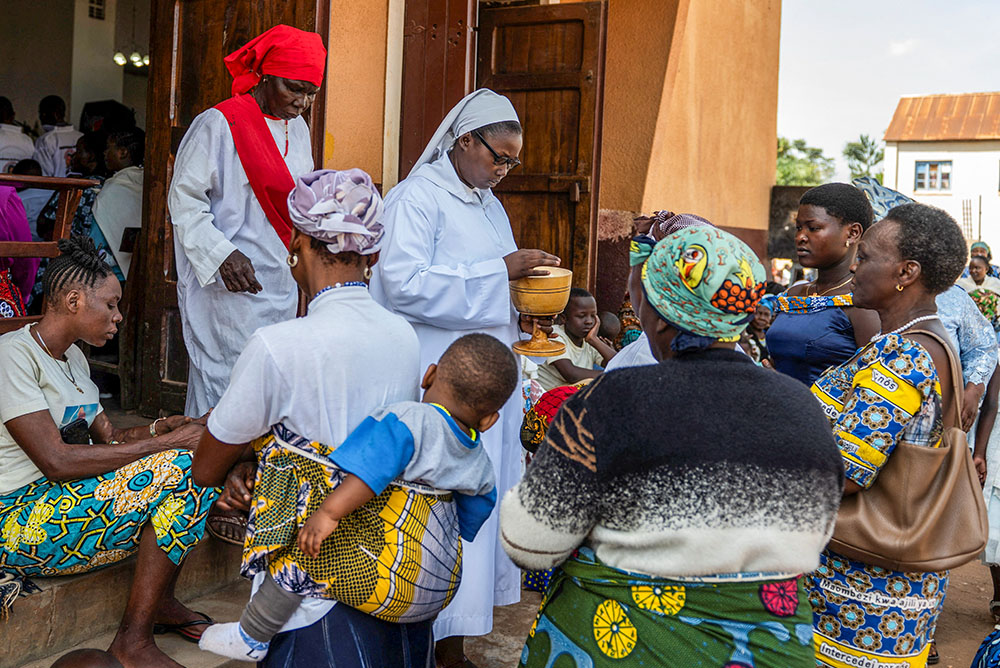
A nun distributes Communion during Mass outside the Cathedral of Our Lady of Graces in Ituri, Congo, May 24, 2026, amid a resurgence of Ebola involving the Bundibugyo strain, a rarer variant of the virus with no approved vaccine currently available. (OSV News/Reuters)

by Doreen Ajiambo
Inside crowded churches and displacement camps across eastern Congo, prayers now compete with fear as another deadly threat spreads through a region already shattered by war.
Religious sisters, priests and church workers in the Democratic Republic of Congo say the growing Ebola outbreak is deepening suffering among communities displaced by years of armed conflict, with many families trapped between violence, hunger and disease.
Health authorities declared a new Ebola outbreak on May 15 in the eastern provinces of North Kivu, Ituri and Tshopo — volatile regions bordering Rwanda and Uganda that have long been affected by armed conflict and mass displacement. Major cities, including Goma and Bukavu, important commercial and humanitarian hubs near the Rwandan border, are now on heightened alert as churches and overcrowded displacement camps brace for a possible wider spread of the disease.
"In Goma, the situation remains precarious as usual," a sister of the Congregation of Charité Maternelle told Global Sisters Report. "People are afraid and don't know where to go. Borders closed between neighboring countries, no money, banks remain closed. This is in brief what we are going through at home today."
The sister's congregation ministers in Goma, Bunia and Mahagi — towns heavily affected by displacement and insecurity in eastern Congo. She said sisters are struggling to continue their apostolates while communities descend deeper into uncertainty.
"We are no longer sure how to position ourselves," she said. "Despite everything, God continues to watch over us."
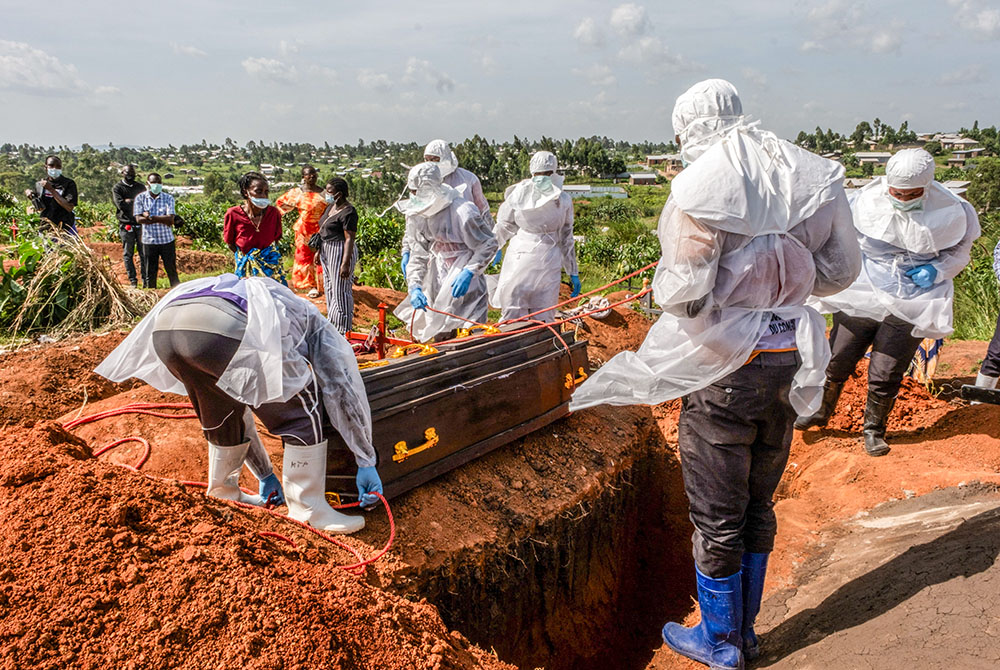
Red Cross workers wearing personal protective equipment at the Nyamurongo cemetery in Bunia, Congo, May 26, 2026, prepare to bury a coffin containing the body of Dr. Tibenderana Katho Blaise, who worked at the Center Medical Evangelique in Hoho commune and died of Ebola virus. (OSV News/Reuters)
Eastern Congo has endured decades of violence fueled by armed rebel groups, ethnic tensions and competition over the region's vast mineral wealth. Fighting involving the M23 rebel movement and other armed groups has intensified in recent years, forcing hundreds of thousands of people from their homes and worsening one of the world's most neglected humanitarian crises.
Many displaced families now shelter in churches, schools and makeshift camps around Goma and other towns, where overcrowding and poor sanitation have heightened fears about the spread of infectious diseases.
The region is also no stranger to Ebola.
Eastern Congo experienced one of the world's deadliest Ebola outbreaks between 2018 and 2020, when thousands of people were infected in North Kivu and Ituri provinces. Health workers and aid agencies struggled to contain the disease amid armed conflict, community mistrust and attacks on treatment centers. The outbreak killed more than 2,000 people before it was declared over.
Now, many residents fear history may be repeating itself.
The World Health Organization says the latest outbreak has already caused hundreds of suspected deaths across parts of eastern Congo. However, ongoing insecurity and limited testing in conflict-hit areas have complicated efforts to confirm cases, with only a small number of deaths officially linked through laboratory testing to the rare Bundibugyo strain of Ebola, a less common form of the virus first identified in Uganda in 2007.
For some, the latest outbreak is not merely a medical emergency but a spiritual warning.
Advertisement
Celestin Kakule, a 28-year-old mother of three living in Goma, said many residents see the epidemic through the lens of suffering that has consumed the region for years.
"This Ebola is like double punishment from God because we are already suffering from war," Kakule said. "Even those who are protecting themselves are getting infected. I leave everything to God."
She said some people in her community believe the disease is a bad omen hanging over eastern Congo.
Churches become lifelines amid fear
Religious sisters say churches have become both sanctuaries and frontline response centers as frightened residents turn to faith institutions for help.
"People come to us for assistance," said one sister superior of a community in Bukavu and mentor of postulants. "But we also have very little resources and we are also trying to be cautious and protect ourselves."
She said fear and misinformation are spreading quickly, with many residents uncertain about the scale of the outbreak.
"There is uncertainty because people are talking about cases, and we do not know whether it is true or false," she told GSR. "The government is asking the population to protect themselves and to respect preventive measures. And we, as a congregation, as citizens, and as the church, are following them."
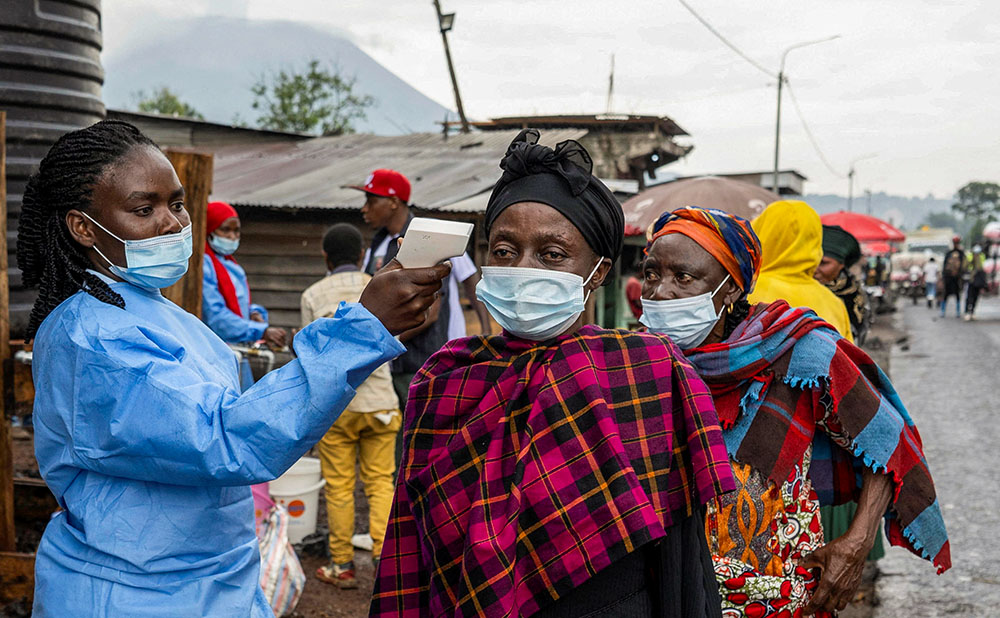
A health worker takes the temperature of a woman passing through the Kanyaruchinya checkpoint into the city of Goma, Congo May 20, 2026, as authorities and aid agencies intensify efforts to contain a new Ebola outbreak caused by the Bundibugyo strain. (OSV News/Reuters/Arlette Bashizi)
In eastern Congo, where years of conflict have weakened trust in institutions, religious leaders often carry more influence than government officials or health authorities. During previous Ebola outbreaks, churches played a critical role in persuading communities to cooperate with medical teams, particularly in remote areas where some residents believed Ebola was fabricated or spiritually caused.
That tension is resurfacing again.
Some Christians continue to interpret the disease through a spiritual lens, while church leaders attempt to balance prayer with strict public health guidance. Religious gatherings, healing services and traditional burial rituals — central parts of community life in Congo — have become sensitive points of concern for health officials trying to contain the virus.
A pastoral communiqué issued May 18 by church leaders in the Goma Diocese and shared with GSR urged Catholics to strictly observe prevention measures and avoid practices that could spread infection. The statement warned that the current Bundibugyo strain has neither a vaccine nor adequate treatment. The communiqué called for vigilance across churches, schools and health facilities.
"The church encourages all Christians and all people of goodwill to strictly observe the preventive measures recommended by health authorities," Fr. Christian Kisonia, communications director for the Goma Diocese, said in the communiqué.
The statement also encouraged pastors and parish leaders to enforce preventive measures during eucharistic celebrations and charismatic gatherings, including confirmation celebrations and Pentecost events. Church leaders urged the faithful not to touch bodies of suspected Ebola victims or participate in unsafe burial practices, customs that remain deeply important in Congolese religious and cultural life.
"Controlling this epidemic depends entirely on surveillance, prevention and community mobilization," the church statement said.
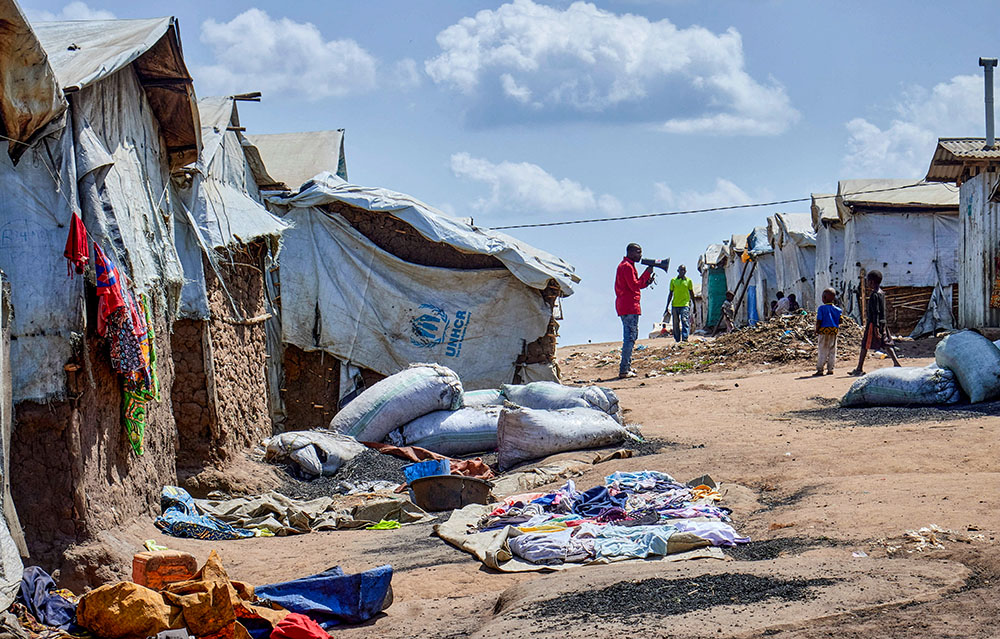
Richard Mbagaro, a supervisor at the Kigonze camp for internally displaced persons, speaks to residents in Bunia, Congo, May 25, 2026, urging them to wash their hands with soap or ash as fears grow over the spread of Ebola. (OSV News/Reuters/Gradel Muyisa Mumbere)
Balancing faith and public health
For many religious sisters, prevention efforts are complicated by poverty, overcrowding and insecurity.
The closure of borders between neighboring countries has disrupted supplies and movement, while ongoing fighting in parts of eastern Congo continues to isolate vulnerable communities. Sisters say many families cannot afford soap, medicine or transportation to health facilities.
"We continue with our apostolates and we are following the preventive measures," the sister superior said. "But this new epidemic situation is affecting us and everyone else because the borders are closed."
In Bukavu, Archbishop François-Xavier Maroy Rusengo urged Christians not to give in to panic while also insisting on strict compliance with health measures.
"Let us not lose courage," the archbishop said in the church exhortation shared with GSR. "Through our prayers, let us place our full trust in God, for nothing is impossible for Him and He remains attentive to our supplications."
For sisters serving on the front lines, faith has become both a source of resilience and a burden of responsibility as desperate families continue turning to churches for hope.
"We need your support," the sister superior said. "Spiritual, moral and financial."
Doreen Ajiambo reported on this story from Kenya. An anonymous reporter, whose identity is concealed for their safety, contributed to this report from Goma, Democratic Republic of Congo.