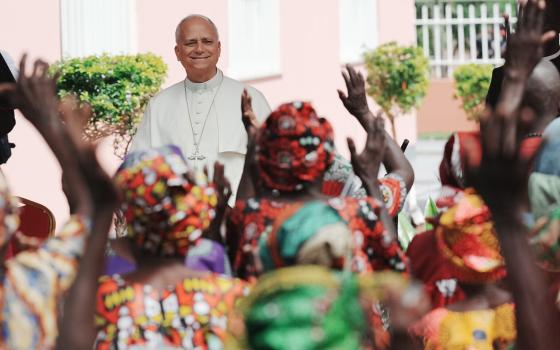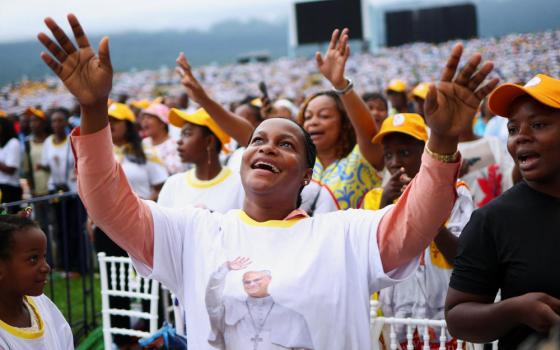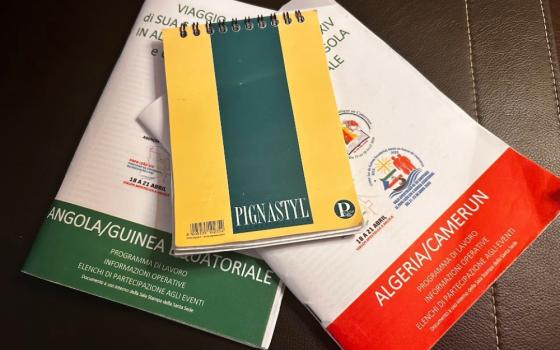
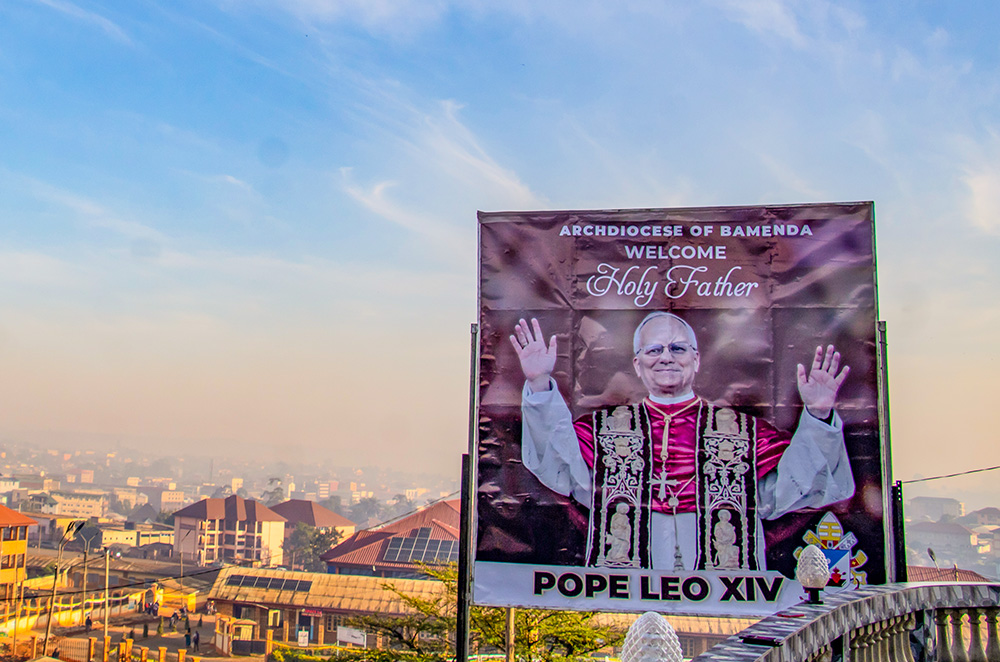
A roadside billboard welcomes Holy Father Pope Leo XIV to Bamenda, Cameroon, April 14, 2026. (AP/Welba Yamo Pascal)

by Doreen Ajiambo
The afternoon after Pope Leo XIV arrived in Cameroon, church bells rang across Bamenda's misty hills as choirs rehearsed hymns inside parish compounds and women knelt in prayer circles clutching rosaries.
On stretches of road long scarred by years of conflict and neglect, yellow-and-white Vatican flags fluttered from church fences, shop fronts and roadside poles.
After arriving in Yaoundé on Wednesday, April 15, as part of the second leg of his four-nation African pilgrimage, the pope is expected to travel about 230 miles northwest to Bamenda on Thursday. There, he will preside over a Meeting for Peace bringing together religious and traditional leaders in a city long battered by conflict.
Along Commercial Avenue and around several parish centers Wednesday morning, church youth groups could be seen arranging chairs, decorating entrances and rehearsing songs for the papal welcome. Security presence had visibly increased, but so too had the number of civilians moving more freely than usual.
"The Holy Father's visit is itself a sign of hope and concern," said Sr. María José de la Plata, superior of the Calasanzian Sisters in Futru, near Bamenda.
"Coming to Bamenda and taking the risk is a clear gesture that shows care and love," she said. "I pray and hope his presence brings relief to the people who are suffering because of the sociopolitical crisis. I expect that he could be a mediator in the situation."
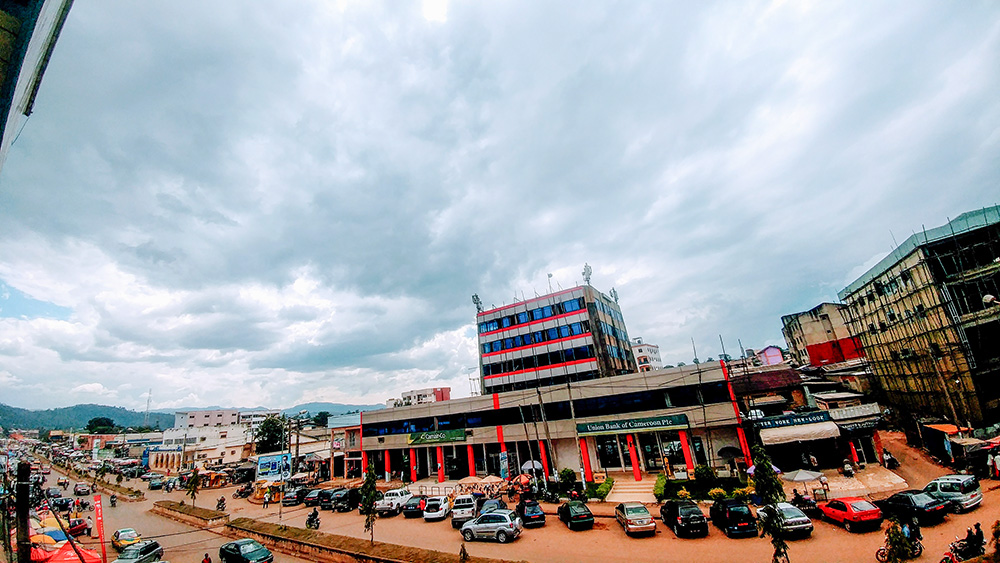
A view of Commercial Street in Bamenda, Cameroon, is seen in a 2019 file photo. (Wikimedia Commons/Ambo64)
That hope deepened after leaders of several Anglophone separatist groups announced a three-day period of "safe travel passage" and a halt in fighting ahead of the pope's expected arrival in Bamenda, according to local and international reports.
Cameroon's government in the capital, Yaoundé, did not immediately respond to the announcement, Global Sisters Report found. Calls by GSR to a government spokesperson were not answered.
"For years, we have lived with fear and uncertainty," said Judith Wanyu, a mother of four in Bamenda's Nkwen neighborhood. "Now people feel seen again. They are praying this visit and the ceasefire can finally open a way for peace."
A crisis that has reshaped daily life
Bamenda lies at the center of Cameroon's Anglophone crisis, which erupted in late 2016 after English-speaking teachers and lawyers peacefully protested over what they described as political and institutional marginalization by the predominantly French-speaking central government.
What began as demonstrations escalated into armed conflict in 2017 between government forces and separatist fighters seeking an independent English-speaking state they call Ambazonia.
At least 6,000 civilians have been killed since the violence began, according to Human Rights Watch, while more than 600,000 people have been displaced. Entire communities across the Northwest and Southwest regions have endured repeated lockdowns, school closures, kidnappings and military operations.
'Many families here have suffered loss, displacement and fear for many years. The Holy Father coming to Bamenda gives them a sense that the universal church is standing with them.'
—Sr. María José de la Plata
For sisters working in education and health care, the conflict has transformed every aspect of ministry.
"When the crisis started in 2016, classes stopped and many girls left," de la Plata said of her congregation's nursery school and women's promotion center.
"We are used to ghost towns and lockdowns, but those days disturb the normal process of learning."
For the Tertiary Sisters of St. Francis in Njinikom, the crisis has changed their conventional ministry to peace accompaniment.
"It has shifted our role from simply doing ministry to truly being a presence of peace, compassion and hope through our resilience," the congregation said.
Serving in health care, Sr. Felicitas Lukong — of the Sisters of St. Therese of the Child Jesus of Buea, Cameroon — said that on lockdown days, the sisters "often have to work double, reaching out to patients in their homes and picking up those who cannot travel."
For the sisters who have remained in Bamenda throughout years of violence, Leo's visit carries a meaning that goes beyond ceremony.
Advertisement
"For our ministry, this visit is symbolic because it tells the people that their pain has been seen," de la Plata said. "Many families here have suffered loss, displacement and fear for many years. The Holy Father coming to Bamenda gives them a sense that the universal church is standing with them."
The Tertiary Sisters of St. Francis said the pope's presence validates the daily work of sisters who have continued serving in schools, clinics and pastoral outreach, despite insecurity.
"It strengthens our mission as women religious to remain a sign of peace, healing and hope among the wounded and displaced," the congregation said. "For the people we serve, it is symbolic because it restores dignity and reminds them they have not been abandoned."
Can the ceasefire hold?
Many in Bamenda are now asking whether the temporary ceasefire could outlast the pope's visit and whether it could open space for a more durable peace process.
Joseph Nfor, a catechist in Bamenda and a religious scholar, said the pope's moral authority could help encourage both armed separatists and the government to consider dialogue.
"When a pope comes to a conflict zone, it is never just a ceremonial visit," Nfor said. "His words can influence consciences, soften hardened positions and give communities courage to demand peace."
He said many residents hope the temporary halt in fighting could become the beginning of a broader cessation of hostilities, particularly if the pope's peace meeting in Bamenda succeeds in bringing together religious, traditional and civic voices.
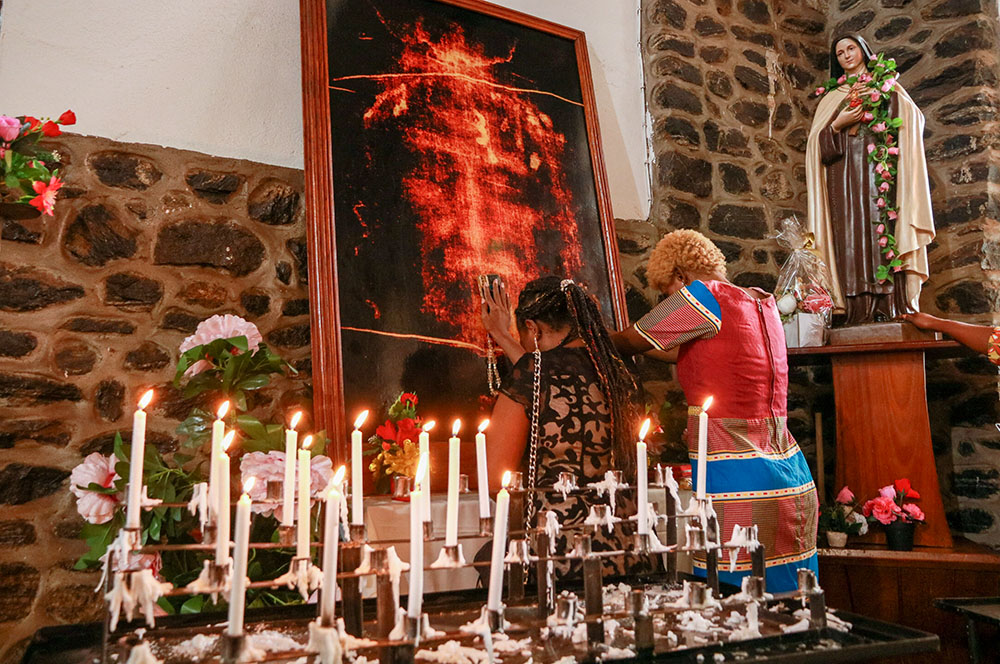
Catholic worshippers are seen at the Cathedral of Our Lady of Victories in Yaoundé, Cameroon, April 12, 2026. (OSV News/Reuters/Durel Epoh)
"For this region and for Cameroon as a whole, his coming is important because it puts our suffering before the world and before those in power," Nfor said. "If both sides listen, this could help create momentum toward a lasting solution."
De la Plata said the visit also has national significance because it reminds Cameroonians that peace in the Anglophone regions is central to the country's future.
"Peace in Bamenda means hope for the whole nation," she said.
On Thursday, the pope is expected to preside over a Meeting for Peace involving a traditional chief, a Presbyterian moderator, an imam and a Catholic nun — a rare symbolic gathering in a city where dialogue itself has often felt impossible.
A test of peace and global attention
Still, the visit has not been without controversy.
Some Cameroonian Catholics and members of the clergy have voiced concern that the pope's meeting with longtime President Paul Biya in Yaoundé could be seen as an opportunity for the 93-year-old leader to polish his international image, six months after deadly protests followed his contested reelection.
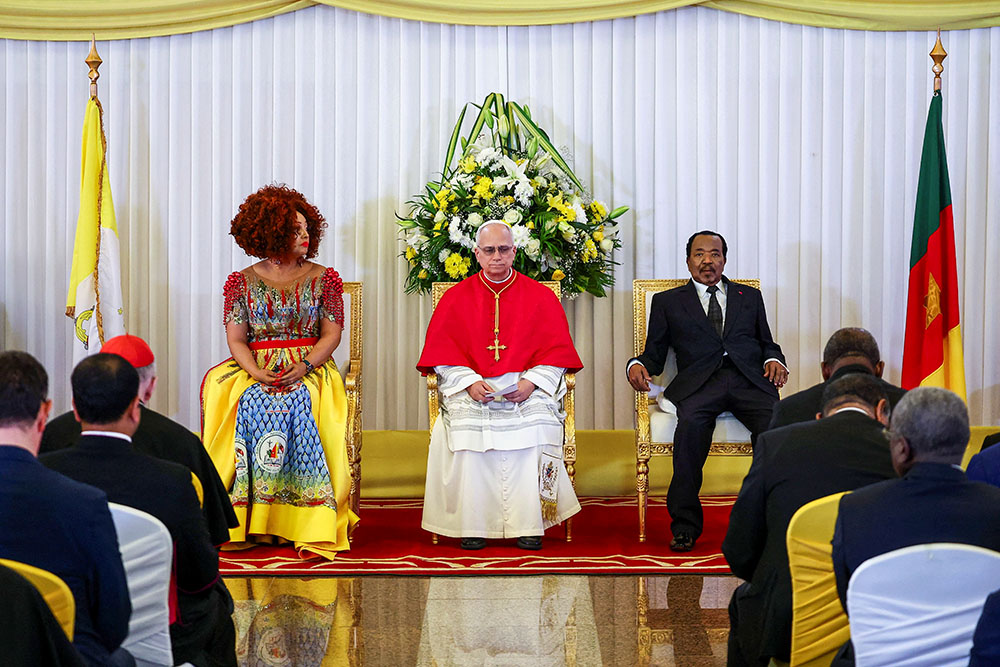
Pope Leo XIV meets with Cameroon President Paul Biya and his wife, Chantal Biya, after arriving at the Presidential Palace in Yaoundé April 15, 2026. (OSV News/Reuters/Guglielmo Mangiapane)
The concerns reflect wider unease among some faithful that a high-profile papal visit might be interpreted as an endorsement of the country's political leadership at a time when questions remain over governance, repression and the unresolved conflict in the Anglophone regions.
At the same time, many Catholics in Bamenda say the visit should instead be understood as a chance for the pope to speak directly to those in power and press for peace and reconciliation.
"This is no longer just Bamenda's story," Nfor said. "What is happening here is a test of whether the world still listens to forgotten conflicts."
He said the pope's decision to visit the region early in his pontificate sends a message not only to Cameroonians but also to the wider international community.
"When the Holy Father comes here, he is telling Europe, America and the rest of the world that African suffering must also matter," Nfor said. "Too many people outside this continent do not know that children here have missed school for years, that families have lived with fear for almost a decade."
As Bamenda waits, the city's churches remain full.
"People still believe that God has not abandoned us," Nfor said. "We pray that when Pope Leo speaks, those carrying guns will listen."