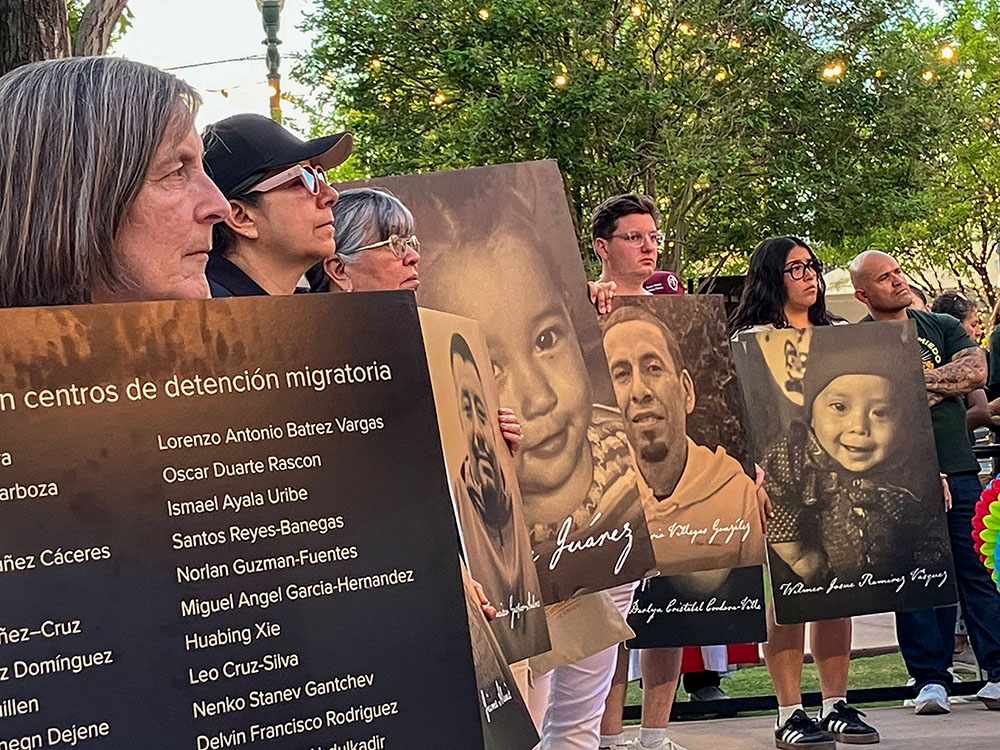
Demonstrators hold placards with photographs and names of people who died in immigration-related circumstances as they take part in a protest in El Paso, Texas, March 24, 2026, against mass deportations and the immigration policies of the Trump administration. (Photo by Elvira Ramirez/Maryknoll.)
by Pauline Hovey
A little more than a week after signing a pastoral letter against mass detention and deportations, Bishop Mark Seitz of El Paso, Texas, joined members of Hope Border Institute and local and national immigrant advocates in a town hall meeting, followed by a march and vigil in El Paso on the feast day of St. Óscar Romero of El Salvador.
Seitz spoke of the need to risk speaking up and acting nonviolently in support of human rights for the marginalized.
"I will do everything I can to uphold the God-given dignity of every person in our borderlands community," Seitz told the hundreds of participants March 24.
This year's march expanded well beyond the local community as bishops, priests, religious and lay volunteers involved in migrant ministries from California, Illinois, Minnesota and North Carolina came to El Paso to show solidarity and respond to a call to action at an unprecedented time in the United States.
They were joined by Auxiliary Bishop Evelio Menjivar of Washington, D.C., Bishop Brendan Cahill of Victoria, Texas, and Dominican Fr. Brendan Curran of the International Dominican Commission for Justice and Peace in Chicago.
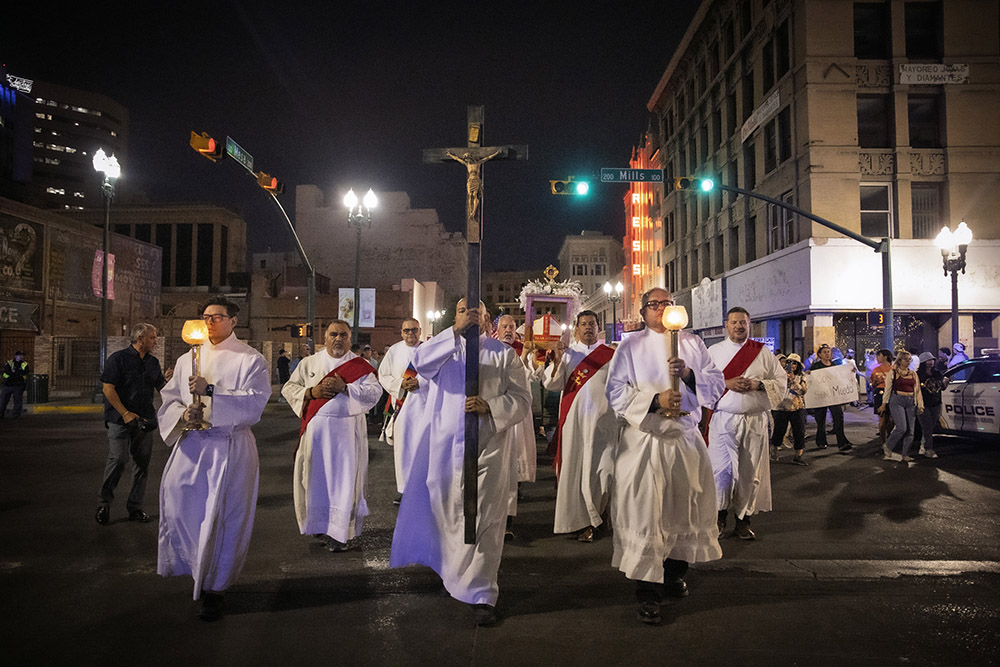
Deacons carry relics of St. Óscar Romero through the streets of downtown El Paso, Texas, during a procession and vigil March 24, 2026, against mass deportations and the immigration policies of the Trump administration. (OSV News/Courtesy of El Paso Diocese/Fernando Ceniceros)
"We came to be more intentional in being in solidarity with immigrant rights as a human right," Curran said. "I don't think that's anything extraordinary. This is what we're supposed to do as Christians. The extraordinary nature is being unethical and inhumane to others."
Cahill, who succeeded Seitz as chairman of the U.S. Conference of Catholic Bishops' Committee on Migration, said he believes more U.S. bishops are becoming vocal on this issue, although none have taken as strong a stand as Seitz. Still, Cahill has witnessed bishops who stand on the opposite end of the political spectrum agree that the bottom line is the dignity of the human person, particularly as immigration practices affect Catholics who are being deported or living in fear of that.
For Menjivar, the issue is both emotional and personal. A native of El Salvador, he entered the U.S. without proper documentation in 1990 and was subjected to the same treacherous and traumatic journey as taken by those he ministers to today. Eventually, Menjivar obtained a work permit and temporary protected status given to Salvadorans because of the country's extreme political violence. El Salvador's temporary protected status is set to expire this September.
"I spend a lot of time listening to immigrants' stories, and I go back to what we experienced in El Salvador, when people were 'disappeared,' the government took their family members, their relatives. This is what we are seeing in this country these days. People looking for their loved ones, not knowing where they've been taken."
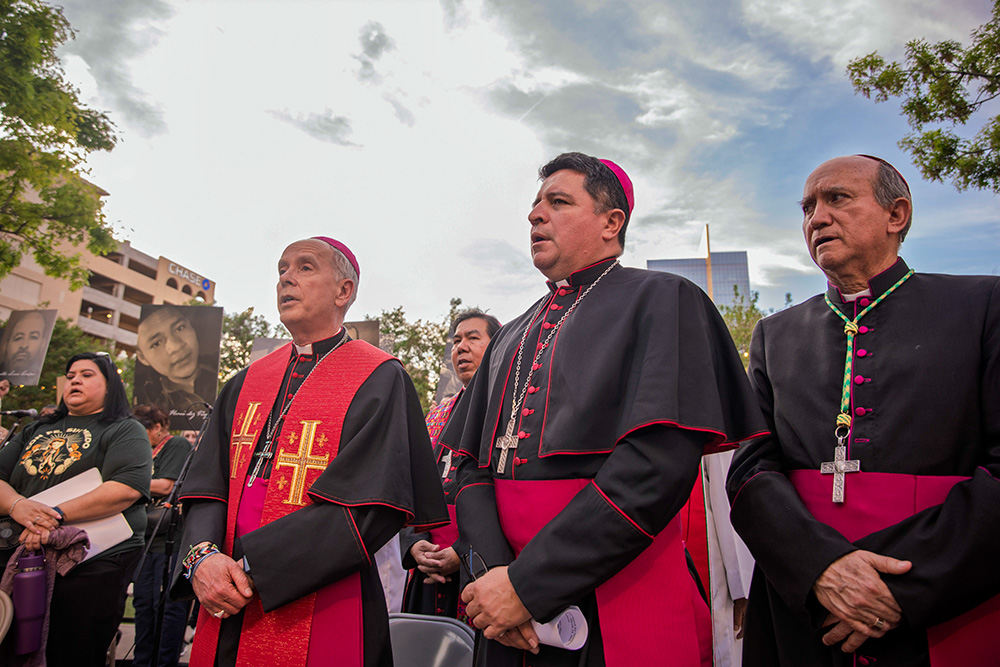
Bishop Mark Seitz of El Paso, Texas, Auxiliary Bishop Evelio Menjivar of Washington, D.C., and Bishop José Guadalupe Torres Campos of Ciudad Juárez, Mexico, take part in a vigil and protest in El Paso March 24, 2026, against mass deportations and the immigration policies of the Trump administration. (OSV News/Courtesy of El Paso Diocese/Fernando Ceniceros)
Menjivar challenged immigrants to come out of the shadows and tell their stories, and he called on Christians to do their part, "to raise our voices in defense of our immigrant brothers and sisters."
Some don't understand or believe the plight of the immigrant, he said, "but for us it's our reality. When they start to encounter and know real immigrants, they can start to soften and understand that not everyone is a criminal."
As the Department of Homeland Security continues to claim that immigrants being detained and deported are criminals who pose danger to American society, religious and lay volunteers accompanying immigrants and asylum seekers in detention, at courthouses and at legal proceedings around the country are experiencing a different reality.
"We are living in a time when cruelty is applauded," said Sr. Mary Ann Azanza, a Religious of the Assumption. She and Scalabrinian Sr. Elisete Signor received a personal copy of Seitz's pastoral letter, in gratitude for their migrant accompaniment. Signor also assisted Seitz in inviting immigrant families who'd been detained and deported to tell their stories via Zoom at a breakfast prior to the pastoral letter presentation.
Advertisement
"The unnecessary cruelty of these stories is what hit me," Azanza said. One woman had been detained for a year without the ability to present her claim and tried for months to get medical treatment while in pain in detention. "She was writhing in pain, and they'd tell her it was all in her head. Finally, they had to bring her to the hospital for surgery. I have to ask, what threat did this person pose to our country? What terrible thing could she have done to subject her to such cruelty during incarceration?"
While accompanying immigrants at the courthouse, Azanza has witnessed Immigration and Customs Enforcement agents taking people even when they have their documentation in order or have entered legally and simply overstayed their visas. "These people are doing what they can to stay in the government's good graces, but the government keeps moving the bar."
Such experiences have caused Azanza to wonder, "What country am I living in? There isn't any justice. And there's no longer any need to give orientations on 'know your rights' because there aren't any. Now it's 'know your risks.' It's hard to understand how much we have changed in the last year."
A native Filipina, Azanza understands firsthand what it means to have her rights taken away. From October 1981 through January 1982, she lived under house arrest under the regime of Ferdinand Marcos.
Yet Azanza and other volunteers at the courthouse treat everyone, including federal agents, with humanity. "We are not there as adversaries, but as agents of reconciliation," she told the National Catholic Reporter.
Azanza sees this as both the Christian and El Paso way.
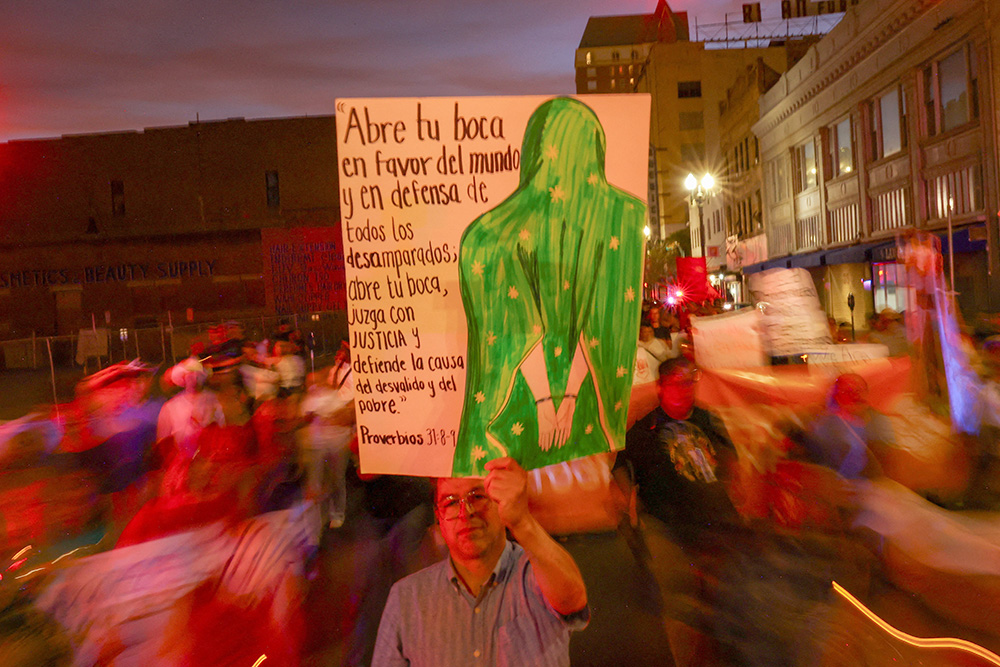
A man holds a placard with an image of Our Lady of Guadalupe during a protest in El Paso, Texas, March 24, 2026, against mass deportations and the immigration policies of the Trump administration. The sign, which quotes Proverbs 31:8-9, says, "Open your mouth in behalf of the mute, and for the rights of the destitute; open your mouth, judge justly, defend the needy and the poor." (OSV News/Jose Luis Gonzalez)
El Paso has a long history both of welcoming the stranger and of being a training ground for the federal government's policies against immigrants, including being the inaugural site of the family separation policy during the first Trump administration.
Now, El Paso has become the ICE detention capital of the world, according to Melissa Lopez, executive director of Estrella del Paso, the diocesan office providing legal services to low-income immigrants and refugees. "All people detained in other parts of the country wind up in detention in El Paso," she said.
When Lopez began working for the diocese in 2008, the county had a detention facility with 700 beds. That number slowly increased to 2,000, but, with the August 2025 opening of Camp East Montana, the largest detention facility in the country, El Paso currently has 7,000 detention beds. If the federal government has its way, Lopez said, that number will increase to 13,500 beds when it opens a new planned facility.
"We must fight this," Lopez said. "We don't want to be known as the region where people are detained."