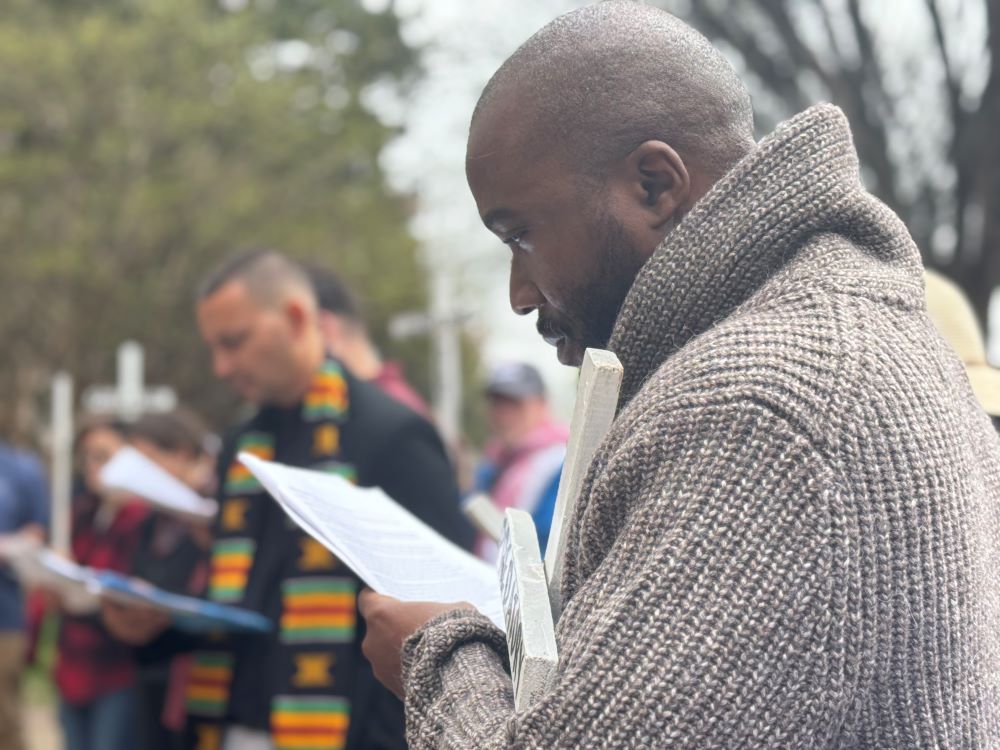
Steven Nabieu Rogers, of the Africa Faith and Justice Network, prays while holding a cross outside the U.S. Department of Justice in Washington April 3, 2026, during the Way of the Cross on Good Friday. It feels as if the institutions of governance are not carrying out their role and as Catholics, there’s a need to pray about that, he said. (NCR photo/Rhina Guidos)

by Rhina Guidos
Like many Christians around the world, Susan Gunn observed Good Friday remembering the suffering of Christ on his way to the cross. With other social justice-minded Catholics living in and around the nation's capital, she marked one of Christianity's most solemn days of the year praying the Way of the Cross outside Washington institutions such as the World Bank, the Department of Justice and the U.S. Customs and Border Patrol Building.
More than 100 people joined Gunn April 3, calling out federal policy decisions they say have produced modern-day crucifixions. Though most participants were lay Catholics, Mercy Sisters, a Maryknoll sister, Religious of the Sacred Heart sisters and other women religious, including Sr. Carol Zinn, executive director of the Leadership Conference of Women Religious, also attended and took part reading at some of the stations.
"We're followers of Jesus who was executed by an authoritarian power … and there is an inherent connection with our policies," said Gunn, director of the Washington-based Maryknoll Office for Global Concerns, an organizer of the Good Friday Way of the Cross for Peace and Justice.
Written materials for the event describe modern-day crucifixions as wealth disparity, violence against migrants and the erosion of peace efforts.
"Here in Washington, D.C., we are surrounded by powerful political and economic forces that mirror Jesus' journey to the cross, forces that repeatedly crucify Christ among us with weapons and war, and by prioritizing a privileged few while millions live and die in debt and dire poverty," Gunn said in welcoming participants outside the National Archives building.
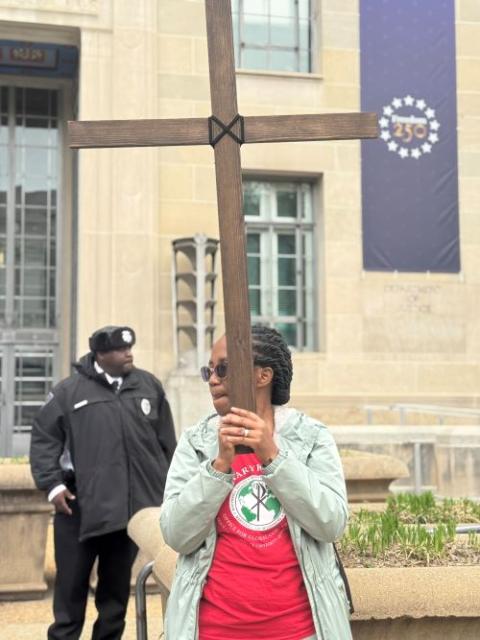
Maryknoll Sr. Susana Nchubiri holds a cross outside the U.S. Department of Justice in Washington April 3, 2026, during the Way of the Cross for peace and justice. Catholics and others sang and prayed at various federal buildings. (NCR photo/Rhina Guidos)
The annual event has been around since the 1990s, said Marie Dennis, former co-president of Pax Christi International. And even though participants are mostly from Catholic groups such as the Franciscan Action Network, Pax Christi USA and Network Catholic social justice lobby, people of various faiths also participated.
"There was a lot of focus on… how do we create a just economy? And as we looked around Washington, we began to realize that throughout this city, there are agencies and institutions and government offices that have… a very important role in the shape of the global economy,” said Dennis. "So, we began to do what was then called the economic Way of the Cross."
Over the years, the event's focus has expanded, and its route varies, as do the prayers "to reflect our greatest challenges and our most pressing needs," Gunn told the National Catholic Reporter.
Outside the Internal Revenue Service, the third station this year, participants reflected on wealth inequality; at the fourth station, the Environmental Protection Agency, environmental degradation and resource extraction. The sixth station, outside the U.S. Customs and Border Patrol, focused on the treatment of migrants and refugees.
'I see the suffering of these communities as really connected to Christ's suffering on the cross, and I really feel close to those who are suffering today.'
—Susan Gunn
LCWR’s Zinn read at the 14th station, Jesus is placed in the tomb, outside the International Monetary Fund.
"The yoke of global debt, by contrast, is an intolerable and unjust burden. Indebted countries are forced to make deep cuts to social services, limiting access to medicine and schooling, while facing skyrocketing food and energy prices," Zinn read. "Countries need debt cancellation and restructuring, with reforms that will help prevent a global debt crisis in the future."
In 2025, Jesuit Fr. Kevin Gillespie, of Washington's Holy Trinity Catholic Church, attended the event shortly after the Trump administration's mass firings of federal workers, which included some of his parishioners. Although he couldn't make the downtown Way of the Cross this year, he said he had found last year's event a profound experience.
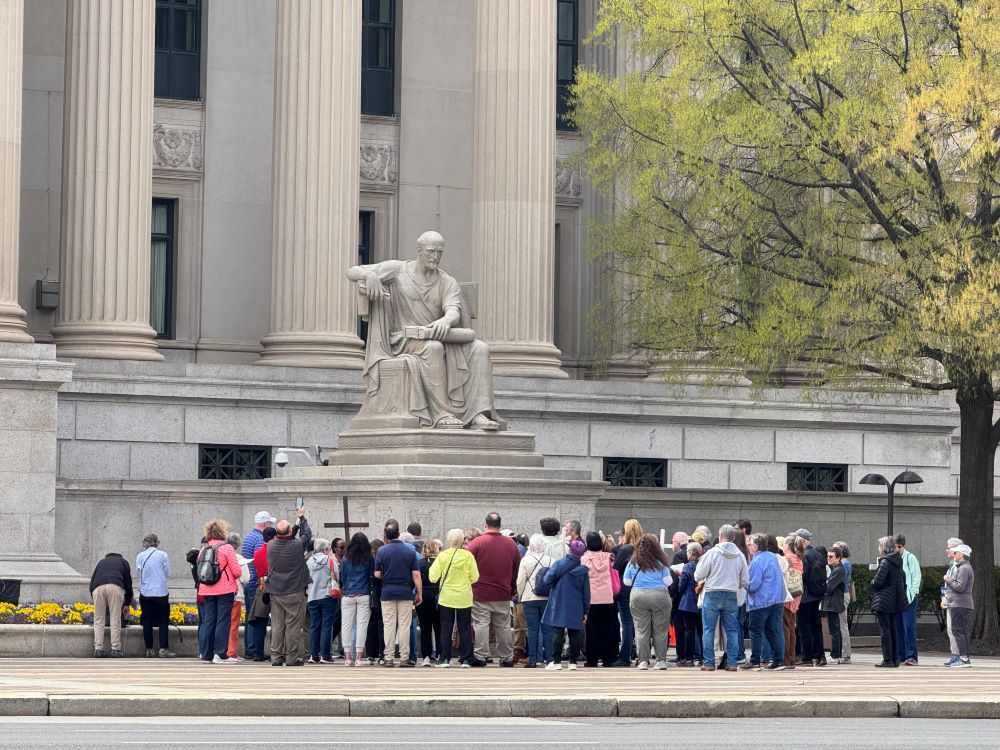
A group of Catholics and others gather at the National Archives building as they start to pray Way of the Cross on Good Friday outside Washington institutions April 3, 2026. (NCR photo/Rhina Guidos)
He prayed outside buildings such as the U.S. Agency for International Development where some of his parishioners had worked. A garbage bag covered the sign marking the building's former use. During the Stations of the Cross, Gillespie kept in mind, too, those affected in other parts of the world, who had benefited from the agency's help.
The former USAID building, with eroded signs of what it once had been, was included again in this year's Via Crucis.
"How sad it was to pray in front of buildings knowing that so many competent and patriotic people, after sacrifices and services for our nation, no longer worked there," Gillespie said April 2. "There we were at the buildings and the desolation of what was going on … where it was impacting people's lives, not just Americans but across the sea. The whole issue of how the U.S. has in the past helped so many nations, so many peoples, and all that was being disrupted."
Prayers for the unemployed soon turned into action as a Trinity parishioner, a social worker, organized activities to help former USAID employees find new jobs, practice for interviews and provide hope, Gillespie said.
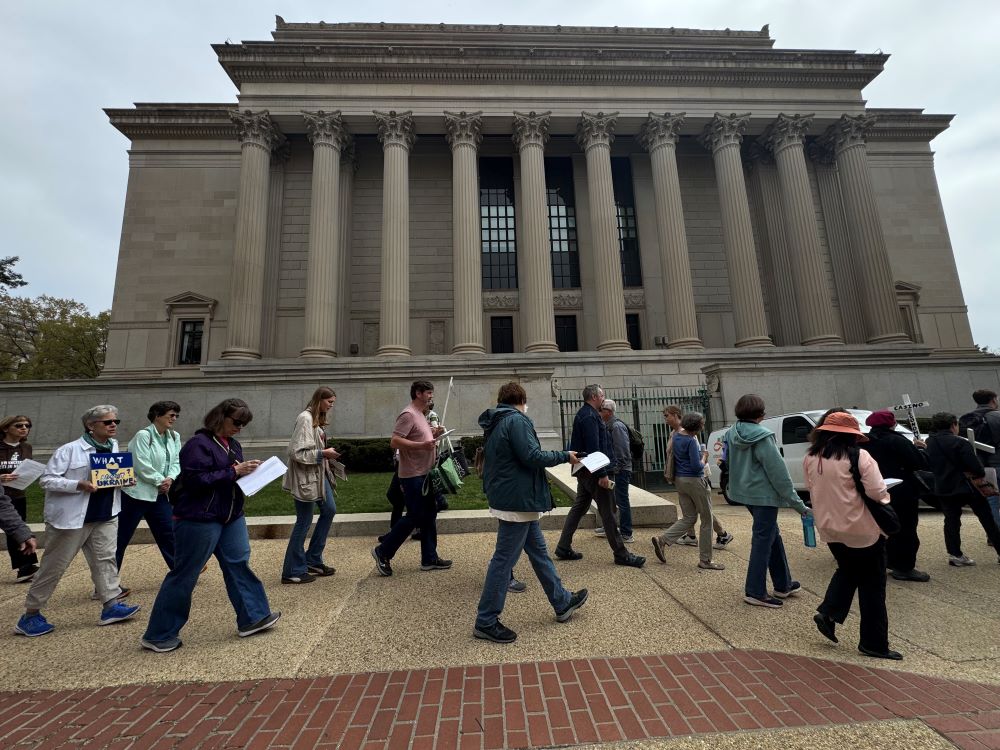
A group of Catholics and others sing as they walk past the National Archives building in Washington during the Way of the Cross on Good Friday April 3, 2026. The event includes what organizers describe as modern-day crucifixions such as wealth disparity, violence against migrants and the erosion of peace efforts. (NCR photo/Rhina Guidos)
For some, the Way of the Cross also helped relieve a certain anxiety.
"It's a way of coping with the losses that are happening in our democracy, in our government, and praying about it with people, all that reality that we're facing and the political divisions," Gillespie said. "And here's a chance to pray about it with others in a traditional Christian ritual, the Stations of the Cross."
This year participants couldn't pray in front of the White House because a long black fence blocked access to an area where participants usually pray.
Steven Nabieu Rogers, of the Africa Faith and Justice Network, said that as a person of faith, he felt the need to attend.
"This is quite an experience for me because these are not usual times," he said, adding that it feels as if government institutions are not carrying out their role.
"Clearly, we need to be here to speak out as a faith based organization, as Catholics, this is what we have signed for, not only for ourselves, but for others," he said.
Advertisement
Gunn said the shared prayers of Washington's Way of the Cross express mutual care toward people in other parts of the world. And, she said, they collectively raise a voice about U.S. policies that in some instances hinder the ability of others to live in safe neighborhoods and homes, have access to the common good, and what they need for their lives to flourish.
"And so, as a Catholic, as a Christian, I see the suffering of these communities as really connected to Christ's suffering on the cross, and I really feel close to those who are suffering today and knowing that we collectively, we can speak up," she said. "And as Mother Teresa [of Kolkata] said, when we pray, then we are changed, we are transformed, and we can make the world a better place."